


And God said, “Let the waters under the heavens be gathered together into one place, and let the dry land appear.” And it was so. God called the dry land Earth, and the waters that were gathered together he called Seas. And God saw that it was good.
And God said, “Let the earth sprout vegetation, plants yielding seed, and fruit trees bearing fruit in which is their seed, each according to its kind, on the earth.” And it was so. The earth brought forth vegetation, plants yielding seed according to their own kinds, and trees bearing fruit in which is their seed, each according to its kind. And God saw that it was good. And there was evening and there was morning, the third day.
(Genesis 1:9-13) ESV
As we build Matty’s Paradigm we find amazing opportunities to account for a lot of scriptural oddities that are a problem for Creationism and Flat Earthers alike.
In the six hundredth year of Noah’s life, in the second month, the seventeenth day of the month, the same day were all the fountains of the great deep broken up, and the windows of heaven were opened.
(Genesis 7:11) KJV
One consideration is the great deep. This is referred to in places and appears to refer to a large body of water that’s within the Earth, or it was. We also need a model that accounts for the a variety of things in scripture that cause some misguided folk to promote the idea of a flat earth.
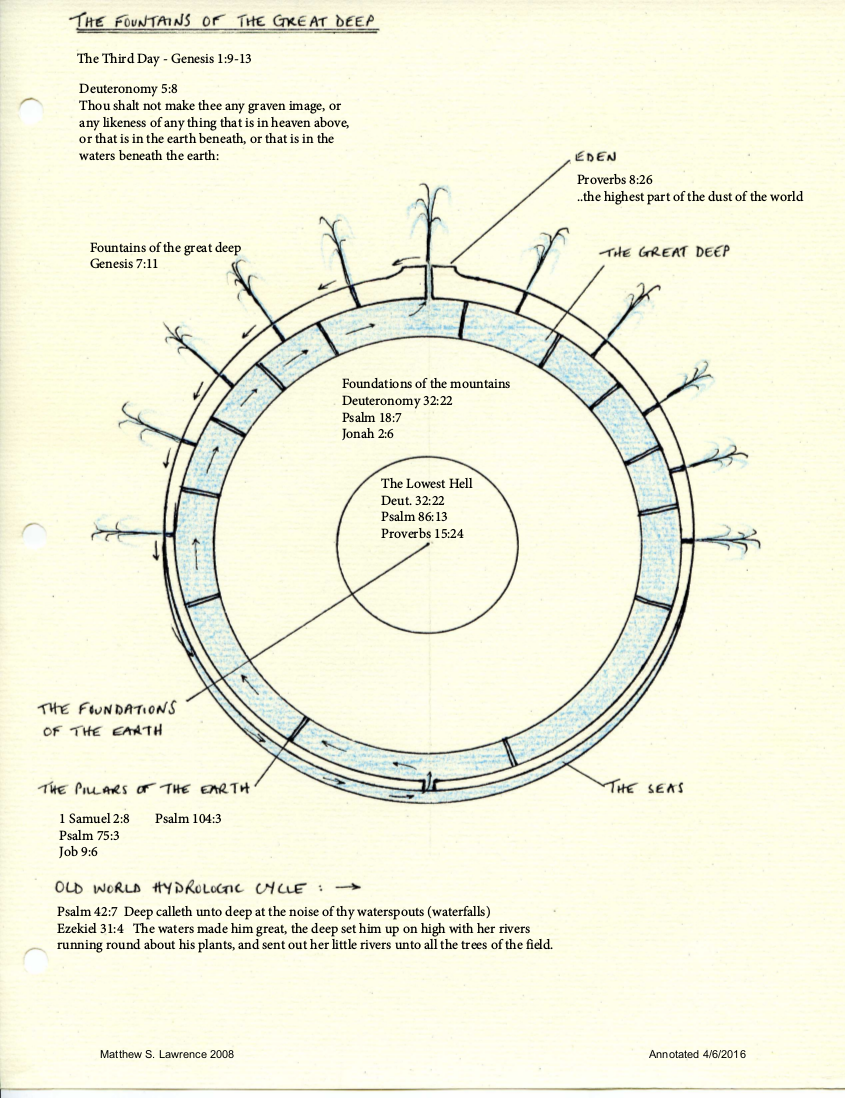
What’s really cool is that we can also resolve some tricky passages that, it turns out, describe the hydrological cycle of the antediluvian Earth. In the passage below Job is describing the power of God and prophesying events in the future.
Which shaketh the earth out of her place, and the pillars thereof tremble. Which commandeth the sun, and it riseth not; and sealeth up the stars. Which alone spreadeth out the heavens, and treadeth upon the waves of the sea.
(Job 9:6) KJV
This not only refers to the pillars of the earth, but also spreading out the heavens as we have described happened on the second day. Genesis Chapter 2 includes a brief description of what the Earth was originally like:
And a river went out of Eden to water the garden; and from thence it was parted, and became into four heads. The name of the first is Pison: that is it which compasseth the whole land of Havilah, where there is gold; And the gold of that land is good: there is bdellium and the onyx stone. And the name of the second river is Gihon: the same is it that compasseth the whole land of Ethiopia. And the name of the third river is Hiddekel: that is it which goeth toward the east of Assyria. And the fourth river is Euphrates.
(Genesis 2:10-14) KJV
This tells us that four rivers, from a source in the Garden of Eden, watered the face of the whole Earth. Other passages tell us that there was no rain before the flood of Noah. Water flows downhill, which makes it obvious that Eden was the highest point on Earth. This is also in line with the dream vision that Daniel explained to Nebuchadnezzar:
Then was the iron, the clay, the brass, the silver, and the gold, broken to pieces together, and became like the chaff of the summer threshingfloors; and the wind carried them away, that no place was found for them: and the stone that smote the image became a great mountain, and filled the whole earth.
(Daniel 2:35) KJV
A mountain filled the whole Earth, with Eden on a plateau at the summit. The surface of the Earth was watered by rivers that flowed from it. Water circulates deep within the Earth. This gives us a basic understanding of an hydrological cycle and also conveniently explains a tricky passage in Psalm 42:
Deep calleth unto deep at the noise of thy waterspouts: all thy waves and thy billows are gone over me.
(Psalms 42:7) KJV
Waterspouts is also translatable as waterfalls, so the hydrological cycle consists of water from the great deep issuing from a spring in Eden. This flows through the garden before splitting into four heads, also translatable as waterfalls. The waterfalls flow off the Eden plateau and then the four rivers follow their courses to water the face of the Earth. The water returns underground to enter the great deep. These channels are the fountains of the great deep which feature in the explanation of the flood of Noah. The water is then circulated back to the spring in Eden.
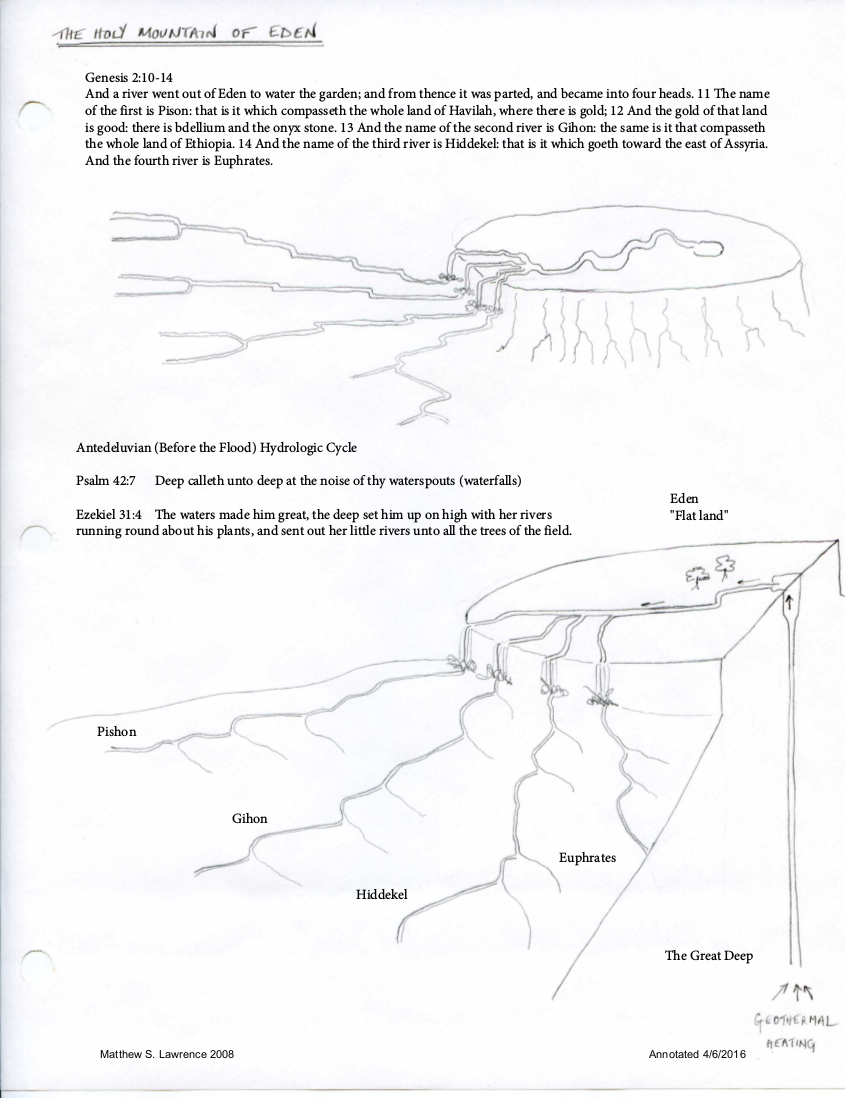
This arrangement also helpfully explains why, when Adam and Eve were sent away from the garden of Eden, the only side that needed a Cherubims and a flaming sword to protect it was the East. The North, West and South were unscalable cliffs.
So he drove out the man; and he placed at the east of the garden of Eden Cherubims, and a flaming sword which turned every way, to keep the way of the tree of life.
(Genesis 3:24) KJV
This description of the new Earth, as fanciful as it may seem, accounts for several otherwise troublesome Bible passages to say the least.

March 3rd – Where did the water come from?
Hydrology deduction 1: Where did the water come from to water the Earth if there hadn’t been any rain?
 Matty (Headwind)