This is a direct copy of a SciPop or news article preserved here because things on the internet have a bad habit of disappearing when you try to find them again. Full credit is given to the original authors and the source.
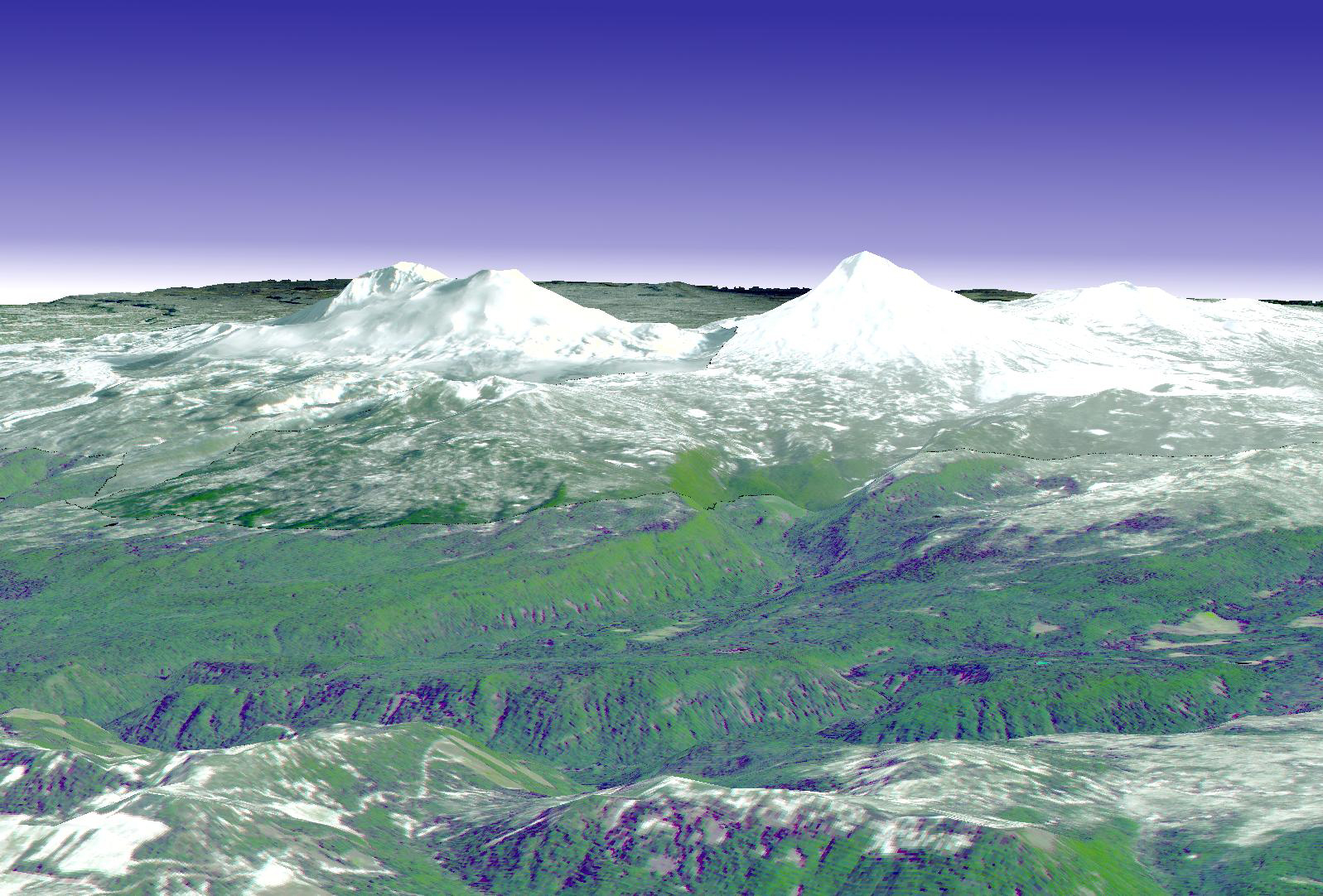
Volcanic activity is causing the earth to rise in Oregon, scientists have found. Though whether such uplift is a sign of an imminent eruption remains uncertain.
This is a direct copy of a SciPop or news article preserved here because things on the internet have a bad habit of disappearing when you try to find them again. Full credit is given to the original authors and the source.
At some point in Earth’s 4.5-billion-year history, its entirely liquid iron core cooled enough to form a solid ball in the centre. Today, our planet’s core consists of a solid iron inner core surrounded by a molten iron outer core, but pinning down exactly when this change occurred has proven quite difficult.
Two iridium abundance peaks, both 0.11 ppb (whole‐rock basis) over local background of 0.017 ppb, have been found in Middle Cretaceous marine rocks near Pueblo, Colorado. They occur just below the 92‐million‐year‐old Cenomanian‐Turonian (C‐T) stage boundary.
This is a direct copy of a SciPop or news article preserved here because things on the internet have a bad habit of disappearing when you try to find them again. Full credit is given to the original authors and the source.
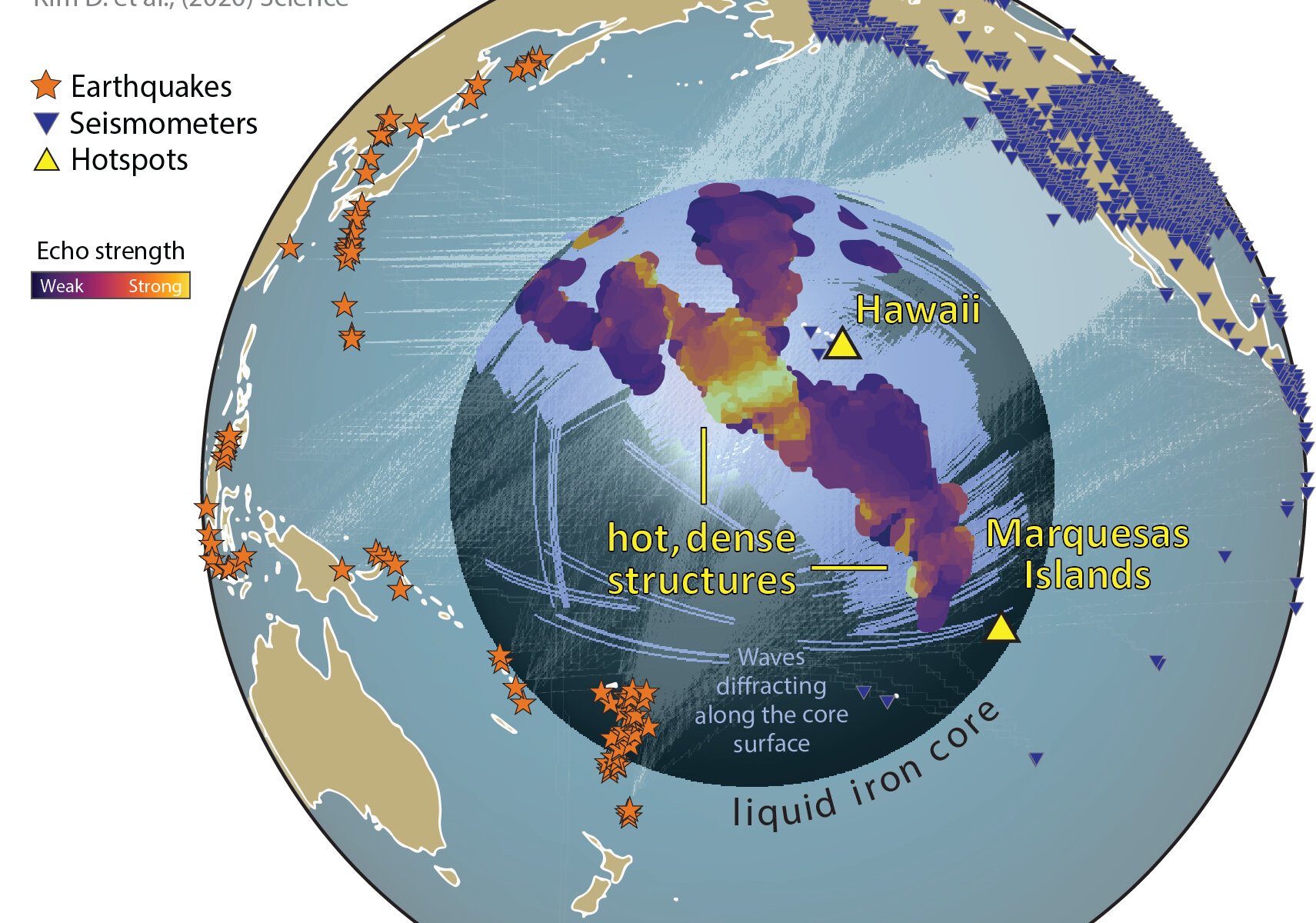
University of Maryland geophysicists analyzed thousands of recordings of seismic waves, sound waves traveling through the Earth, to identify echoes from the boundary between Earth’s molten core and the solid mantle layer above it. The echoes revealed more widespread, heterogenous structures—areas of unusually dense, hot rock—at the core-mantle boundary than previously known.
An eruption would be capable of returning humanity to a pre-civilisation state
The mammoth explosions could release over 1,000 gigatons of ash into the air
Super eruptions may occur as regularly as once every 17,000 years
The window between super-eruptions could be as short as every 5,200 years
The next volcanic ‘super eruption’ with
the power to return humanity to a pre-civilised state could be due much
sooner than previously thought.
Experts have previously predicted that the massive eruptions are likely to occur roughly once every 45,000 to 714,000 years.
This
assessment, made in 2004, is now being challenged by new findings which
say that the most likely time frame is just 17,000 years.
Researchers also estimate the eruptions could happen as often as once every 5,200 years.
Geological records studied by researchers
from the University of Bristol shows that the most recent volcanic
super-eruptions occurred on Earth between 20,000 and 30,000 years ago.
They looked at a database of eruptions, called the LaMEVE database, to make the findings.
By
using statistical analysis they discovered that, while large eruptions
of around 100 million metric tonnes are less frequent than previously
thought, the very largest eruptions of 1,000 gigatonnes or more are much
more frequent.
Jonathan Rougier,
professor of statistical science at the university, said: ‘According to
geological records, the two most recent super-eruptions were between
20,000 and 30,000 years ago.
‘On balance, we have been slightly lucky not to experience any super-eruptions since then.
‘It is important to appreciate that the absence of super-eruptions in the last 20,000 years does not imply that one is overdue.
‘What we can say is that volcanoes are more threatening to our civilization than previously thought.
‘The
technology and techniques used to determine the average time between
super-eruptions can also be used to change the approach of seismologists
looking at earthquakes.’
Earth might be due for its next volcanic super-eruption, an event that would devastate the planet and wipe out civilization.
A
team of scientists looked into the average time between such monstrous
eruptions of volcanoes and found that these catastrophic explosions
happen more often than previous scientific estimates would indicate,
according to a study in the journal Earth and Planetary Science Letters.
The new research put the schedule at roughly 17,000 years after the
last one, although it said super-eruptions can occur as quickly as 5,200
years or as late as 48,000 years after its predecessor.
“Volcanoes pose a larger risk to human civilization than previously thought,” the study says.
The University of Bristol explained that geological evidence shows the last two super-eruptions occurred between 20,000 and 30,000 years ago.
“On balance, we have been slightly lucky not to experience any
super-eruptions since then,” researcher Jonathan Rougier said in the
university statement. “But it is important to appreciate that the
absence of super-eruptions in the last 20,000 years does not imply that
one is overdue. Nature is not that regular.”
Previous scientific estimates have calculated a range of 45,000 to 714,000 years between eruptions.
A
volcanic explosion is classified as a super-eruption when it spews more
than 1,000 gigatons of material into the air and onto the planet’s
surface. That’s equal to 2.2 quadrillion pounds of ash, gas and rock.
It’s “enough to blanket an entire continent with volcanic ash, and
change global weather patterns for decades,” the university explained.
“One recent assessment described them as capable of returning humanity
to a pre-civilization state.”
The new timeframe for super-eruptions comes as the public, bracing for a large eruption, has been watching Mount Agung
in Indonesia spit out ash and molten rock for the last few days and as
scientists have warned that glaciers melting due to climate change could
change the pressure on Iceland’s icy volcanoes and cause them to explode.
Activity
at Mount Agung had changed by Wednesday. While the volcano had
previously been upgraded to a red alert level within the Volcano
Observatory Notice for Aviation, or VONA for short, it was brought back down to an orange level
alert based on information from the Agung Volcano Observatory.
Emissions of ash were continuing, possibly reaching as high as 16,500
feet into the air and blowing toward the southeast. There is also seismic activity, including tremors.
When volcanoes erupt, they can kill people by
spitting out projectiles or triggering tsunamis, but many die in the
dark clouds of rock, ash and gas known as pyroclastic flows, which move
faster than people can run or drive to flee the natural disaster.
This is a direct copy of a SciPop or news article preserved here because things on the internet have a bad habit of disappearing when you try to find them again. Full credit is given to the original authors and the source.
Three decades ago, scientists began to study the possibility that there was a plume of hot rock coming up from the mantle, heating parts of Western Antarctica. Back in September, researchers published results of a model showing how such a plume might affect the Antarctic ice sheet. Today, these headlines started to appear:
Earth’s hot, gooey center and its cold, hard outer
shell are both responsible for the creeping (and sometimes catastrophic)
movement of tectonic plates. But now new research reveals an intriguing
balance of power — the oozing mantle creates supercontinents while the
crust tears them apart.
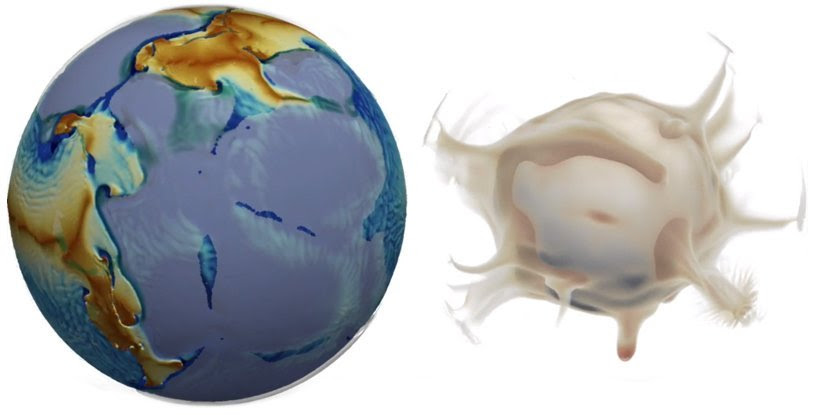
To come to this conclusion about the process of plate tectonics, the scientists created a new computer model of Earth with the crust and mantle considered as one seamless system. Over time, about 60% of tectonic movement at the surface of this virtual planet was driven by fairly shallow forces — within the first 62 miles (100 kilometers) of the surface. The deep, churning convection of the mantle drove the rest. The mantle became particularly important when the continents got pushed together to form supercontinents, while the shallow forces dominated when supercontinents broke apart in the model.
This “virtual Earth” is the first computer model that “views” the crust and mantle as an interconnected, dynamic system, the researchers reported Oct. 30 in the journal Science Advances. Previously, researchers would make models of heat-driven convection in the mantle that matched observations of the real mantle pretty well, but didn’t mimic the crust. And models of the plate tectonics in the crust could predict real-world observations of how these plates move, but didn’t mesh well with observations of the mantle. Clearly, something was missing in the way that models put the two systems together.
Crust plus mantle
Every grade-school model of Earth’s interior shows
a thin layer of crust riding atop the hot, deformable layer of the
mantle. This simplified model might give the impression that the crust
is simply surfing the mantle, being moved this way and that by the
inexplicable currents below.
But that isn’t quite right. Earth
scientists have long known that the crust and mantle are part of the
same system; they’re inescapably linked. That understanding has raised
the question of whether forces at the surface — such as the subduction
of one chunk of crust under another — or forces deep in the mantle are
primarily driving the movement of the plates that make up the crust. The
answer, Coltice and his colleagues found, is that the question is
ill-posed. That’s because the two layers are so intertwined, they both
make a contribution.
Over the past two decades, Coltice told Live Science, researchers have been working toward computer models that could represent the crust-mantle interactions realistically. In the early 2000s, some scientists developed models of heat-driven movement (convection) in the mantle that naturally gave rise to something that looked like plate tectonics on the surface. But those models were labor-intensive and didn’t get a lot of follow-up work, Coltice said.
Coltice and his colleagues worked for eight years on their new
version of the models. Just running the simulation alone took 9 months.
Building a model Earth
Coltice
and his team had to first create a virtual Earth, complete with
realistic parameters: everything from heat flow to the size of tectonic
plates to the length of time it typically takes for supercontinents to
form and come apart.
There are many ways in which the model isn’t a perfect mimic of Earth, Coltice said. For example, the program doesn’t keep track of previous rock deformation, so rocks that have deformed before aren’t prone to deform more easily in the future in their model, as might be the case in real life. But the model still produced a realistic-looking virtual planet, complete with subduction zones, continental drift and oceanic ridges and trenches.
Beyond showing that mantle forces dominate when continents come
together, the researchers found that hot columns of magma called mantle
plumes are not the main reason that continents break apart. Subduction
zones, where one chunk of crust is forced under another, are the drivers
of continental break-up, Coltice said. Mantle plumes come into play
later. Pre-existing rising plumes may reach surface rocks that have been
weakened by the forces created at subduction zones. They then insinuate
themselves into these weaker spots, making it more likely for the
supercontinent to rift at that location.
The next step, Coltice
said, is to bridge the model and the real world with observations. In
the future, he said, the model could be used to explore everything from
major volcanism events to how plate boundaries form to how the mantle
moves around in relation to Earth’s rotation.
As solid as our planet’s crust might feel beneath our feet, we’re literally surfing mountains across a churning sea of hot minerals. For years, researchers have struggled to understand what drives the complex movements of Earth’s surface layers; now, we might be a little bit closer to the answer.
To determine whether drifting tectonic plates stir the mantle, or the mantle’s currents are what moves the crust, scientists have now stepped back to look at the problem in a different light, treating it all as a single system. And it’s looking complicated.
An international team from École Normale Supérieure and the Université Grenoble Alpes in France, and the University of Texas at Austin in the US has come up with fresh new 3D models of an Earth-like world, complete with equations that took a supercomputer nine months to solve.
The
results suggest we’ve been looking at this question the wrong way this
whole time. Forget asking whether it’s the sinking of a cooling crust
that pushes against the mantle, or vice-versa – both play key roles in
deforming a planet’s surface as it ages.
We’ve imagined for the better part of a century that Earth’s outer coat slips around like a loose suit of armour, its plates clanking together in some parts and pulling apart in others.
Early attempts
to describe such a theory of plate tectonics suggested this movement
could be largely the result of convection currents in the fluid of hot,
pressurised rock we call the mantle as it rises, cools, and sinks.
Since the 1950s we’ve learned a great deal
about how the surface sinks in some parts and rises in others, churning
out fresh new rock while melting old crust in a constant conveyer belt
of destruction.
Models attempting to describe this process have inevitably run into problems trying to match the dragging and friction forces of grinding plates with the dynamics of a flowing mantle deep below.
“Results point to a
prevalence of slab pull force over mantle drag at the base of plates,
which suggests that tectonic plates drive mantle flow,” the researchers explain in their report.
The
picture we get now suggests we’re not surfing on a flowing mantle, but
sailing, with our continental ‘sailboats’ whipping up whirlpools in the
molten sea below.
If these models suggest the movements of tectonic plates create currents in the mantle, we find ourselves with a chicken-and-egg conundrum of asking how currents in the mantle might push around the plates in the first place.
Metaphors of boats and suits of armour have their limits. To really understand the complex interactions between the crust and mantle we need to stop seeing them as distinct materials, argue the researchers, and come up with better descriptions.
The descriptions the team arrived at allowed them to recreate a planet like ours and watch it evolve over its first 1.5 billion years. By looking at the mantle and crust as gradients of heat and pressure, they could better understand how they each changed.
Their Earth twin revealed a rather complex dance of continent formation, drifting, and mantle flow that shifted over millions of years.
About
20 to 40 percent of the surface, they found, is indeed pulled along by
the flowing guts of the planet. But that means as much as 60 percent of
the surface drags on the mantle.
These patterns
also change over time. The thicker chunks of continental plates are
dragged along by deeper currents, until they crunch together into a
supercontinent. As the supercontinent fractures and breaks apart, the
sinking of plates in turn causes the mantle to flow.
The
models suggest there’s a lot more going on down there than we can make
out from the surface, which has made it challenging to imagine just how
the mantle’s currents and the crust interact.
So much of what happens deep beneath the surface has grave repercussions for life on the surface.
From earthquakes to volcanoes, to the protective magnetic cage shielding us from blasts of high energy particles from the Sun, we’re at the mercy of geology we’re still working out.





 Matty (Headwind)