<< Previous | Next >>
Lower Noachian
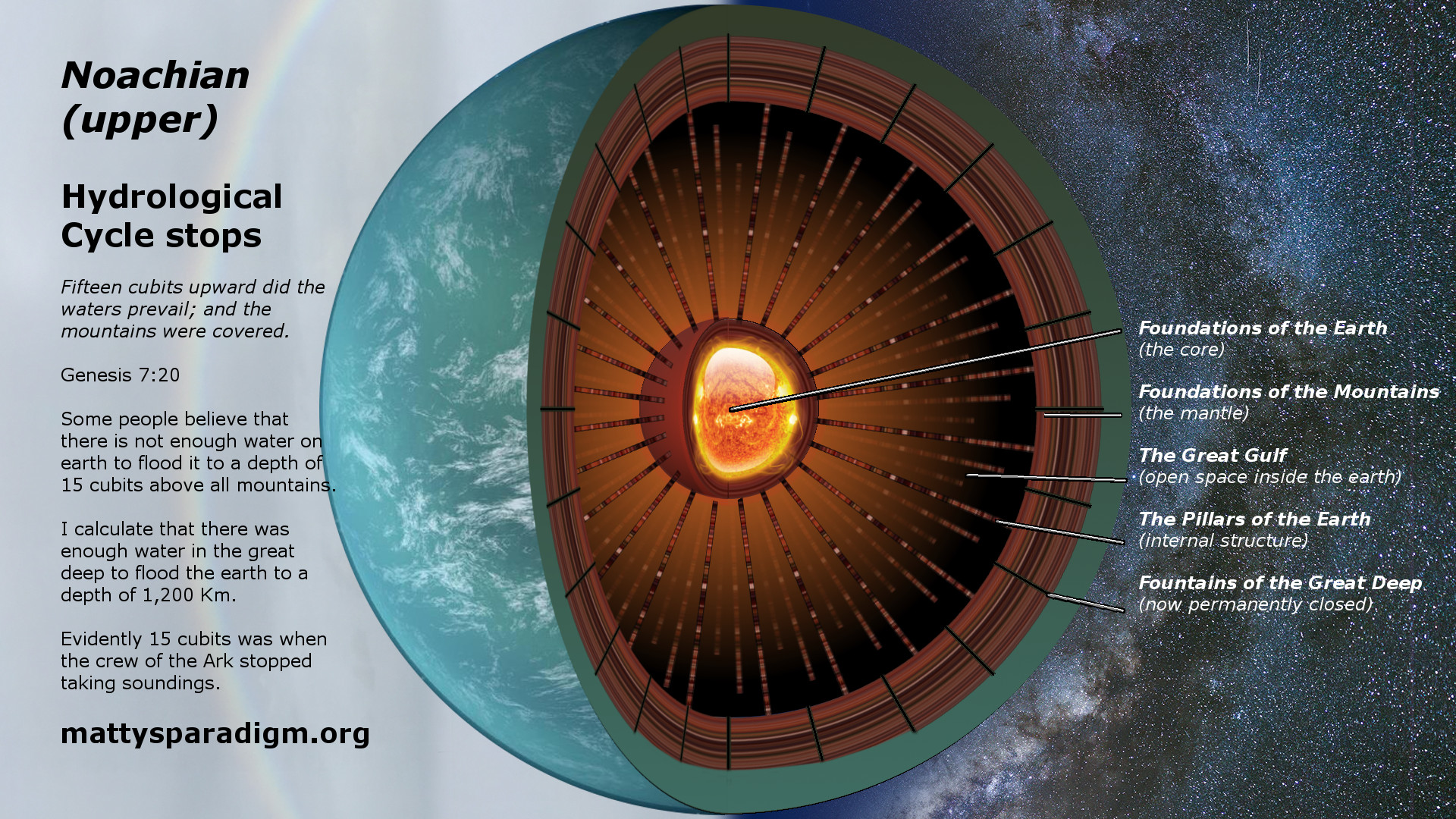
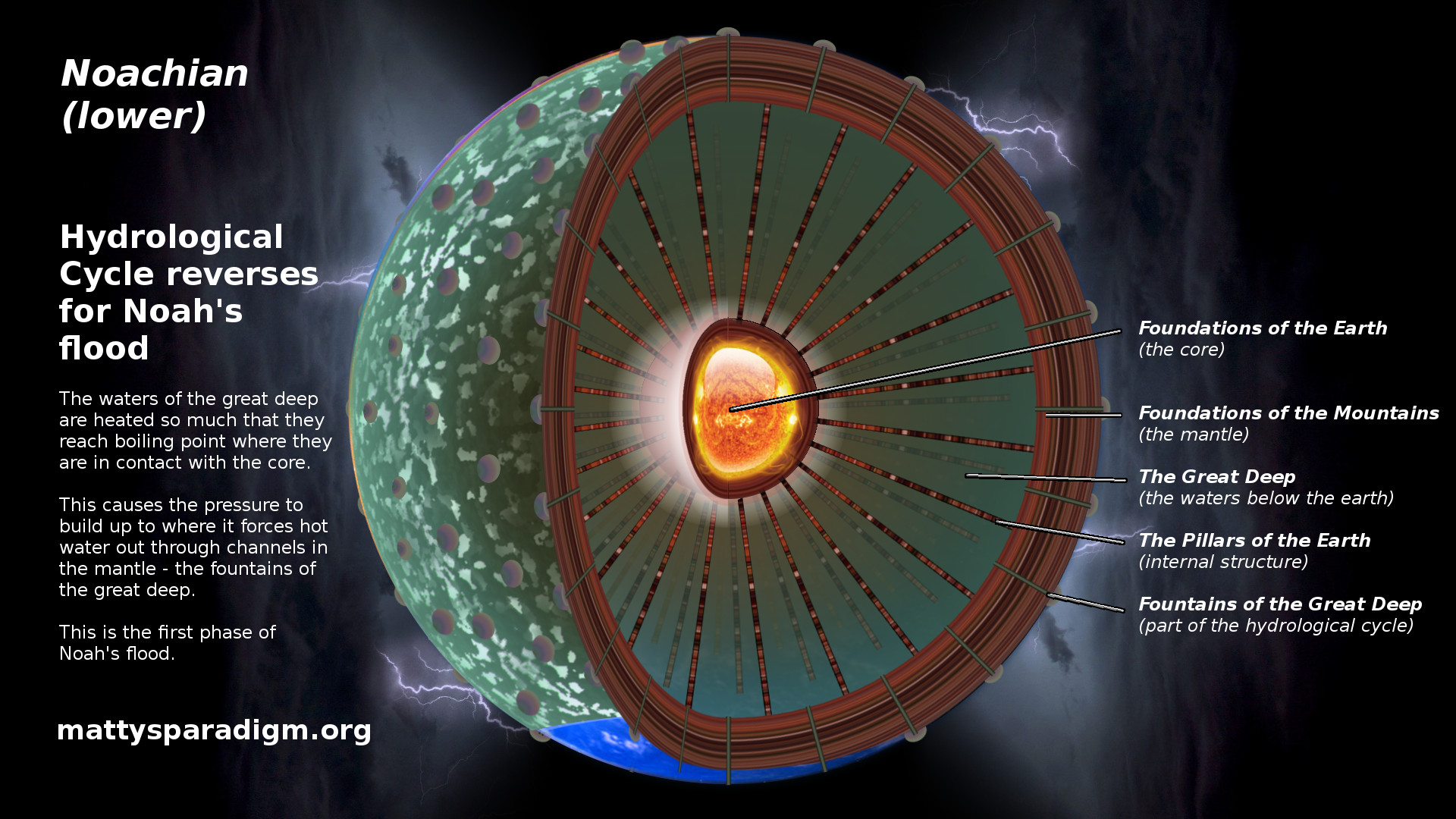
Noah’s flood was not only a world-wide catastrophe, it was also a very complex process which involved several phases. The first of these was when the fountains of the deep burst open and the windows of heaven opened. The fountains of the deep burst open because the expansion of hell caused the waters of the great deep to heat up, eventually to boiling point where they were in contact with the core. The pressure burst open the fountains of the great deep and caused hot water to come flooding out of the ground in many locations around the globe.
As this was occurring, water from above the firmament, which had been traveling through space for some time, also hit the earth. This water was very cold, probably frozen, and so we have the intermixing of very hot and very cold water in a deluge which is rapidly drowning the earth. The evidence of this process is sufficient to have led naturalists of bygone ages to propose that “Gigantic waves,” wrote J. Geikie, “were supposed to have precipitated upon the land, and swept madly on over mountain and valley alike, carrying along with them a mighty burden of rocks and stones and rubbish.” The problem was that no cause could be ascertained which could account for the gigantic waves, and the idea was replaced by the theory of ice ages.
It should now be possible to resolve all of these issues. The Noachian is the term we are giving to the sedimentary deposits which were deposited in Noah’s flood. This includes strata currently assigned to all Periods of the geological time scale from the Cambrian to the Quaternary. This equates to the Paleozoic, Mesozoic and Cenozoic Eras. We have already seen the way in which the Cretaceous/Tertiary boundary (Mesozoic/Cenozoic) with its Iridium anomaly can be resolved as the moment when the 40 days and nights of rain ended, but we may also be able to define the boundary between the Paleozoic and Mesozoic Eras as part of the process of the flood too.
When the waters of the great deep burst forth and were met at the surface of earth by the waters from above the firmament there were indeed gigantic waves which propagated from the equator to the poles, destroying everything in their path and carrying the debris along with devastating force. As these waves reached the poles they gained height and energy, scrubbed the poles completely clean of all surface deposits, then began to retreat back to the equator. This is the Paleozoic/Mesozoic boundary. The waters made their first pass across the land traveling from the equator to the poles, depositing the sediments which we refer to as the Cambrian, Ordovician, Silurian, Devonian, Carboniferous and Permian (Paleozoic Era). The water then reversed course and flowed back to the equator, depositing the sediments which we assign to the Triassic, Jurassic and Cretaceous (Mesozoic). When the rain ended and the waves stopped propagating the Tertiary and Quaternary sediments were deposited (Cenozoic). We are going to call the Cenozoic Era the Upper Noachian.
The Lower Noachian encompasses the Paleozoic Era, the Middle Noachian encompasses the Mesozoic Era.
This is just a rough idea. Bear in mind that all rock strata were deposited in the same event: Noah’s flood. The only reason that they have been arranged in the way that they have in the geological time scale is to make it compatible with the basic premise of the theory of evolution, which is the idea that simple forms are the oldest, more complex forms are recent.






 Matty (Headwind)