The voice of the LORD breaks the cedars, Yes, the LORD splinters the cedars of Lebanon.
(Psalms 29:5) NKJV
According to our compilation of doublespeak terms used in Paleobotany and Paleontology “abundant” is a euphemism for eradication. That’s what Jurassic sediments preserve: the eradication of dinosaurs.
I am a brother to dragons, and a companion to owls.
(Job 30:29) KJV
First mammals? A place where mammals were buried doesn’t make them the first mammals. The presence of mammal remains in sediment is used to place the sediment in timeline of the evolution narrative. That’s what you call circular reasoning.
In the middle of its street, and on either side of the river, was the tree of life, which bore twelve fruits, each tree yielding its fruit every month. The leaves of the tree were for the healing of the nations.
(Revelation 22:2) NKJV
In real estate it’s location, location, location. In Paleodoublespeak its location, location, location. Glossopterids didn’t inhabit a savanna ecosystem with arid to semiarid climates, so there aren’t any.
Scientific blindness is never so apparent as when dealing with remnants of Noah’s flood. This articles shows how the words flood, wet, catastrophe, intense, dry and drought are unavoidable.
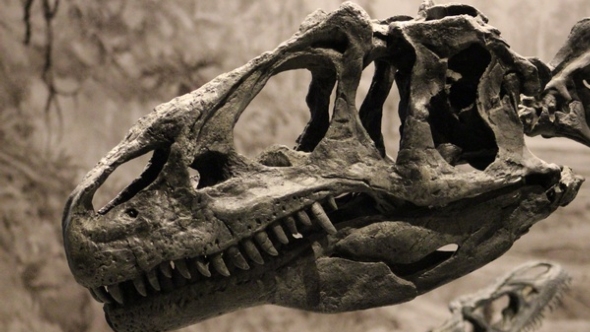
Out in Utah’s eastern desert, nestled among the purple- and red-banded hills of the Morrison Formation, there rests one of the richest dinosaur bonebeds ever found. It’s also the most mysterious. Since the site’s initial discovery over a century ago, the jumbled remains of over 46 Allosaurus – as well as the comparatively rare bones of other Jurassic dinosaurs – have been pulled from this one spot, and there’s every indication that there is more to be found than has yet been uncovered. But what brought all these dinosaurs here, and why do predators dominate this spot when almost every other bonebed of its kind has the expected array of abundant herbivores and rare carnivores?
There are almost as many takes on what created the bonebed at Cleveland-Lloyd Dinosaur Quarry as scientists who have studied it. The initial, and most obvious, idea was that this was a predator trap like the La Brea asphalt seeps. Some poor herbivore got stuck in mud, died, and its rotten stink drew scores of Allosaurus here, which became trapped in turn. But there’s no tar or other trapping mechanism to do the dirty work. This led to other suggestions – that the dinosaurs were killed by drought, that the site was a poison spring, that the dinosaurs died elsewhere and their carcasses were washed to the spot – but there was always some point that didn’t make sense or remained contentions. Where some experts saw a dry environment, others saw one that was frequently wet. Where some saw evidence of one catastrophic event, others saw multiple depositions that happened over time.
That’s what led geoscientists Joe Peterson, John Warnock, Steven Clawson, and their colleagues to move literal tons of rock and excavate Cleveland-Lloyd anew. Not for new bones, but for the geological clues that might let the researchers more accurately envision what happened there in the days of the Late Jurassic. What they’ve found doesn’t conclusively solve the Mesozoic murder mystery, but it refines the setting where the inscrutable events took place.
Peterson and coauthors looked at the fossil assemblage from two angles – a geological technique called x-ray florescence to determine the geochemistry of the Cleveland-Lloyd rocks and a detailed analysis of bone fragments found within the quarry. Together, these two lines of evidence help outline what must have been an incredibly smelly Jurassic scene.
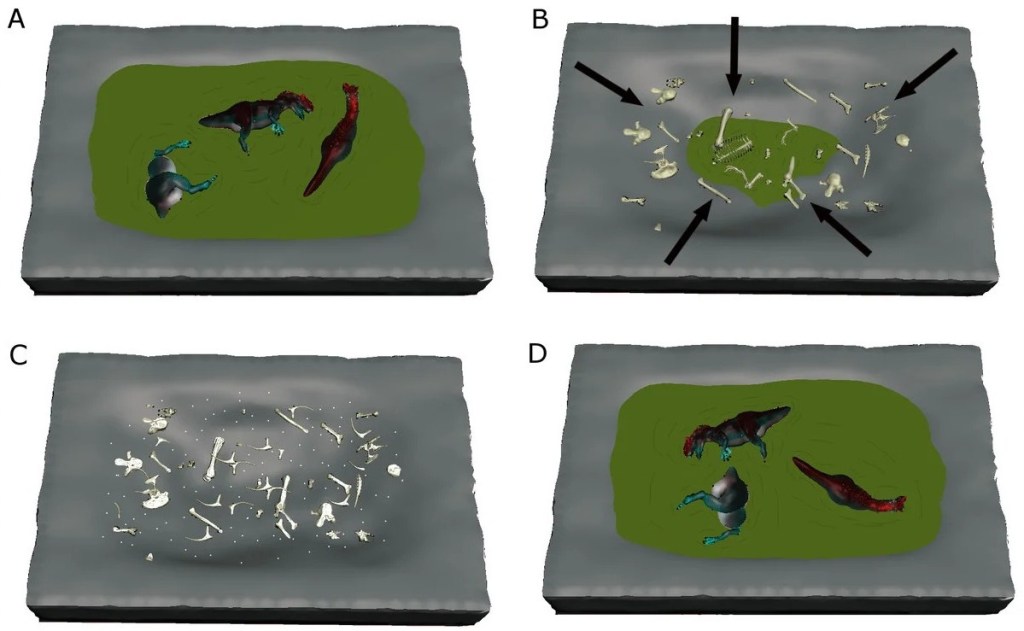
While it’s certainly dramatic to think of hundreds of dinosaurs accumulating in one spot all at once, the findings of Peterson and his colleagues suggest that Cleveland-Lloyd didn’t form in a single event. This spot in the Utah desert was once an ephemeral pond that came and went as the Jurassic seasons shifted from wet to dry. And during the wet times, local flooding transported dinosaur bodies and bones to this particular spot where they settled.
How the CLDQ bonebed was formed, starting with carcasses being washed in, bones being exposed, bones being weathered and broken into fragments, and the addition of more carcasses in the next flood stage. Credit: Peterson et al 2017
The bone fragments help tell the story. The patterns of abrasion and other details suggest that the fragments came from bones already within the pond deposit, getting jostled and reworked with the swings between the seasons. Likewise, the geochemical results supported that this was a wet spot for at least some times of the year. In fact, the analysis showed that the Cleveland-Lloyd sediments had unusually elevated levels of heavy metals compared to other bonebeds of similar age. This doesn’t mean that Cleveland-Lloyd was a poison spring – as has also been suggested to explain the carnage – but that the geochemical profile is instead a sign of rotting carcasses sitting in a standing body of water, turning the pond into an undrinkable, mineral-rich soup. And this could explain why fossils of fish, turtles, and crocodiles are rare in the quarry, as well as why bite marks and signs of scavenging are so rare. When full, this was a rank spot with foul water that was best avoided.
What the new study does is look at the environment of Cleveland-Lloyd over the span of Jurassic seasons. It sets new parameters for thinking about, and questioning, what happened there over 145 million years ago. The site was an ephemeral pond, and it didn’t come together all at once. That may sound simple, but it sets a new baseline for interpreting how such an unusual site came to be.
Plenty of questions remain. If the dinosaurs were washed in, then what killed them in the first place? And does this deposit represent especially harsh times – like intense, recurring droughts – or does it encapsulate the normal comings and goings of dinosaurs during the Late Jurassic? On top of that, we still don’t know why Allosaurus is overrepresented at this site compared to almost every other Morrison Formation bonebed of its kind.
Perhaps something unusual was happening in the vicinity that caused Allosaurus to congregate. Then again, the “different lizard” was by far the most common carnivore of the Late Jurassic west – if you find a theropod in the Morrison, nine times out of ten it’s going to be Allosaurus – and so exhuming an abundance of Allosaurus in a deposit that formed over years and years might not actually require a special explanation other than the predators were abundant at that time. In fact, a few hours away from Cleveland-Lloyd just over the Colorado border, there is another, smaller bonebed where Allosaurus dominates. Perhaps Cleveland-Lloyd represents just another slice of regular Jurassic life rather than something unusual that requires special explanation. Then again, as Peterson and colleagues write, it’s possible that the surfeit of Allosaurus at Cleveland-Lloyd is pointing towards previously-unknown aspects of their behavior – perhaps there was a breeding or nesting site nearby, or maybe these dinosaurs were brought into closer numbers in times of drought and then die as is seen with modern animals in sharply seasonal habitats.
The story of Cleveland-Lloyd is far from told. The conditions that created the bonebed, and what led to Allosaurus
being buried in unprecedented numbers, are still unknown, not to
mention all the other paleobiological and ecological details still
embedded in bone and rock. But the new study is a significant step in
reconstructing what happened during the days when dinosaurs ruled the
Earth. And by starting with how they died, maybe we can learn something
new about how these amazing animals lived.
And I will make Jerusalem heaps, and a den of dragons; and I will make the cities of Judah desolate, without an inhabitant.
(Jeremiah 9:11) KJV
We want to take another opportunity to address the issue of dinosaurs and humans being present on the Earth at the same time. If we believe the creation narrative then of course they were on the Earth at the same time, because there was never a time before humans other than the 6 days of creation. If this is the case, why don’t we find fossil deposits which contain the remains of dinosaurs and humans together?
I have loved you, saith the LORD. Yet ye say, Wherein hast thou loved us? Was not Esau Jacob’s brother? saith the LORD: yet I loved Jacob, And I hated Esau, and laid his mountains and his heritage waste for the dragons of the wilderness.
(Malachi 1:2-3) KJV
The Triassic is another microcosm of inductive reductive circular reasoning that we may wryly refer to as an “eddy in the space-time continuum.”
“Behold, Behemoth, which I made as I made you; he eats grass like an ox. Behold, his strength in his loins, and his power in the muscles of his belly. He makes his tail stiff like a cedar; the sinews of his thighs are knit together. His bones are tubes of bronze, his limbs like bars of iron.
“He is the first of the works of God; let him who made him bring near his sword! For the mountains yield food for him where all the wild beasts play. Under the lotus plants he lies, in the shelter of the reeds and in the marsh. For his shade the lotus trees cover him; the willows of the brook surround him. Behold, if the river is turbulent he is not frightened; he is confident though Jordan rushes against his mouth. Can one take him by his eyes, or pierce his nose with a snare?
(Job 40:15-24) ESV
Dinosaurs are classified into two main types based on hip structure: Ornithischia and Saurischia. Hip structure relates to their origin in Hydrosphere vs. Atmosphere.
Behold now behemoth, which I made with thee; he eateth grass as an ox. Lo now, his strength is in his loins, and his force is in the navel of his belly. He moveth his tail like a cedar: the sinews of his stones are wrapped together. His bones are as strong pieces of brass; his bones are like bars of iron. He is the chief of the ways of God: he that made him can make his sword to approach unto him. Surely the mountains bring him forth food, where all the beasts of the field play. He lieth under the shady trees, in the covert of the reed, and fens. The shady trees cover him with their shadow; the willows of the brook compass him about. Behold, he drinketh up a river, and hasteth not: he trusteth that he can draw up Jordan into his mouth. He taketh it with his eyes: his nose pierceth through snares.
(Job 40:15-24) KJV
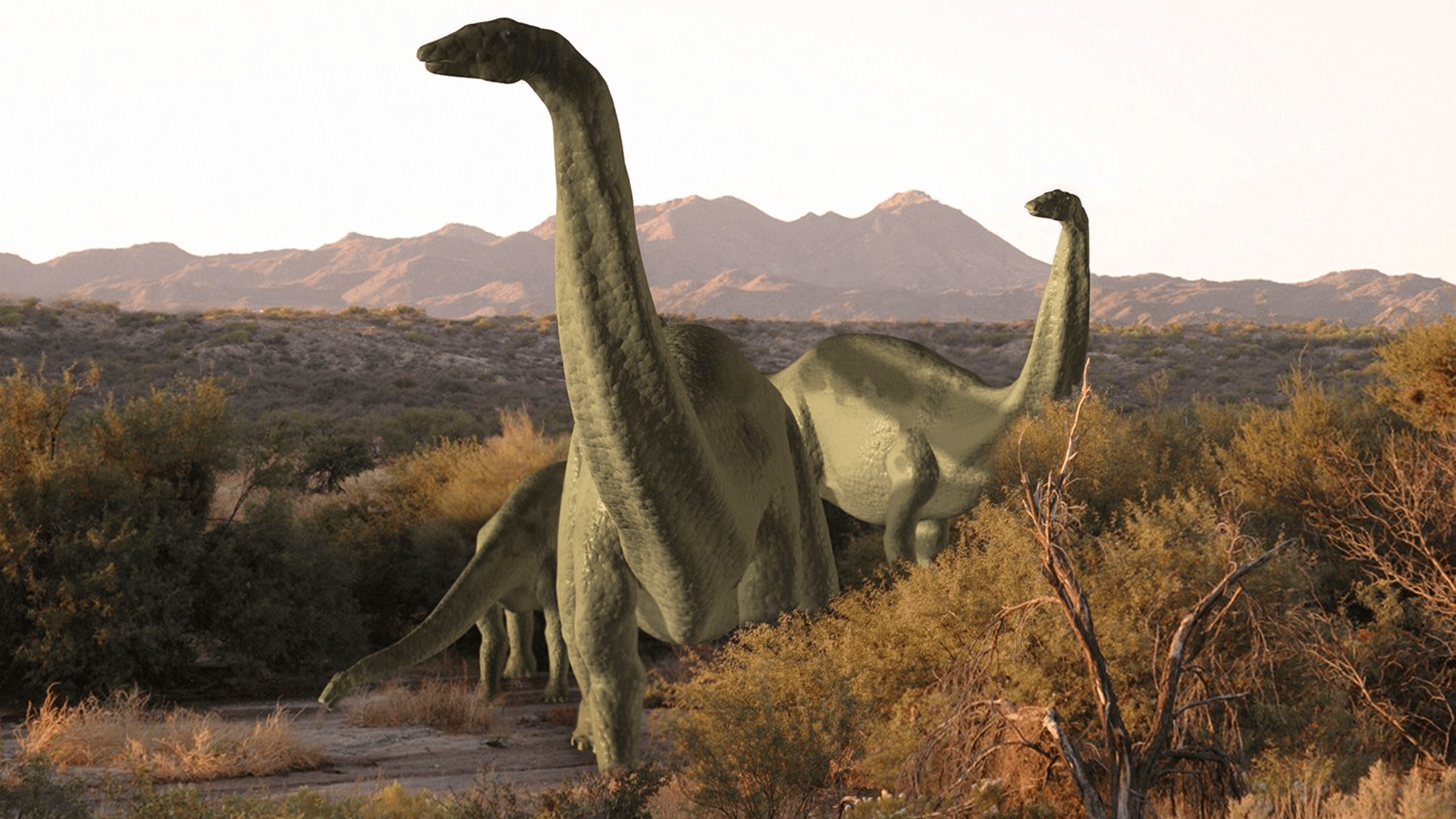
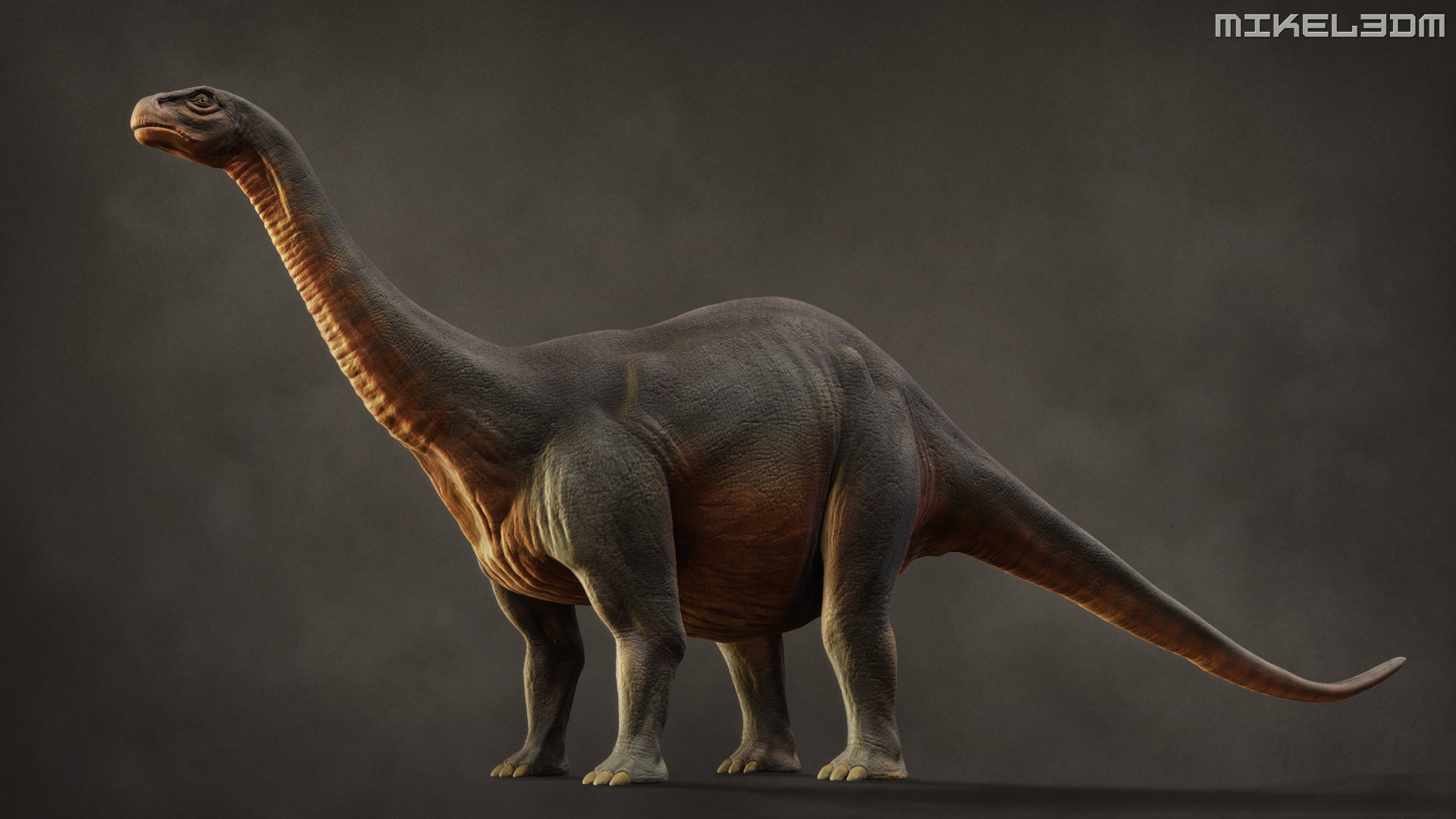
Behold now Behemoth. Is there any doubt that this passage is about a Brontosaurus? If it’s merely poetry then the picture it paints for is of a sauropod dinosaur, lumbering around taking it’s time, eating everything in sight. See the full article.
Thou didst divide the sea by thy strength: thou brakest the heads of the dragons in the waters.
(Psalms 74:13) KJV
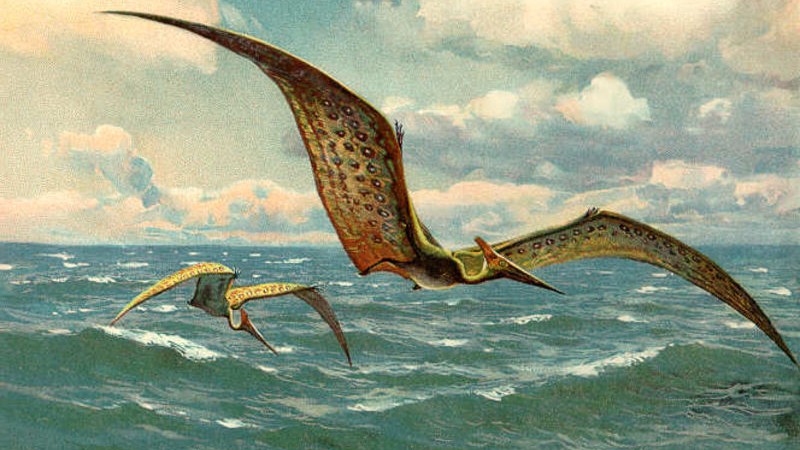
The first fliers are intended to fly with periods of roosting. They needed well-developed wings and feet but not arms. Logically the first aerial dragon had two legs but no arms. It was a Wyvern.
Wherefore, as by one man sin entered into the world, and death by sin; and so death passed upon all men, for that all have sinned:
(Romans 5:12) KJV
Given that synapomorphies only occur after the process of evolution has started, and evolution is a consequence of sin, it’s appropriate to change the spelling of synapomorphy to sinapomorphy.









 Matty (Headwind)