

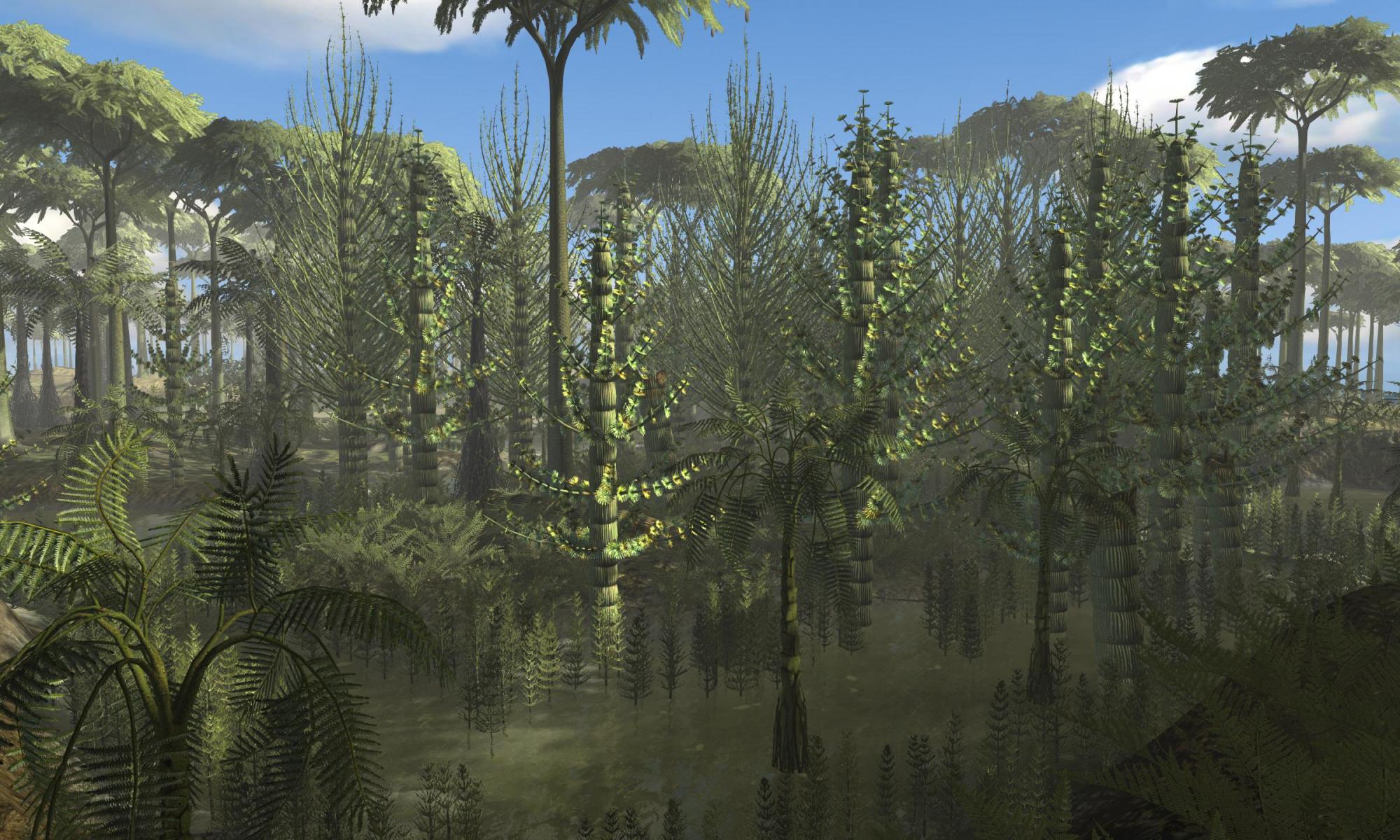
- William A. Dimichele, W. John Nelson, Scott Elrick and Philip R. Ames
- PALAIOS Vol. 24, No. 3/4 (Mar. – Apr., 2009), pp. 159-166
- Link to Article
Abstract
A catastrophically buried stand of calamitean sphenopsids and sigillarian lycopsids is reported from the Middle Pennsylvanian of southwestern Indiana, in the Illinois Basin.
The plants were exposed in the highwall of a small surface mine and were rooted in a thin bed of coal (peat), thus representing a flooded and buried swamp surface. Coarse, floodborne silts and sands buried the forest to a depth of ❤ m or more, before further incursions of water and sediment truncated the deposit. The rocks are part of the Staunton Formation. Taking up >250 linear meters of exposed highwall surface, the vegetation appears to have been a patchwork of calamitean thickets, with stems perhaps as tall as 3–5 m, within which scattered, but much larger, emergent Sigillaria trees grew, possibly reaching heights of 10–15 m. No ground cover was observed, nor were foliage or reproductive organs attributable to the dominant plants found. The growth of this vegetation in a peat-forming swamp indicates conditions of high water availability, likely in a humid, high-rainfall climate. This kind of plant assemblage, however, cannot be characterized as a rain forest, given that it consisted of medium-height thickets of horsetails with scattered, emergent, and polelike, giant lycopsids, thus lacking a closed upper canopy and possibly only partially shading the ground.
Pennsylvanian – Navigation
| Section | Title | Scripture |
| 1 | Pennsylvanian | Romans 12:21 |
| 2 | Uniformly Warm, Humid Climates | Genesis 7:17 |
| 3 | Further Intrusion of Epicontinental Seas | Genesis 7:24 |
| 4 | Formation of the Great Coal Swamps | Matthew 7:1 |
| 5 | Catastrophically Buried | (Further reading) |
| 6 | Mosses, Lycopods, Sphenopsids | Isaiah 10:17-18 |
| 7 | The Origin of Abundant Diversification | Isaiah 5:20 |
| Salvation | Romans 10:9-10 |

August 11th – Pennsylvanian
The premise that Noah’s flood didn’t happen is needed to establish the timescale for biological evolution. However, the evidence clearly shows that Noah’s flood happened.
 Matty (Headwind)