


They fought from heaven; the stars in their courses fought against Sisera.
(Judges 5:20) KJV
Most people believe that the heliocentric theory disproves Geocentrosphericity. The fact is that heliocentric and geocentrospheric are two different frames of reference in the same system. They coexist.
Geocentrospheric is what we see from our frame of reference on the Earth. It’s empirical. Heliocentric is what you would see if you were on the sun. It’s theoretical (imaginary).
Unfortunately the heliocentric theory has several major weaknesses, the most prominent being Kepler’s laws. We can use Kepler’s laws to understand the observations we have of the solar system to see if it aligns with our Geocentrospheric paradigm.
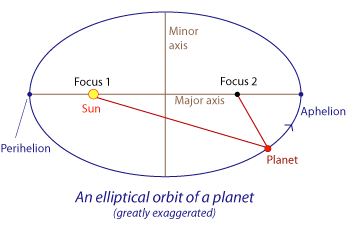
Kepler’s Laws
Elliptical planetary orbits have 2 foci, that means that two sources of gravity are required.
This is resolved in the Geocentrospheric model: earth is f1, the sun is f2.
The gravitational requirements of Kepler’s laws are resolved if the Earth is f1 and the sun is f2, and we can deduce that the asteroid belt, the Kuiper Belt and the visible stars are the same thing. They also obey Kepler’s laws.
We’re going to review Kepler’s Laws and use them to understand news articles predicting our destruction by asteroids, but not yet, and show how asteroid orbital plots make it rather obvious that asteroids speed up as they approach earth because it their perigeon. These posts combine to give us Hypothesis 29.
 Matty (Headwind)