
Chapter 11

The President of the United States of America was preening.  An aide scampered around while he practised his stern look in the mirror and directed his hair dresser.  He raised an eyebrow quizzically.  Then he raised the other one and burst out laughing.  He glanced at his watch.“OK folks, let them in.”

The aid ran to the door and opened it the instant three men in tailored suits and silk ties ploughed through it.

“Whoa gentlemen, easy does it now,” chirped the President with an amicable smile on his face.

The first to speak was his Chief-of-staff.  “Mr. President, we’ve got a busy day ahead of us and we have to get you to Marine 1 right now if we’re going to make it to the UN Financial Union countdown briefing in New York, but as I told you yesterday, we have a Mr. Smith here from the CIA to brief you on the Salt City dome project.” The Chief of Staff turned to the man, Smith, who was the rearmost of the three.  “OK, you’ve got precisely 5 minutes while we walk.”

“Yes sir, Mr. President.  These are the facts, Sir.

“The Salt City dome project is a front for a military intelligence installation.

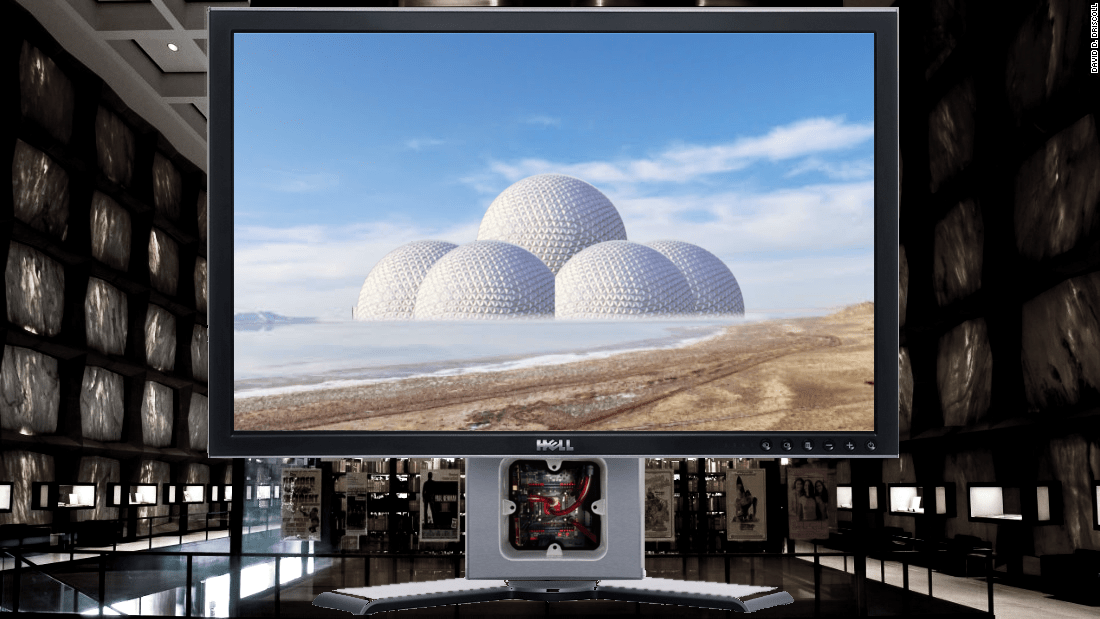
“The location is directly over a large natural cave system that was developed in the 1940s and 50s as a nuclear fallout shelter for a battalion-sized force and equipment.  It is connected by rail to our sub-station under Moab, Utah, and we could get there from here on the Subterranean Intercontinental Rail Link in about 8 hours.  The city is covered by 7 geodesic domes that are designed to withstand direct blast from a nuclear warhead with a nominal yield of 30 kilo tonnes.  The city is self-sufficient for water and energy, and currently is stocked with food for 20 years.  The cover story is that this is an achievement by the tree hugging sustainability crowd.

“One of the many reasons why this installation has high potential is the computer system that has been built into the Municipal Library.  This is an advanced model of the one that we have here in the West Wing, Sir.  You only have to talk to it and it understands what you say.  The Salt City Library system has over 100 terminals and is about to start trials on interpreting intelligence gathered by the Clandestine Service.”

They were moving quickly through the passages of the White house, on their way to the Helicopter landing pad.  The President interrupted Smith,  “Seems like a lot of trouble to go to build a computer system.”

“Yes and no Sir.”  Smith returned quickly.  “The added bonus of this installation is that we can detonate a nuke outside, blame it on anybody we need to go to war with, declare it off-limits to civilians and we’ve got ourselves a top-secret base and a revenue generating war.”

The President stopped dead in his tracks.  He slowly turned to look directly at the man, Smith.  His hair and moustache were neatly trimmed, the cut of his suit was just as fine as any he had seen lately, he was  medium height, medium build, not overweight, he seemed boringly normal.  Just offering to start a war by detonating a nuclear weapon on top of an US city, then blaming it on a foreign nation.

Chapter 9

As a High School student Carlton had been withdrawn and quiet, unsocial and uninvolved.  One of his teachers had been convinced that he was using drugs because he was so pale and tired.  In reality, he had been up late into the night, designing, building and refining his electrically independent computer.  He drew his own blood for it, leading to symptoms of anemia.

His prototype was, in retrospect, an archaic fossil as soon as it was operational, but he won a National competition with it.  He won because his design exemplified the philosophical goals of the contest: energy efficiency.  A small cup of sugar-water ran the computer for a week. A unique feature of his system was that it had its own personality.  It was more than just artificial intelligence being self-aware.  This was deeper.  The computer was curious about the people it interacted with.  It wanted to know how to please its operators, and what it could do to be of value in the pursuit of knowledge. The fifteen minutes of fame it bought Carlton was fun, but more important was the availability of funding to be able to pursue his idea full-time.

That was ten years ago.  Since then he, and the computer systems he built, had come a long way.  When his invention received the National spotlight there were imitators right away, even mass-produced versions from Asia.  He could usually stay a step ahead of the competition.  Any time there was an innovation from elsewhere he could adapt quickly.  Over time the competitors had failed because they couldn’t develop viable business models.  Their computers also lacked the flair of personality that Carlton’s had.

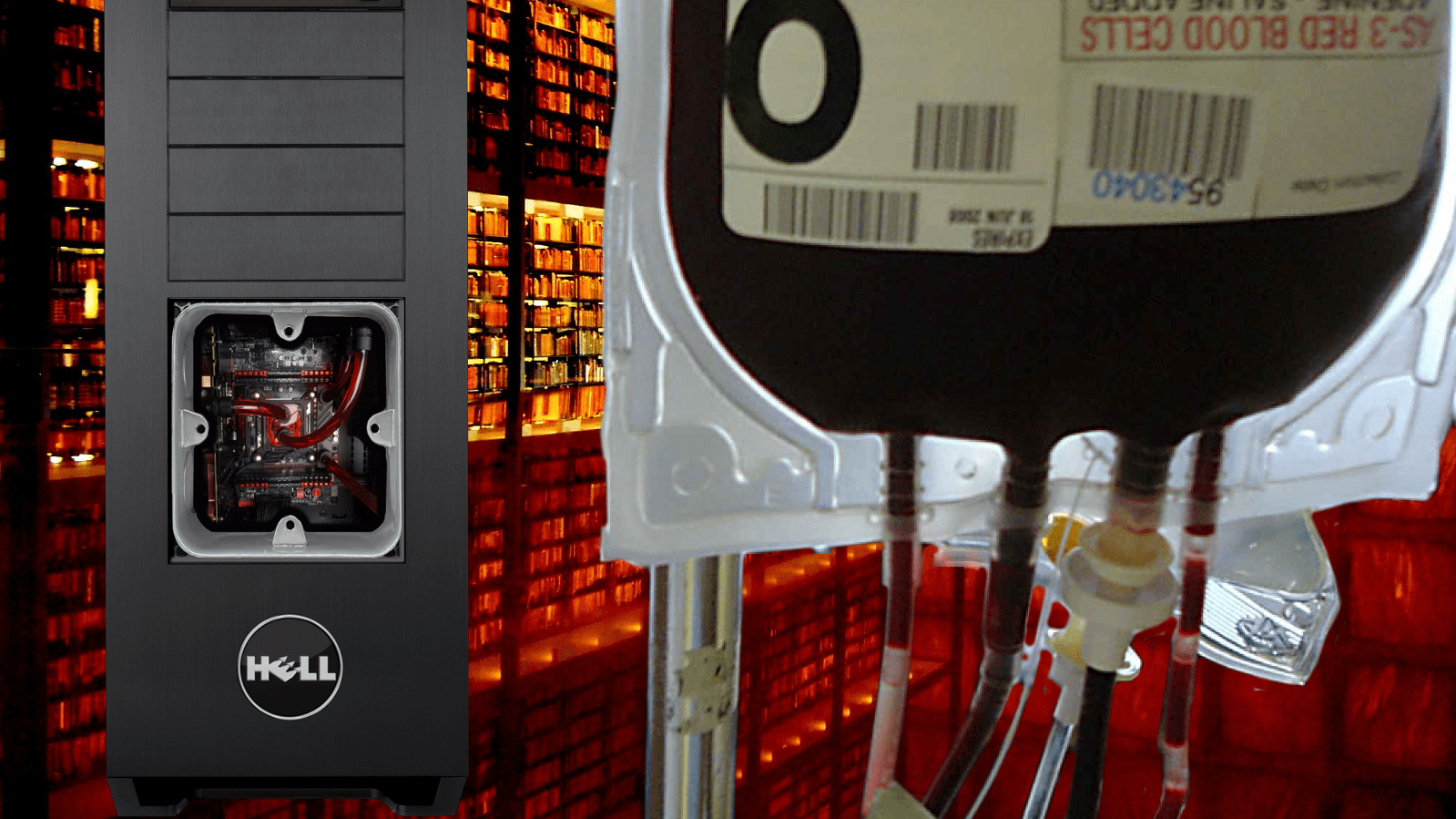
Carlton had learned a lot by trial and error.  A big boost to the performance of the computers came from using artificial red blood cells.  The effect had been dramatic.  But with increase in processing power came an unfortunate side effect.  The computer had no personality.  It couldn’t function in the unique manner that was the whole point of building the system that way.  Carlton went back to using real blood and supplemented it with artificial additives, he just didn’t tell anyone.

Carlton’s business was called Hemalytic Erythroprocessors LLC. There is no such thing as a hemalytic erythroprocessor, it was just a name that Carlton made up by combining the words hemoglobin (the molecule in red blood cells that carries oxygen) with analytic, and erythrocyte (red blood cell) with processor.  It meant that Carlton could call his company HELL Computers, which he thought was funny.  He would chuckle every time he read the name.  One of Carlton’s major flaws was that he thought he was clever and witty.  He was often confused about why people didn’t think his jokes were funny, and would usually assume that they were just a bit dim.  It didn’t occur to him that he was being offensive.

It had played out in his attempts at romance more than once. His preoccupation with the development of his systems was very obvious to anyone who knew him. Every now and then though, usually in the spring of the year, he would emerge from seclusion with the notion that he was lonely, isolated, and needed a companion. He would latch onto whatever poor soul crossed his path and smiled at him, causing him weeks of pining and consternation until she eventually succame to his charms. After that things would go downhill quite quickly as he realized that the attention that his new companion deserved was well beyond his capacity to provide in an ongoing relationship. Things always ended badly. His car had been vandalized more than once, his garage doors sprayed with graffiti three times, and had been called every name under the sun. Oddly enough, his spurned ex-girlfriends somehow all seemed to settle on the same expression of their utter disdain, unmentionable here. His most recent encounter, which really wasn’t very recent so, technically, he was overdue, had ended with the lady calling him, “the stupidest genius she had ever met,” which was one of the nicest insults he had ever received.

Save

Chapter 8

Carlton’s computer systems were a remarkable feat of theoretical pioneering.  The engineering was fairly simple, and the raw computing power was not great, but that was not the point.  In a similar way to how fine art has an intrinsic value to culture and society, even though it may be just a few bits of wood, canvas and paint, Carlton’s computers were revolutionary.  The fundamental basis was an idea that Carlton had in High School.  There had been a big push back then to develop energy-efficient technology.  There was a well sponsored National competition for clever inventions that Carlton decided to win.  Carlton’s idea was to generate electrical power at the place where it was needed, rather than storing it elsewhere and using wires and connectors to transport it.

The human body, Carlton theorized, is powered by changes in electrical potential as electrons move across cell membranes.  The energy to do this comes from biochemical reactions in the cells.  This is called respiration.  Power is not transported to the cells like electricity is, but fuel, from metabolizing food, is taken there in the blood.  Each cell converts the fuel into the energy needed to power all of the cellular processes.  Blood transports everything necessary for metabolism to each cell, and it takes the waste products away.  Carlton figured on making a computer that operated in a similar way.

Carlton wanted to generate the computer processor’s electrical power right at the processor.  The processor would need to be small and have low power usage, but if hundreds, maybe thousands, of these processors were linked together the computer should be fast enough.  Most importantly it would not need a source of electricity.

The idea was simple enough but it turned out to be a practical nightmare.  As Carlton thought and designed he built small replicas of human organs.  A pump to circulate oxygenated solution was the heart.  An aerator to add oxygen and remove carbon dioxide was the lung.  A filter to remove waste products from the solution was the kidney.  The solution in the machine was the blood.  To keep it simple Carlton used real blood, his own. Each of these components also needed power, and so his problem was not only to make a system that could power its processor, but could produce enough surplus electrical current to run the other peripherals necessary to the system.

One of the early challenges was how to develop a membrane that was big enough to be useful, but that would be able to perform in the same way that a human cell membrane does. His first experiments involved using the papery layer of skin that is found in between the layers of an onion. This is just one cell thick but it can be peeled off if you are careful. He was very careful, and his success at generating a measurable electrical current by filling onion skin membrane with his blood was all he needed to develop a full fledged obsession.

His work after that introduced him into the medical field and the world of cosmetic surgery, where researchers were growing human skin from stem cells for use in re-constructive surgery. He convinced his parents to fund his project and custom ordered a sheet of artificially grown human skin that was one cell thick, and big enough to cover a twenty inch computer screen. It died, but not before he demonstrated the validity of his idea, prompting a new burst of investigation into a cellular substrate that was not living tissue. This he eventually found in a lab in Geneva, Switzerland, who had stumbled upon the invention by chance while developing a lining for the inner wall of the Superconducting Supercollider at CERN. Now he had a cellular substrate that was the equivalent to one cell thick, was made of cell-sized miniature compartments and was porous. It was ceramic and very durable. It worked perfectly, and he began generating the electrical current he needed. The next challenge became finding a processor that would work in the system.

Save

Save

Save

Save

Chapter 6

“Rachel?” The woman of his dreams was standing before him.  He would have fled if she wasn’t holding him.

“Yes,” she smiled some more, then let him go.  She checked her outfit in a professional way then turned to her two companions at the circulation desk. She gave a dismissive wave to say get back to work.  She looked back at Carlton smiling, “Carlton, wow, I mean, it’s been a long time. How are you?“

“Rachel.”  Carlton reached to shake her had and looked into her eyes.  “It’s really good to see you.“  Rachel blushed slightly and looked away.  He held her hand for a moment, until she shook free.  She focused on the computer terminal.  “Are you finished?  I mean, we have to have this thing turned on and running before the folks come in.”

“Sure, you’re all set.”  He regained his composure.  She nudged passed him and stood at the terminal, hit the power switch and waited. Carlton smelled perfume, fabric softener and woman.  A pump began humming, then a trickle as fluid coursed through the fine tubing that Carlton had installed.  Beneath the monitor was conduit box that Carlton had not put the cover on.  It was possible to see some of the internal working of the computer.  There were clear plastic tubes connected to the motherboard, and red liquid crept along them, flowing into the terminal.

“Is it real blood?” she asked Carlton quietly.

“Oh no,” he said dismissively, trying to cover a lie.  “Well, parts of it were once.”  He knew that she did not believe him so he tried to remake his answer.  “It’s a souped up blend, the red blood cells are real, and the platelets and stuff.  But it’s mixed with a special plasma-like fluid that works as a coolant and lubricant.”

“Plasma-like?”

“Well, err plasma.  From volunteers.”  He wished she would stop.

“Volunteers?”

“Of course,” he frowned beginning to get irritated.  “He should be ready.”

Ruth leaned in close to him and whispered, “Are you sure she’s a he?”

“Oh yes,” he nodded emphatically, “He’s a he all right, just you wait.”

Ruth straightened up and addressed the console, “Can you hear me?”

There was a slight hiss that drew into a ragged wheeze, like the labored breath of a dying man.  It coughed, and seemed to clear it’s throat.

“Yes,” came a man’s voice from the console, “I can hear you.”

“Hello, my name is Rachel Robbins, I will be your programmer.  We are in the records section of the municipal library in Salt City, Utah.  Have you accessed your primary commands?”

“Yes,” the voice strengthened and had a deep resonance.

“See!” Carlton mouthed.

Rachel began a sequence of checks with the machine.  Carlton began to clean up his tools ready to leave.  He still couldn’t believe it.  Rachel Robbins, after all this time.  And wearing a skirt.  The glasses were gone, but it was Rachel Robbins.  Who would have thought.

As he made for the door, Rachel called to him.

“Wait, I only have a few left,” she indicated her clipboard, “Can you hang on for a few minutes?”

“Sure,” Carlton smiled.  Sure he could wait around for a few minutes, for the woman who had occupied his daydreams for years.

When Rachel finished it was quite a bit later, but she was cheerful when she at last turned her attention fully to Carlton.

“I ’d really like to talk about the computer, but I’m hungry, need a cup of coffee, and you probably do too?” she raised her eyebrows emphatically.

This was getting better and better.  Now he was about to get to go sit down in a Café with this women.

“You must be a genius, I can’t think of anything I’d rather do.”

“Great, where’s a good place to go, I’m new in town.”

Save

Save