Woe to those who call evil good and good evil, who put darkness for light and light for darkness, who put bitter for sweet and sweet for bitter! Woe to those who are wise in their own eyes, and shrewd in their own sight!
(Isaiah 5:20-21) ESV
Technically speaking, in order to be scientific, a hypothesis must be predictive, testable and falsifiable. The truth isn’t falsifiable. If it was, it couldn’t be the truth.
For after seven more days I will cause it to rain on the earth forty days and forty nights, and I will destroy from the face of the earth all living things that I have made.”
(Genesis 7:4) NKJV
One of the pillars of the popular science paradigm (SciPop) is the acceptance of sleight-of-hand and smoke-and-mirrors in place of science. Pithy memes have won the day along with false definitions and propaganda.
And God remembered Noah, and every living thing, and all the cattle that was with him in the ark: and God made a wind to pass over the earth, and the waters asswaged.
(Genesis 8:1) KJV
Why did God flood the world, kill everybody, start over again, yet forget to absolve Noah and his descendants of original sin? And if Noah’s family were cleansed of it, how did humanity get it back?
This question makes it clear that there’s confusion over what original sin is. Original sin is not a conceptual thing that can be removed, it set in motion a course of history which can’t be stopped or changed.
The thing that hath been, it is that which shall be; and that which is done is that which shall be done: and there is no new thing under the sun. Is there any thing whereof it may be said, See, this is new? it hath been already of old time, which was before us.
(Ecclesiastes 1:9-10) KJV
Welcome to the 19th Century! It’s ironic that, even today, people will presume to disprove God by cobbling together some math based on Uniformitarianism ideals.
Scientific blindness is never so apparent as when dealing with remnants of Noah’s flood. This articles shows how the words flood, wet, catastrophe, intense, dry and drought are unavoidable.
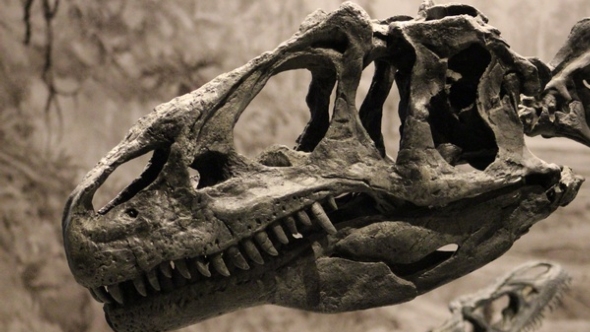
Out in Utah’s eastern desert, nestled among the purple- and red-banded hills of the Morrison Formation, there rests one of the richest dinosaur bonebeds ever found. It’s also the most mysterious. Since the site’s initial discovery over a century ago, the jumbled remains of over 46 Allosaurus – as well as the comparatively rare bones of other Jurassic dinosaurs – have been pulled from this one spot, and there’s every indication that there is more to be found than has yet been uncovered. But what brought all these dinosaurs here, and why do predators dominate this spot when almost every other bonebed of its kind has the expected array of abundant herbivores and rare carnivores?
There are almost as many takes on what created the bonebed at Cleveland-Lloyd Dinosaur Quarry as scientists who have studied it. The initial, and most obvious, idea was that this was a predator trap like the La Brea asphalt seeps. Some poor herbivore got stuck in mud, died, and its rotten stink drew scores of Allosaurus here, which became trapped in turn. But there’s no tar or other trapping mechanism to do the dirty work. This led to other suggestions – that the dinosaurs were killed by drought, that the site was a poison spring, that the dinosaurs died elsewhere and their carcasses were washed to the spot – but there was always some point that didn’t make sense or remained contentions. Where some experts saw a dry environment, others saw one that was frequently wet. Where some saw evidence of one catastrophic event, others saw multiple depositions that happened over time.
That’s what led geoscientists Joe Peterson, John Warnock, Steven Clawson, and their colleagues to move literal tons of rock and excavate Cleveland-Lloyd anew. Not for new bones, but for the geological clues that might let the researchers more accurately envision what happened there in the days of the Late Jurassic. What they’ve found doesn’t conclusively solve the Mesozoic murder mystery, but it refines the setting where the inscrutable events took place.
Peterson and coauthors looked at the fossil assemblage from two angles – a geological technique called x-ray florescence to determine the geochemistry of the Cleveland-Lloyd rocks and a detailed analysis of bone fragments found within the quarry. Together, these two lines of evidence help outline what must have been an incredibly smelly Jurassic scene.
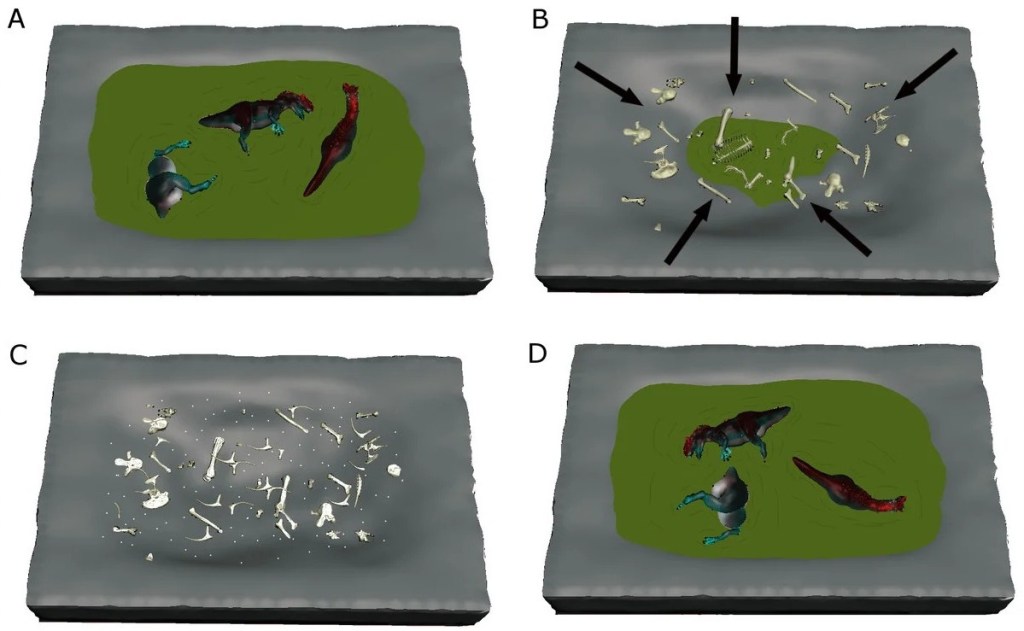
While it’s certainly dramatic to think of hundreds of dinosaurs accumulating in one spot all at once, the findings of Peterson and his colleagues suggest that Cleveland-Lloyd didn’t form in a single event. This spot in the Utah desert was once an ephemeral pond that came and went as the Jurassic seasons shifted from wet to dry. And during the wet times, local flooding transported dinosaur bodies and bones to this particular spot where they settled.
How the CLDQ bonebed was formed, starting with carcasses being washed in, bones being exposed, bones being weathered and broken into fragments, and the addition of more carcasses in the next flood stage. Credit: Peterson et al 2017
The bone fragments help tell the story. The patterns of abrasion and other details suggest that the fragments came from bones already within the pond deposit, getting jostled and reworked with the swings between the seasons. Likewise, the geochemical results supported that this was a wet spot for at least some times of the year. In fact, the analysis showed that the Cleveland-Lloyd sediments had unusually elevated levels of heavy metals compared to other bonebeds of similar age. This doesn’t mean that Cleveland-Lloyd was a poison spring – as has also been suggested to explain the carnage – but that the geochemical profile is instead a sign of rotting carcasses sitting in a standing body of water, turning the pond into an undrinkable, mineral-rich soup. And this could explain why fossils of fish, turtles, and crocodiles are rare in the quarry, as well as why bite marks and signs of scavenging are so rare. When full, this was a rank spot with foul water that was best avoided.
What the new study does is look at the environment of Cleveland-Lloyd over the span of Jurassic seasons. It sets new parameters for thinking about, and questioning, what happened there over 145 million years ago. The site was an ephemeral pond, and it didn’t come together all at once. That may sound simple, but it sets a new baseline for interpreting how such an unusual site came to be.
Plenty of questions remain. If the dinosaurs were washed in, then what killed them in the first place? And does this deposit represent especially harsh times – like intense, recurring droughts – or does it encapsulate the normal comings and goings of dinosaurs during the Late Jurassic? On top of that, we still don’t know why Allosaurus is overrepresented at this site compared to almost every other Morrison Formation bonebed of its kind.
Perhaps something unusual was happening in the vicinity that caused Allosaurus to congregate. Then again, the “different lizard” was by far the most common carnivore of the Late Jurassic west – if you find a theropod in the Morrison, nine times out of ten it’s going to be Allosaurus – and so exhuming an abundance of Allosaurus in a deposit that formed over years and years might not actually require a special explanation other than the predators were abundant at that time. In fact, a few hours away from Cleveland-Lloyd just over the Colorado border, there is another, smaller bonebed where Allosaurus dominates. Perhaps Cleveland-Lloyd represents just another slice of regular Jurassic life rather than something unusual that requires special explanation. Then again, as Peterson and colleagues write, it’s possible that the surfeit of Allosaurus at Cleveland-Lloyd is pointing towards previously-unknown aspects of their behavior – perhaps there was a breeding or nesting site nearby, or maybe these dinosaurs were brought into closer numbers in times of drought and then die as is seen with modern animals in sharply seasonal habitats.
The story of Cleveland-Lloyd is far from told. The conditions that created the bonebed, and what led to Allosaurus
being buried in unprecedented numbers, are still unknown, not to
mention all the other paleobiological and ecological details still
embedded in bone and rock. But the new study is a significant step in
reconstructing what happened during the days when dinosaurs ruled the
Earth. And by starting with how they died, maybe we can learn something
new about how these amazing animals lived.
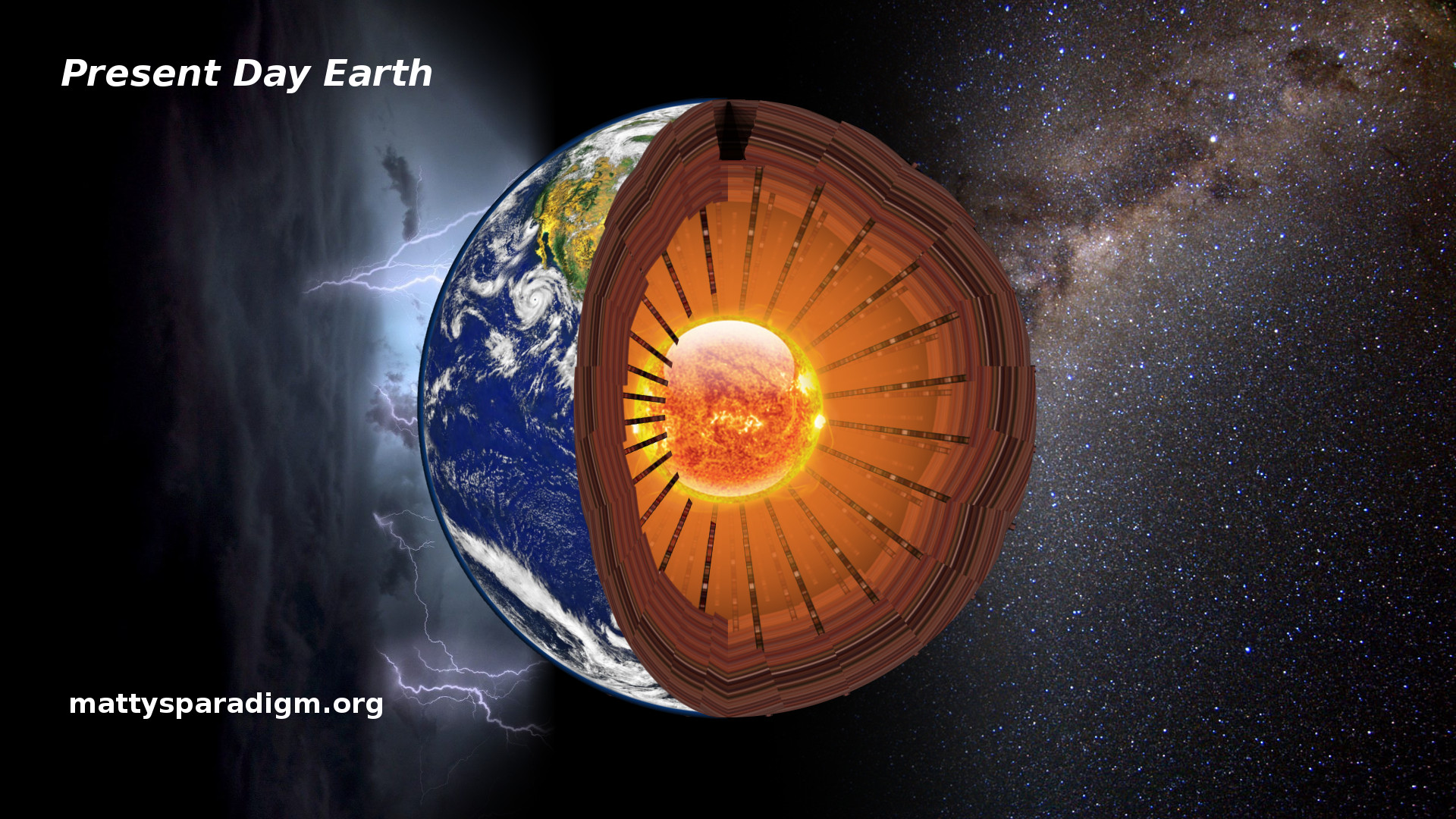
What can we say? Hell is continuing to expand. It’s the cause of global warming. Believing in Jesus Christ is the only way to escape it. The expansion of hell is at least 2 predictive testable hypotheses:
If hell is at the center of the earth and there is a great gulf of open space as Jesus described (Luke 16:19-31) then we would expect to find that it is indicated by a P-wave shadow zone.
Both of these hypotheses are confirmed by empirical observations.
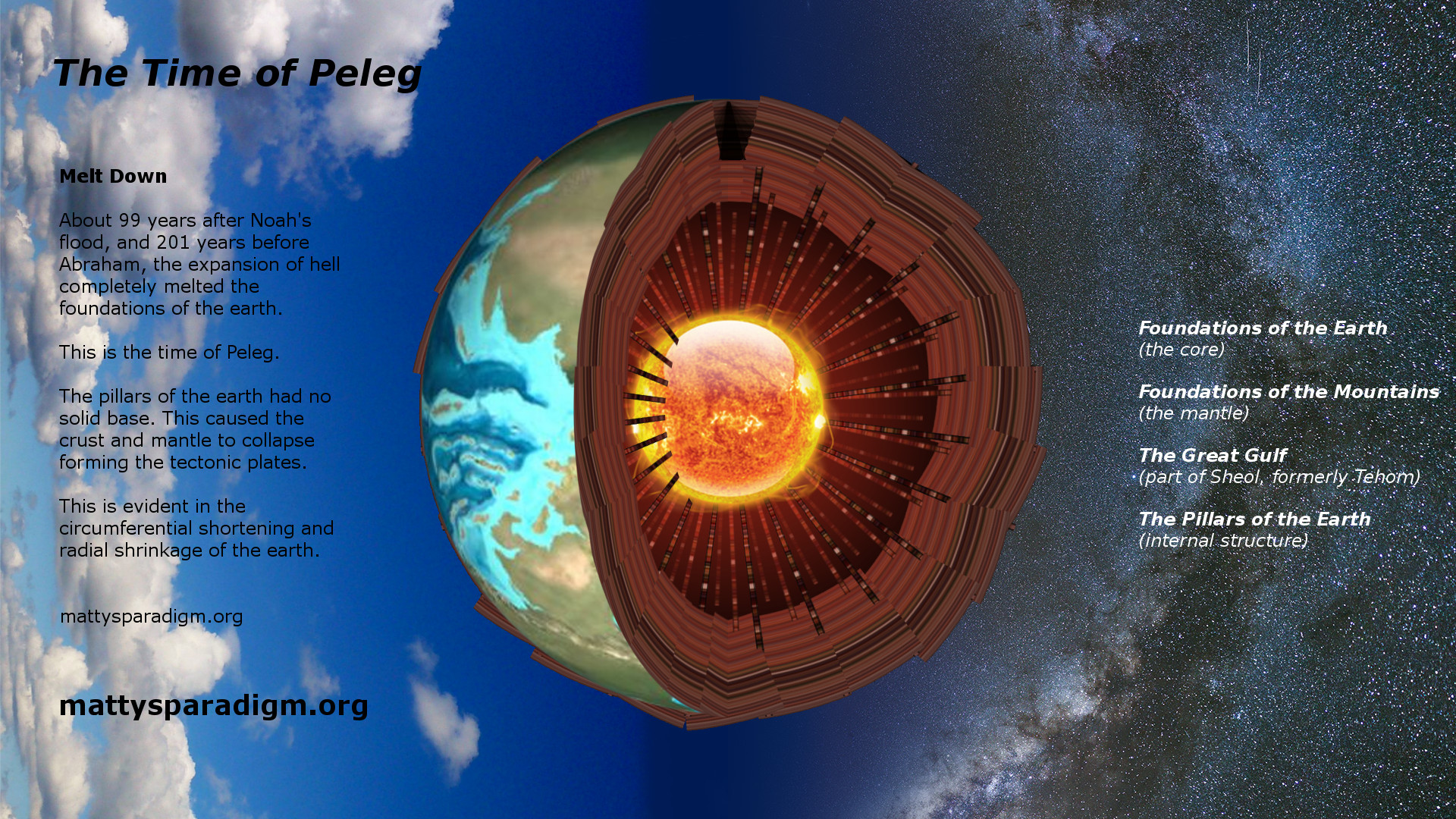
The expansion of hell melted the foundations of the mountains completely. There was now no support for the pillars of the earth and the crust of the earth collapsed.
It appears that the earth lost about 1,200 km of radius, and 8,000 km in circumference. Both of these concepts are part of the development of the theory of plate tectonics, they are referred to as radial shrinkage and circumferential shortening.
Evolution and Plate Tectonics
It is hard to imagine living through this event. Certainly we have not experienced anything this dramatic since it happened.
These are the generations of the sons of Noah, Shem, Ham, and Japheth. Sons were born to them after the flood.
(Genesis 10:1) ESV
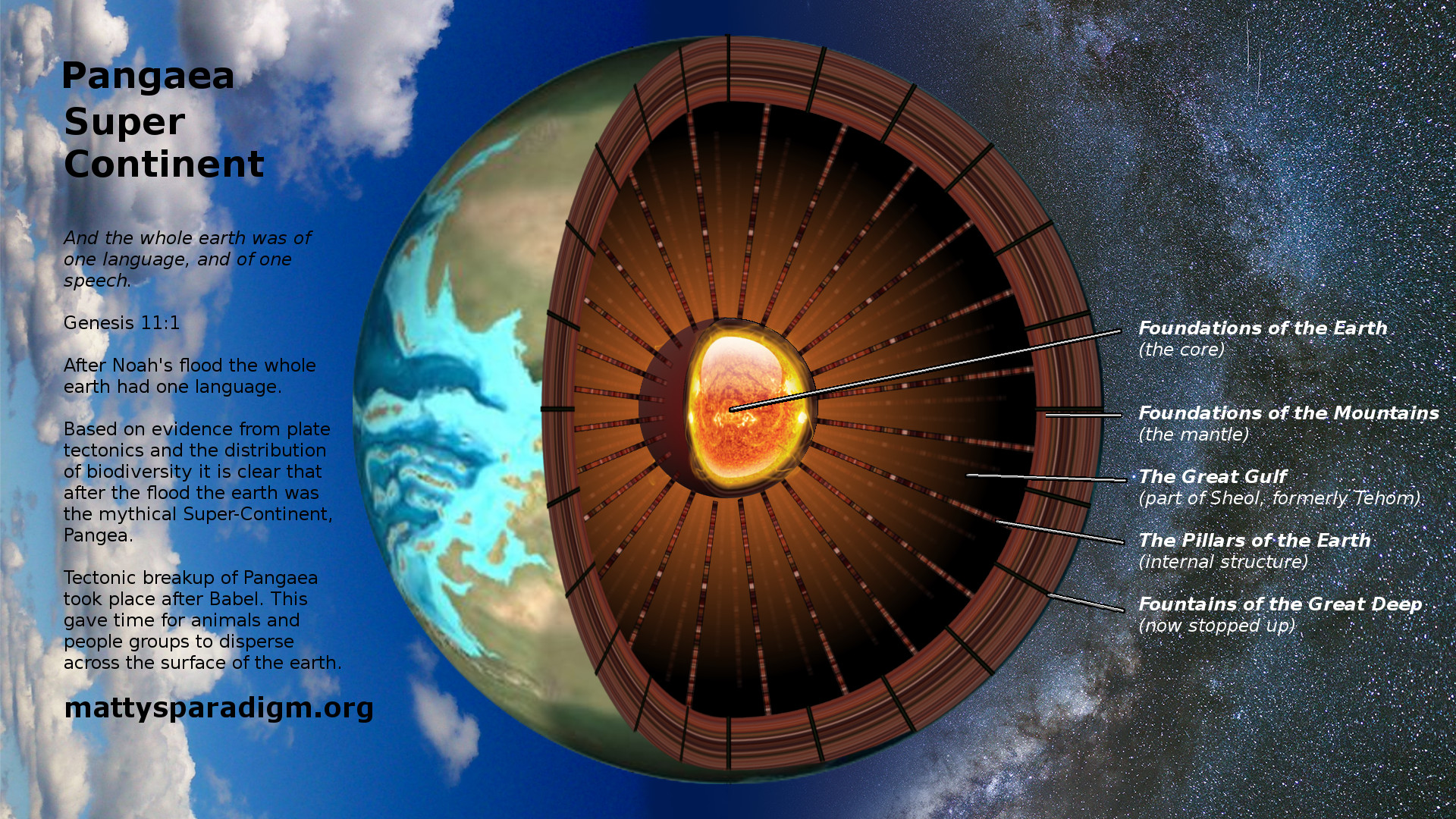
In popular science (SciPop) Pangaea is the original super-continent which predates the formation of the continents as we know them today. This is a conclusion which we deduce from the evidence.
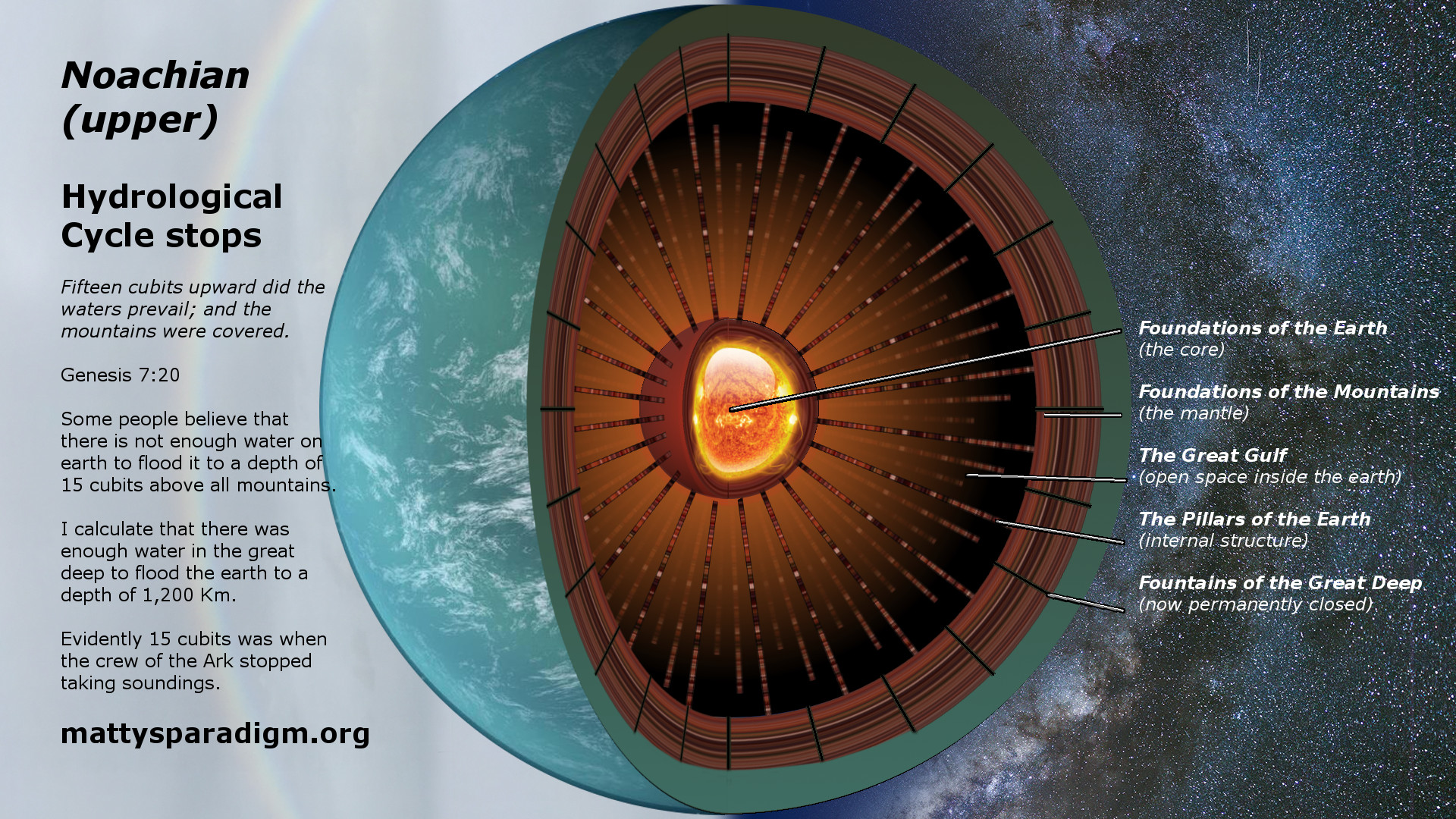
Some people have gone to great lengths to be able to say that there is presently not enough water on earth to flood it to a depth of 15 cubits above all mountains. They use math to do this so, naturally, everybody believes them because, hey, it’s math. Those folk are, sadly, depending of the philosophical foundation of nineteenth Century Uniformitarianism. Uniformitarianism is the belief that the conditions on earth have been so stable for so long that the conditions of the present day are a sufficiently accurate indicator of conditions in the past.
Nothing could be further from the truth.
There are several reasons why the math-based flood-deniers are not even in the same ball park:
they have not considered the great deep, a vast open space inside the earth (replaced in the scientific paradigm by the outer core) which was full of water,
they have not considered an extra terrestrial source of water which, we are told, was part of the event,
they have not considered that the mountain ranges they use as a measure, i.e. the Himalayas, did not form until AFTER Noah’s flood,
and they have not considered that the earth’s radius has shrunk dramatically since the time of the flood.
So, just because a bunch of flood-deniers can wave some math around, don’t believe it. If you want to see some math on how much water was available in the great deep see the post Noah’s Math.
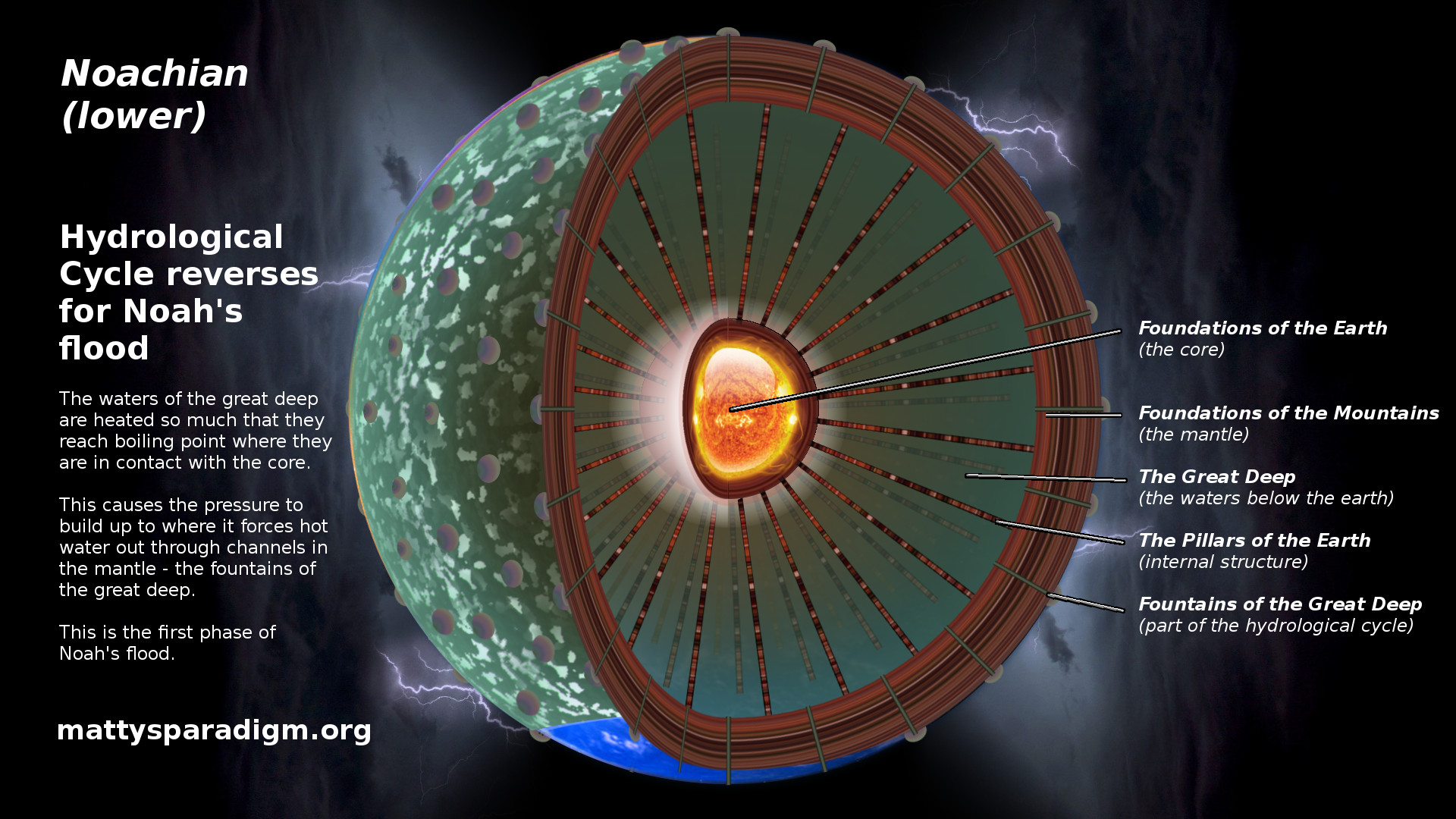
Noah’s flood was not only a world-wide catastrophe, it was also a very complex process which involved several phases. The first of these was when the fountains of the deep burst open and the windows of heaven opened. The fountains of the deep burst open because the expansion of hell caused the waters of the great deep to heat up, eventually to boiling point where they were in contact with the core. The pressure burst open the fountains of the great deep and caused hot water to come flooding out of the ground in many locations around the globe.
As this was occurring, water from above the firmament, which had been traveling through space for some time, also hit the earth. This water was very cold, probably frozen, and so we have the intermixing of very hot and very cold water in a deluge which is rapidly drowning the earth. The evidence of this process is sufficient to have led naturalists of bygone ages to propose that “Gigantic waves,” wrote J. Geikie, “were supposed to have precipitated upon the land, and swept madly on over mountain and valley alike, carrying along with them a mighty burden of rocks and stones and rubbish.” The problem was that no cause could be ascertained which could account for the gigantic waves, and the idea was replaced by the theory of ice ages.
It should now be possible to resolve all of these issues. The Noachian is the term we are giving to the sedimentary deposits which were deposited in Noah’s flood. This includes strata currently assigned to all Periods of the geological time scale from the Cambrian to the Quaternary. This equates to the Paleozoic, Mesozoic and Cenozoic Eras. We have already seen the way in which the Cretaceous/Tertiary boundary (Mesozoic/Cenozoic) with its Iridium anomaly can be resolved as the moment when the 40 days and nights of rain ended, but we may also be able to define the boundary between the Paleozoic and Mesozoic Eras as part of the process of the flood too.
When the waters of the great deep burst forth and were met at the surface of earth by the waters from above the firmament there were indeed gigantic waves which propagated from the equator to the poles, destroying everything in their path and carrying the debris along with devastating force. As these waves reached the poles they gained height and energy, scrubbed the poles completely clean of all surface deposits, then began to retreat back to the equator. This is the Paleozoic/Mesozoic boundary. The waters made their first pass across the land traveling from the equator to the poles, depositing the sediments which we refer to as the Cambrian, Ordovician, Silurian, Devonian, Carboniferous and Permian (Paleozoic Era). The water then reversed course and flowed back to the equator, depositing the sediments which we assign to the Triassic, Jurassic and Cretaceous (Mesozoic). When the rain ended and the waves stopped propagating the Tertiary and Quaternary sediments were deposited (Cenozoic). We are going to call the Cenozoic Era the Upper Noachian.
The Lower Noachian encompasses the Paleozoic Era, the Middle Noachian encompasses the Mesozoic Era.
This is just a rough idea. Bear in mind that all rock strata were deposited in the same event: Noah’s flood. The only reason that they have been arranged in the way that they have in the geological time scale is to make it compatible with the basic premise of the theory of evolution, which is the idea that simple forms are the oldest, more complex forms are recent.






 Matty (Headwind)