

But avoid foolish questions, and genealogies, and contentions, and strivings about the law; for they are unprofitable and vain.
(Titus 3:9) KJV
The Bible explains the Bible. However, we’ve only got what we’ve been given, but everything that we’ve been given has been given us for a reason. Now, based on the premise God cannot lie and the Bible is true, we ought to be able to use what we’ve been given to deduce how the Bible accounts for all empirical observations and physical evidence. The key is deduction. The theological word for deductive reasoning is exegesis.
Deductive reasoning, also deductive logic, logical deduction or, informally, “top-down” logic, is the process of reasoning from one or more statements (premises) to reach a logically certain conclusion. It differs from inductive reasoning or abductive reasoning.
– Deductive Reasoning, definition (Wikipedia)
So why are the Bible and popular science (SciPop) completely different? And, why are mainstream theology (spaghetti theology) and the Bible substantially different?

Spaghetti Syndrome
In Matty’s Paradigm we have to show that most theology is a product of the spaghetti syndrome.
SciPop is part of Satan’s war against the seed of the woman, and spaghetti theology is a capitulation with SciPop. This happened because SciPop is inductive, not deductive. Incidentally the theological word for inductive reasoning is eisegesis.
Inductive reasoning (as opposed to deductive reasoning or abductive reasoning) is reasoning in which the premises are viewed as supplying strong evidence for the truth of the conclusion. While the conclusion of a deductive argument is certain, the truth of the conclusion of an inductive argument is probable, based upon the evidence given.
– Inductive Reasoning, definition (Wikipedia)
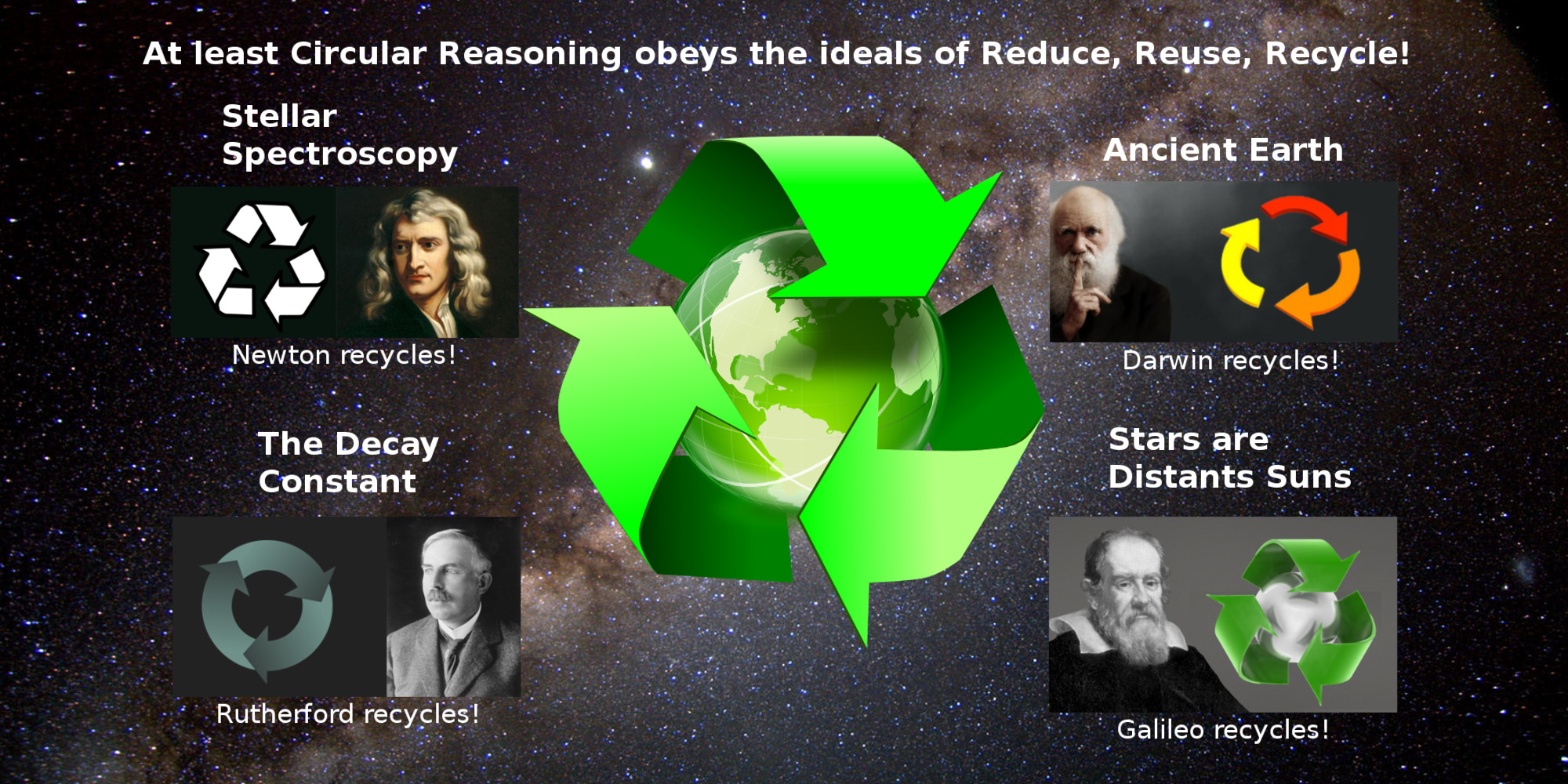
This means that a premise, say heliocentricity, is used to supply evidence for the conclusion, which is also heliocentricity. Heliocentricity isn’t observed, it’s purely theoretical, but it’s used along with stellar parallax, stellar spectroscopy and the decay constant in a classic example of inductive, reductive circular reasoning.
Inductive Reductive Circular Reasoning
- By assuming heliocentricity we can use stellar parallax to confirm heliocentricity.
- We also assume that stars are distant suns and galaxies (synonymy).
- By assuming that stars are distant suns we can use the assumption of heliocentricity to calculate vastly inflated distances to them.
- The vastly inflated distances may be used with stellar spectroscopy to support the assumption of an ancient Earth (needed for biological evolution) as follows:
- spectra show that radioisotope ratios in stars match the ratios we measure on Earth,
- by assuming that the light has traveled for billions of years across the distances contrived by assuming heliocentricity,
- this supports the assumption that the rate of nuclear decay has been constant for billions of years.
None of the assumptions needed are testable hypotheses, unless you accept the premise that the assumptions are true, so, technically, it’s not scientific but most people think that it’s science. It’s SciPop.
Against this backdrop we have spaghetti theology trying to make the Bible “relevant” in a paradigm which has been fabricated. This is why spaghetti theology doesn’t have a physical heaven or hell. It doesn’t have anything in it that we need to be saved from or too. There’s nothing for a savior to do. This is why we have to destroy spaghetti theology along with the SciPop paradigm.
Travailing in Birth – Navigation
| Section | Title | Scripture |
| 1 | Travailing in Birth | Revelation 12:1-2 |
| War in Heaven | Revelation 12:7-9 | |
| 2 | Deducing the Timing of the War in Heaven | Revelation 12:17 |
| Labor Pains | Genesis 3:16 | |
| Enmity | Revelation 12:13 | |
| Is Satan Limbless? | Revelation 12:4 | |
| Salvation | Romans 10:9-10 |

July 2nd – Travailing in Birth
If we compare the Bible with itself and eliminate interpretations which cause conflict between passages, we’re left with a logical arrangement of events.
 Matty (Headwind)