The trees of the LORD are full of sap; the cedars of Lebanon, which he hath planted; Where the birds make their nests: as for the stork, the fir trees are her house.
(Psalms 104:16-17) KJV
We’re continuing our leisurely stroll through the periods of geological time, lead by our guide Wilson N. Stewart. We find once again that the period is question is really a collection of geographic locations where similar plant and animal communities, an ecosystem, occurs. The real similarity is the aspect and elevation of the original geography.
Whose graves are set in the sides
of the pit, and her company is round about her grave: all of them
slain, fallen by the sword, which caused terror in the land of the
living.
( Ezekiel 32:23 )
If you are on a downward course and leave the lower mantle, once you enter the great gulf there is nothing to stop your fall into the core. This means that the pit refers to everything below the mantle.
I went down to the bottoms of the mountains; the earth with her bars was about me for ever: yet hast thou brought up my life from corruption, O LORD my God.
(Jonah 2:6) KJV
Jonah gives us direct observation of the pillars of the earth, he calls them bars. Something directly observed is called empirical. Thanks to Jonah the pillars of the earth aren’t metaphorical nor theoretical, they’re empirical.
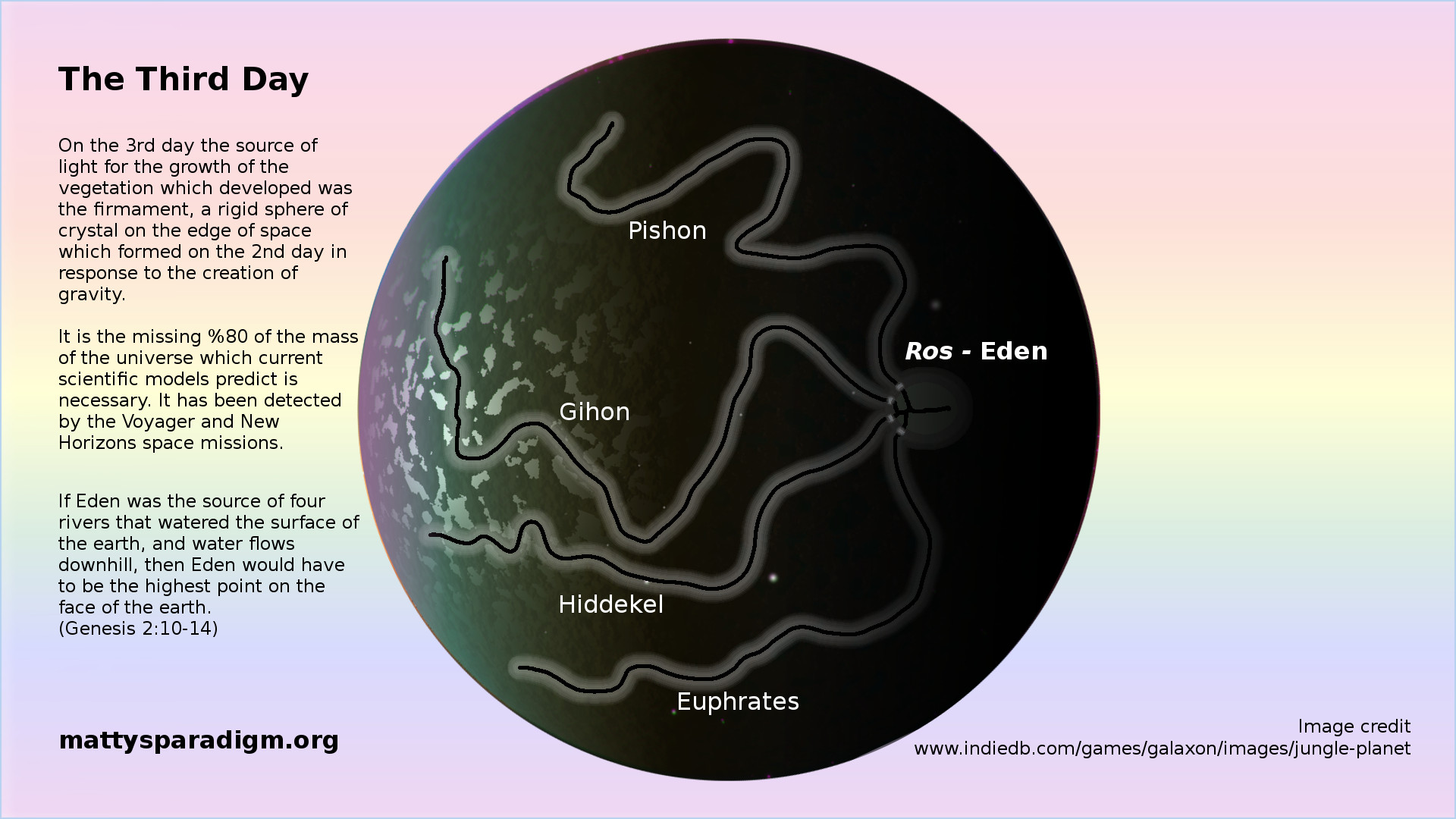
And a river went out of Eden to water the garden; and from thence it was parted, and became into four heads. The name of the first is Pison: that is it which compasseth the whole land of Havilah, where there is gold; And the gold of that land is good: there is bdellium and the onyx stone. And the name of the second river is Gihon: the same is it that compasseth the whole land of Ethiopia. And the name of the third river is Hiddekel: that is it which goeth toward the east of Assyria. And the fourth river is Euphrates.
( Genesis 2:10-14 )
Applying practical knowledge and simple logic to Genesis 2:10-14
IF a river from Eden watered the whole surface of the earth,
AND water flows downhill,
THEN Eden was the highest point on the surface of the earth.
And God said, Let the waters under the heaven be gathered together unto one place, and let the dry land appear: and it was so. And God called the dry land Earth; and the gathering together of the waters called he Seas: and God saw that it was good. And God said, Let the earth bring forth grass, the herb yielding seed, and the fruit tree yielding fruit after his kind, whose seed is in itself, upon the earth: and it was so. And the earth brought forth grass, and herb yielding seed after his kind, and the tree yielding fruit, whose seed was in itself, after his kind: and God saw that it was good. And the evening and the morning were the third day.
( Genesis 1:9-13 )
Genesis 1 and 2 are not contradictory, they have different narrative style. People who think that they conflict are looking for an excuse to dismiss the truth, because they don’t want the truth.
Declaring the end from the beginning, and from ancient times the things that are not yet done, saying, My counsel shall stand, and I will do all my pleasure:
( Isaiah 46:10 )
Science has rationalized that there is no hell and no great gulf of open space inside the earth, because science is trying to be your antidote for guilt, the fear of of judgment and eternal torment.
Evidence of the rapid formation of tectonic plates during the breakup of Pangaea is described in garbled science lingo and woven into the prevailing narrative of asteroid induced mass extinction.
Scientists say they can now describe in detail how the asteroid that wiped out the dinosaurs produced its huge crater.
The
reconstruction of the event 66 million years ago was made possible by
drilling into the remnant bowl and analysing its rocks.
These show how the space impactor made the hard surface of the planet slosh back and forth like a fluid.
At one stage, a mountain higher than Everest was thrown up before collapsing back into a smaller range of peaks.
“And this all happens on the scale of minutes, which is quite amazing,” Prof Joanna Morgan from Imperial College London, UK, told BBC News.
Their
study confirms a very dynamic, very energetic model for crater
formation, and will go a long way to explaining the resulting
cataclysmic environmental changes.
The debris thrown into the
atmosphere likely saw the skies darken and the global climate cool for
months, perhaps even years, driving many creatures into extinction, not
just the dinosaurs.
The outer rim (white arc) of the crater lies under the Yucatan Peninsula itself, but the inner peak ring is best accessed offshore
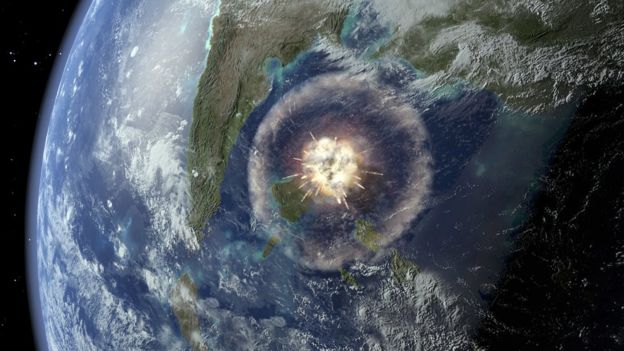
A 15km-wide object dug a hole in Earth’s crust 100km across and 30km deep
This bowl then collapsed, leaving a crater 200km across and a few km deep
The crater’s centre rebounded and collapsed again, producing an inner ring
Today, much of the crater is buried offshore, under 600m of sediments
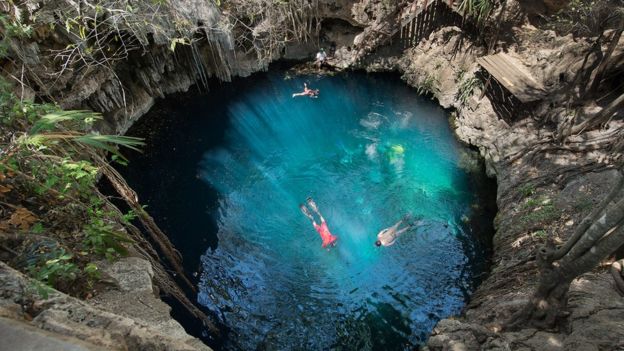
On land, it is covered by limestone, but its rim is traced by an arc of sinkholes
Mexico’s famous sinkholes (cenotes) have formed in weakened limestone overlying the crater
The researchers targeted a particular zone in the 200km-wide bowl
known as the “peak ring”, which – if earlier ideas were correct – should
have contained the rocks that moved the greatest distance in the
impact. These would have been dense granites lifted from almost 10km
down.
And that is precisely what the team found.
“Once we
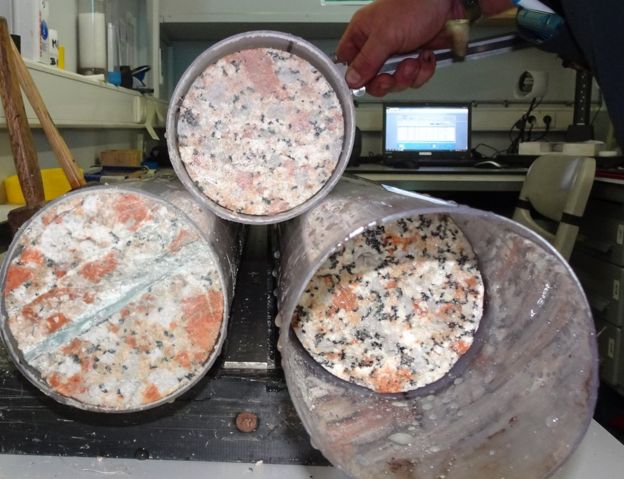
got through the impact melt on top, we recovered pink granite. It was so
obvious to the eye – like what you would expect to see in a kitchen
countertop,” recalled Prof Sean Gulick from the University of Texas at Austin, US.
But these were not normal granites, of course. They were deformed and fractured at every scale – visibly in the hand and even down at the level of the rock’s individual mineral crystals. Evidence of enormous stress, of having experienced colossal pressures.
The team retrieved many hundreds of metres of rock from the crater
The analysis of the core materials now fits an astonishing narrative.
This
describes the roughly 15km-wide stony asteroid instantly punching a
cavity in the Earth’s surface some 30km deep and 80-100km across.
Unstable, and under the pull of gravity, the sides of this depression promptly started to collapse inwards.
At
the same time, the centre of the bowl rebounded, briefly lifting rock
higher than the Himalayas, before also falling down to cover the
inward-rushing sides of the initial hole.
“If this deep-rebound
model is correct (it’s called the dynamic collapse model), then our peak
ring rocks should be the rocks that have travelled farthest in the
impact – first, outwards by kilometres, then up in the air by over 10km,
and back down and outwards by another, say, 10km. So their total travel
path is something like 30km, and they do that in under 10 minutes,”
Prof Gulick told the BBC’s Science in Action programme.
Imagine
a sugar cube dropped into a cup of tea. The drink’s liquid first gets
out of the way of the cube, moves back in and up, before finally
slopping down.
When the asteroid struck the Earth, the rocks it hit also behaved like a fluid.
“These rocks must have lost their strength and cohesion, and very dramatically had their friction reduced,” said Prof Morgan. “So, yes, temporarily, they behave like a fluid. It’s the only way you can make a crater like this.”
One of the important outcomes of the research is that it provides a
useful template also to understand the surfaces of other planets.
All the terrestrial worlds and even Earth’s Moon are scarred with craters just like Chicxulub.
And
knowing how rocks can move vertically and horizontally in an impact
will assist scientists as they attempt to interpret similar crustal
features seen elsewhere in the Solar System.
The project to drill into Chicxulub Crater was conducted by the European Consortium for Ocean Research Drilling (ECORD) as part of the International Ocean Discovery Program (IODP). The expedition was also supported by the International Continental Scientific Drilling Program (ICDP).
Schrodinger Crater on the Moon looks exactly the same as Chicxulub and would have been made – according to this analysis – in a very similar way Artwork: The asteroid that made the crater was probably moving at about 20km/s when it hit the Earth
Therefore I will shake the heavens, and the earth shall remove out of her place, in the wrath of the LORD of hosts, and in the day of his fierce anger.
Our planet’s core powers a magnetic field that shields us from a hostile cosmos. But how does it really work?
This is a direct copy of a SciPop or news article preserved here because things on the internet have a bad habit of disappearing when you try to find them again. Full credit is given to the original authors and the source.
As for the earth, out of it cometh bread: and under it is turned up as it were fire.
(Job 28:5) KJV
We could write about how science really doesn’t have much to go on when it comes to understanding the internal structure of the Earth. Instead we’ll use the words of scientists and science journalists to do it.








 Matty (Headwind)