But Abraham said, ‘Son, remember that in your lifetime you received your good things, and likewise Lazarus evil things; but now he is comforted and you are tormented. And besides all this, between us and you there is a great gulf fixed, so that those who want to pass from here to you cannot, nor can those from there pass to us.’
(Luke 16:25-26) NKJV
We’re at a great advantage over the spaghetti theologians because we’ve deduced how the passage from Luke resolves with a physical reality. We don’t regard any part of this parable as being metaphorical or allegorical.
And being in torments in Hades, he lifted up his eyes and saw Abraham afar off, and Lazarus in his bosom.
“Then he cried and said, ‘Father Abraham, have mercy on me, and send Lazarus that he may dip the tip of his finger in water and cool my tongue; for I am tormented in this flame.’
(Luke 16:23-24) NKJV
The rich man, in hell, lifts up his eyes and speaks of his torment in flame. Here’s the thing: Abraham and Lazarus are also in hell, but they’re not in flame. This may be confusing, but it’s compatible with our model.
Thus hath the Lord GOD shewed unto me: and, behold, the Lord GOD called to contend by fire, and it devoured the great deep, and did eat up a part.
(Amos 7:4) KJV
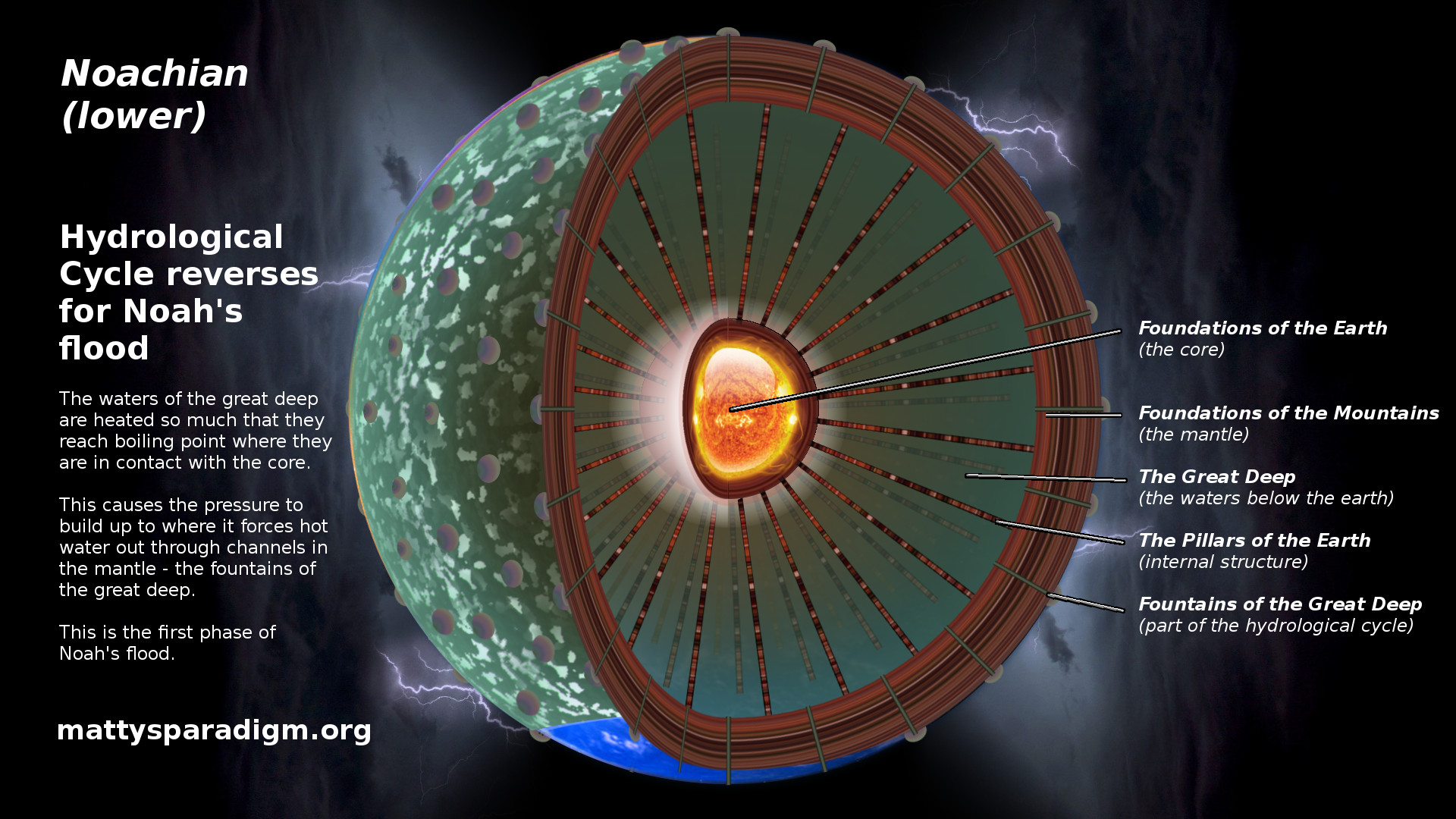
The longsuffering of God waited in the days before Noah. Noah’s flood saw the waters of the deep (tehom), being boiled out from under the Earth creating the open space that Jesus referred to as the great gulf (sheol).
For a fire is kindled in My anger, And shall burn to the lowest hell; It shall consume the earth with her increase, And set on fire the foundations of the mountains.
(Deuteronomy 32:22) NKJV
It’s very useful to know the volume of material in the Earth’s crust and mantle, but before we move on it’s also worthwhile to note that the Earth’s crust and mantle have several Biblical synonyms.
He keepeth back his soul from the pit, and his life from perishing by the sword.
Yea, his soul draweth near unto the grave, and his life to the destroyers.
(Job 33:18, 22) KJV
We (that’s me and the Holy spirit) have made an extensive study of how the zones of the interior of the Earth, or levels of hell, may be deduced from Biblical Hebrew and Greek.
Know therefore this day, and consider it in thine heart, that the LORD he is God in heaven above, and upon the earth beneath: there is none else.
(Deuteronomy 4:39) KJV
A recurring theme in scripture is heaven above and Earth below. Orientation occurs for the first time on the second day. It’s an ordering of the universe which occurred in response to the creation of gravity.
And in hell he lift up his eyes, being in torments, and seeth Abraham afar off, and Lazarus in his bosom.
(Luke 16:23) KJV
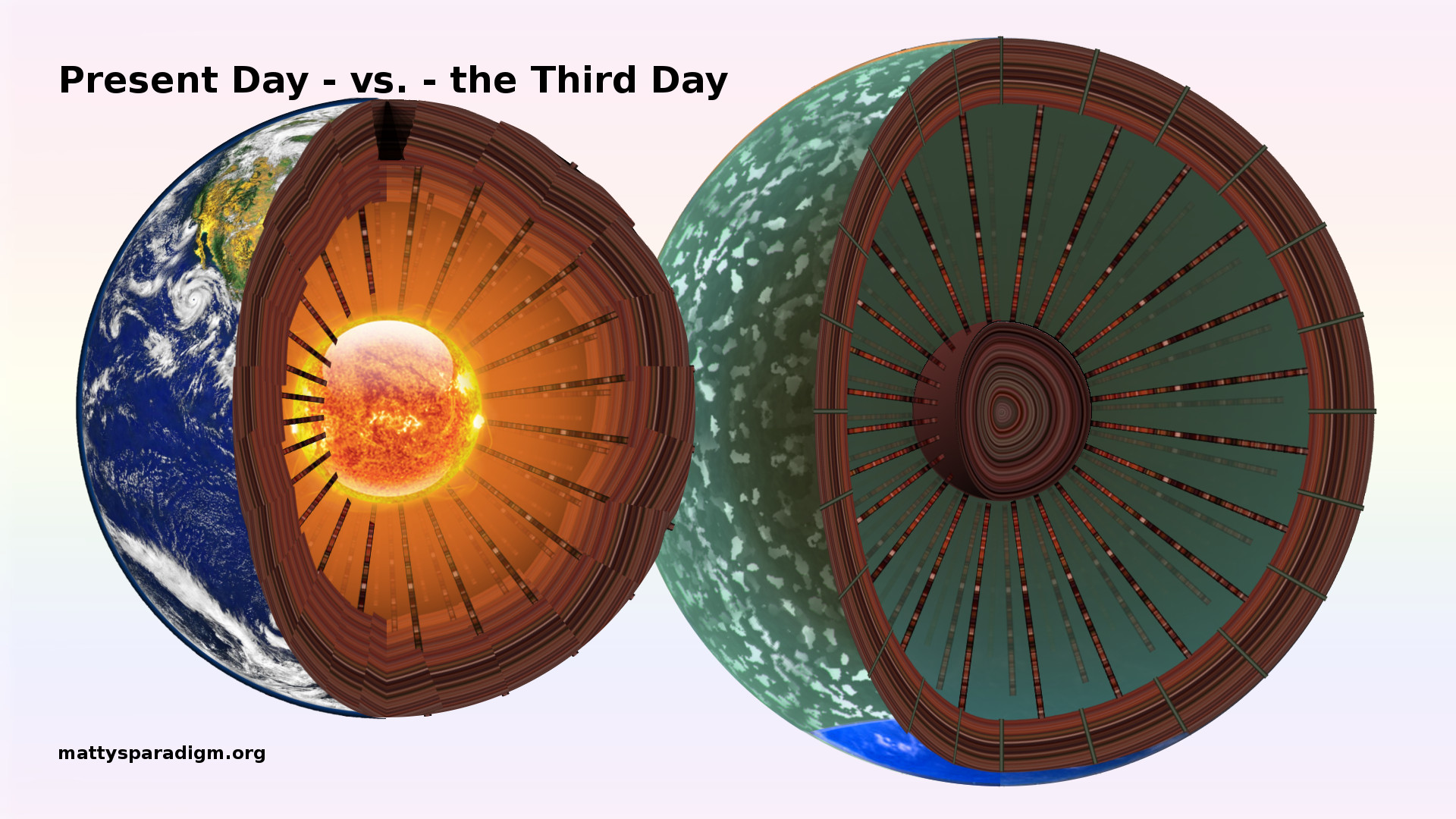
The New Testament (Greek) references to hell and the interior of the earth are in harmony with the spherical hollow earth model (SHEM) which we have constructed from the Old Testament (Hebrew).
In the six hundredth year of Noah’s life, in the second month, the seventeenth day of the month, the same day were all the fountains of the great deep broken up, and the windows of heaven were opened. And the rain was upon the earth forty days and forty nights.
(Genesis 7:11-12) KJV
IF God saw the wickedness of man,
AND decided to take action,
THEN the fountains of the great deep were established either:
as a hedge against this outcome or,
they existed for an unrelated reason.
The existence of hell isn’t an example of God being mean. Hell is the default outcome for all matter and souls, however there is a freely available alternative: faith and life in Jesus Christ.
When there were no depths, I was brought forth; when there were no fountains abounding with water.
(Proverbs 8:24) KJV
The great deep is a feature of the internal structure of the earth, located in the mantle, which is why we are picking our way through this today in March. However, our featured passage speaks of a time when there were no depths. There was a time before the deep existed.
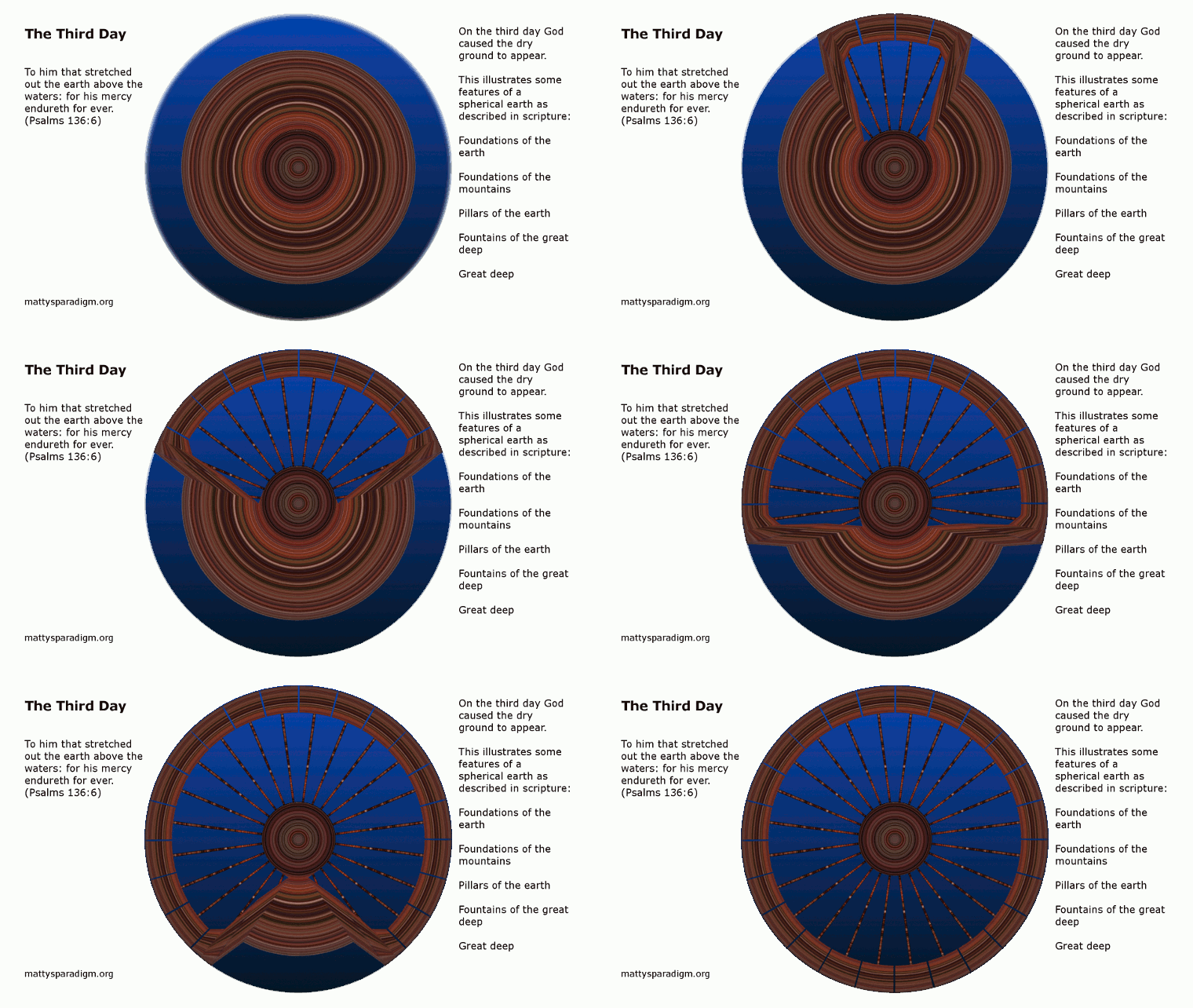
There’s a difference in usage between the English phrases the deep, (Genesis 1:2) and the depths (Proverbs 8:24) vs. the great deep (Genesis 7:11) which is contextual rather than based on nuance of translation. The phrase the deep is used to describe the body of water which was present in the beginning, when God said let there be light. The phrase the great deep, for instance, contextually is this water starting at the end of the 3rd day when it’s drained through the mantle into the great gulf as the earth was spread out over the waters.
To him that stretched out the earth above the waters: for his mercy endureth for ever.
“When there were no depths,” can only refer to Genesis 1:1, because the first mention of the deep, “tehom,” is Genesis 1:2. The Bible uses “tehom,” to refer to the body of water from which the universe was made.
Read more…
Thought for the Day
If I shut up heaven that there be no rain, or if I command the locusts to devour the land, or if I send pestilence among my people; If my people, which are called by my name, shall humble themselves, and pray, and seek my face, and turn from their wicked ways; then will I hear from heaven, and will forgive their sin, and will heal their land.
He raiseth up the poor out of the dust, and lifteth up the beggar from the dunghill, to set them among princes, and to make them inherit the throne of glory: for the pillars of the earth are the LORD’S, and he hath set the world upon them.
(1 Samuel 2:8) KJV
If there are remnants of “the pillars of the earth,” today then we have an important clue that allows us to calculate the original radius of the Earth as it was on the 3rd day of creation: approximately 7,653 km.
Predictive Testable Hypothesis 8
IF geological features such as
Monument Valley, Utah;
Devil’s Tower, Wyoming;
Pilot Mountain, North Carolina; and
Saint Michael’s Mount, UK, are remnants of the pillars of the earth,
THEN we have the approximate radius of the inner surface of the earth’s mantle on the 3rd day,
AND a way to calculate the original radius of the earth,
THEREFORE these geological features will be finely bedded metamorphic structures, not igneous intrusions.






 Matty (Headwind)