Carlton’s computer systems were a remarkable feat of theoretical pioneering. The engineering was fairly simple, and the raw computing power was not great, but that was not the point. In a similar way to how fine art has an intrinsic value to culture and society, even though it may be just a few bits of wood, canvas and paint, Carlton’s computers were revolutionary. The fundamental basis was an idea that Carlton had in High School. There had been a big push back then to develop energy-efficient technology. There was a well sponsored National competition for clever inventions that Carlton decided to win. Carlton’s idea was to generate electrical power at the place where it was needed, rather than storing it elsewhere and using wires and connectors to transport it.
The human body, Carlton theorized, is powered by changes in electrical potential as electrons move across cell membranes. The energy to do this comes from biochemical reactions in the cells. This is called respiration. Power is not transported to the cells like electricity is, but fuel, from metabolizing food, is taken there in the blood. Each cell converts the fuel into the energy needed to power all of the cellular processes. Blood transports everything necessary for metabolism to each cell, and it takes the waste products away. Carlton figured on making a computer that operated in a similar way.
Carlton wanted to generate the computer processor’s electrical power right at the processor. The processor would need to be small and have low power usage, but if hundreds, maybe thousands, of these processors were linked together the computer should be fast enough. Most importantly it would not need a source of electricity.
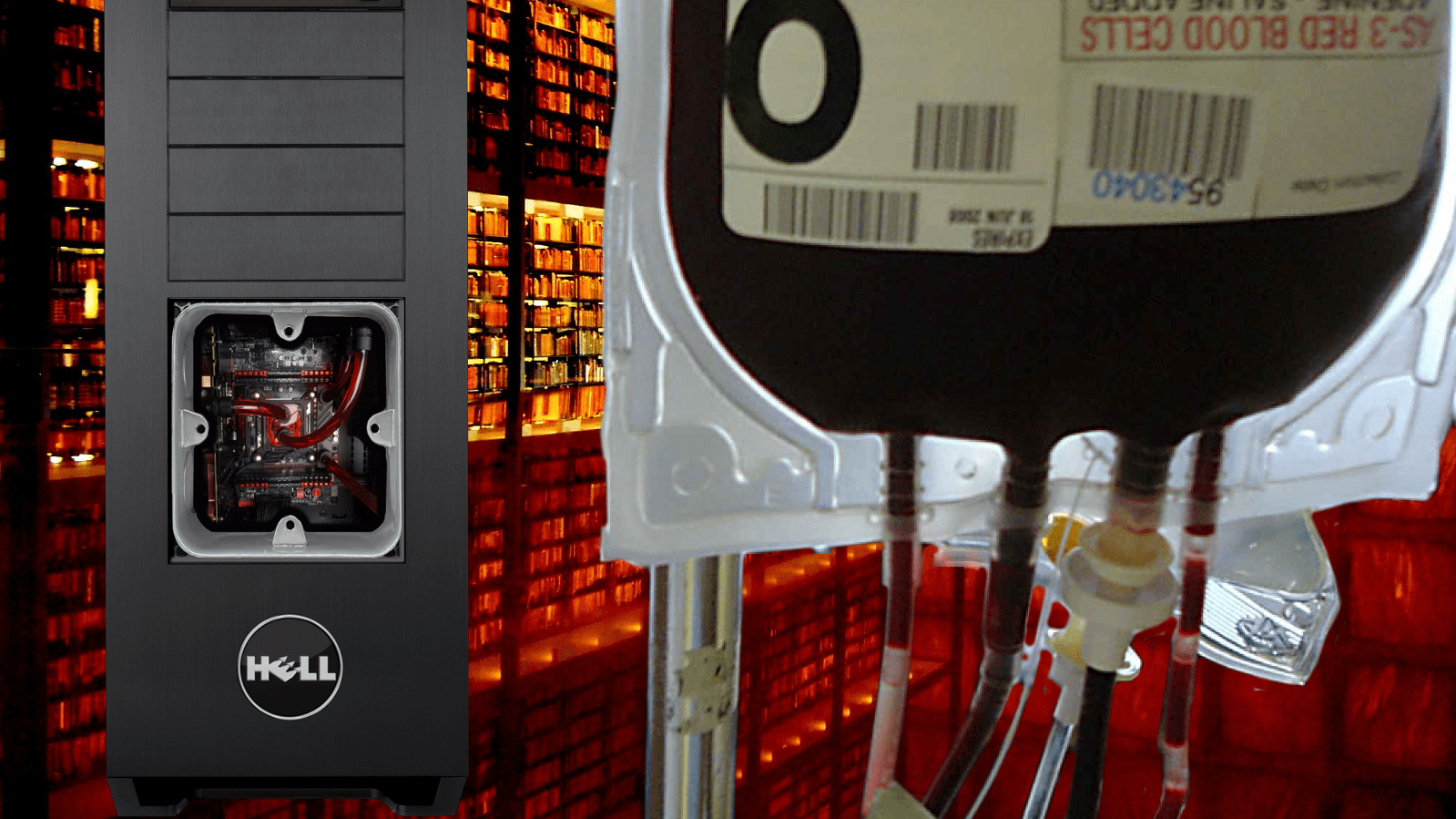
The idea was simple enough but it turned out to be a practical nightmare. As Carlton thought and designed he built small replicas of human organs. A pump to circulate oxygenated solution was the heart. An aerator to add oxygen and remove carbon dioxide was the lung. A filter to remove waste products from the solution was the kidney. The solution in the machine was the blood. To keep it simple Carlton used real blood, his own. Each of these components also needed power, and so his problem was not only to make a system that could power its processor, but could produce enough surplus electrical current to run the other peripherals necessary to the system.
One of the early challenges was how to develop a membrane that was big enough to be useful, but that would be able to perform in the same way that a human cell membrane does. His first experiments involved using the papery layer of skin that is found in between the layers of an onion. This is just one cell thick but it can be peeled off if you are careful. He was very careful, and his success at generating a measurable electrical current by filling onion skin membrane with his blood was all he needed to develop a full fledged obsession.
His work after that introduced him into the medical field and the world of cosmetic surgery, where researchers were growing human skin from stem cells for use in re-constructive surgery. He convinced his parents to fund his project and custom ordered a sheet of artificially grown human skin that was one cell thick, and big enough to cover a twenty inch computer screen. It died, but not before he demonstrated the validity of his idea, prompting a new burst of investigation into a cellular substrate that was not living tissue. This he eventually found in a lab in Geneva, Switzerland, who had stumbled upon the invention by chance while developing a lining for the inner wall of the Superconducting Supercollider at CERN. Now he had a cellular substrate that was the equivalent to one cell thick, was made of cell-sized miniature compartments and was porous. It was ceramic and very durable. It worked perfectly, and he began generating the electrical current he needed. The next challenge became finding a processor that would work in the system.





 Matty (Headwind)