


He hath made the earth by his power, he hath established the world by his wisdom, and hath stretched out the heavens by his discretion.
(Jeremiah 10:12, 51:15) KJV
It turns out that theologians fudge their data just like scientists do. Sometimes things don’t make sense, do they? What could possibly be wrong with helping them make sense? This approach is inductive, aka eisegesis.
When we apply the meaning we think we need we are using our premise to supply evidence for our conclusion. The theological word for this is eisegesis. Basically, what we believe a passage means will influence any translation we render. This is referred to as confirmation bias.
In the interlinear Hebrew we find that the phrase he hath established from couplet 7 in Jeremiah is a translation of the Hebrew word מֵכִ֥ין – mechin. It occurs in one other place in Psalms, below, were it has been rendered as setteth fast.
Which by his strength setteth fast the mountains; being girded with power:
(Psalms 65:6) KJV
This word has been assigned to the root כִ֥ין – kun which means to be firm. The context of the passage, established the world, matches the meaning of the word, to be firm. What could be wrong with that? The problem is that the spelling doesn’t match. Hebrew reads from right to left.
Setteth fast: מֵכִ֥ין – mechin (roots)
| Usage | Assignment | Hebrew | Transliteration |
| Established | Traditional | כִ֥ין | kun |
| Setteth fast | Actual word | מֵכִ֥ין | mechin |
| To sink, sank | Contextual | יִמַּ֣ךְ | makak |
The way we look at it the first three characters of the word are the same, going left to right. However reading right to left mechin has an extra letter. The meaning of the word was induced from the context of the passage, before the concept of gravity was a consideration, and the word was assigned to the root kun because it made sense. The extra letter מֵ (mem) is considered to be a modifier.
The broad context is the creation of the earth but it specifically refers to the event when the foundations of the earth were established and the heavens were spread out. The synchronicity of these actions in scripture is how we know that they are both part of the same event: the inception of gravity. However, as far as we are aware, no one has ever suggested the possibility that the creative act of the 2nd day was the inception of gravity, that’s why the word was assigned the way that it was.
What if the extra letter מֵ (mem) isn’t a modifier? What if this is an entirely different word? If we search for the place in our lexicon where this word would be listed alphabetically what do we find? The word occurs under an obsolete root meaning water.

However, this meaning is rather abstracted from our context. There are six columns of forms listing how this root is used before we finally get down to the place where the word we are looking for occurs, spelled the same way as it is in the text, which means that the initial letter, מֵ, is being ignored for sake of the pre-gravity mindset.
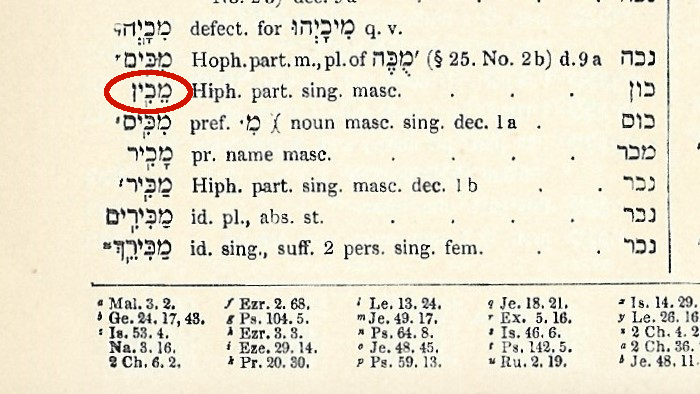
Davidson Analytical Chaldee and Hebrew Lexicon page CCCCLXXXVI
It just so happens (thanks Holy Spirit!) that on the same page is the root makak which means to sink. This just so happens (thanks Holy Spirit!) to match the spelling of our word mê·ḵîn. Now that we understand the role of gravity in creation and we know that it has a scriptural analog taba, it makes perfect sense for the word mê·ḵîn to be assigned to this root, in which case, alphabetically, it would be where you see the horizontal red line.


February 4th – To Sink, Sank
We’ve connected the phrases established the world, and setteth fast the mountains, with sinking down.
 Matty (Headwind)
One Reply to “”