And the Lord’s servant must not be quarrelsome but kind to everyone, able to teach, patiently enduring evil, correcting his opponents with gentleness. God may perhaps grant them repentance leading to a knowledge of the truth, and they may come to their senses and escape from the snare of the devil, after being captured by him to do his will.
(2 Timothy 2:24-26) ESV
In the Biblical narrative of Matty’s Paradigm, at the time when gravity was created, super-sized bacteria existed in an iron-rich aquatic environment before an Oxygen-rich atmosphere formed.
always learning and never able to arrive at a knowledge of the truth.
(2 Timothy 3:7) ESV
In the Matty’s Paradigm narrative cellular life originates in water in zero-G before there was an atmosphere. Here’s some science lingo attempting to explain super-sized prokaryotic cells in an environment with no oxygen.
“There is no one who is righteous, no one who is wise or who worships God. All have turned away from God; they have all gone wrong; no one does what is right, not even one.
(Romans 3:10-11) Good News Translation
If life began in a zero gravity environment on the first day, then the unicellular and multicellular life forms would have reached exceptionally large size as compared to similar organisms grown in gravity.
Scientific blindness is never so apparent as when dealing with remnants of Noah’s flood. This articles shows how the words flood, wet, catastrophe, intense, dry and drought are unavoidable.
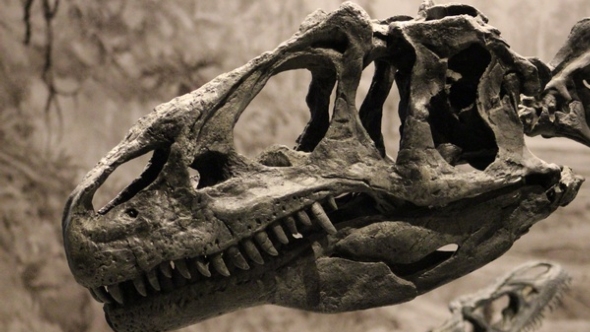
Out in Utah’s eastern desert, nestled among the purple- and red-banded hills of the Morrison Formation, there rests one of the richest dinosaur bonebeds ever found. It’s also the most mysterious. Since the site’s initial discovery over a century ago, the jumbled remains of over 46 Allosaurus – as well as the comparatively rare bones of other Jurassic dinosaurs – have been pulled from this one spot, and there’s every indication that there is more to be found than has yet been uncovered. But what brought all these dinosaurs here, and why do predators dominate this spot when almost every other bonebed of its kind has the expected array of abundant herbivores and rare carnivores?
There are almost as many takes on what created the bonebed at Cleveland-Lloyd Dinosaur Quarry as scientists who have studied it. The initial, and most obvious, idea was that this was a predator trap like the La Brea asphalt seeps. Some poor herbivore got stuck in mud, died, and its rotten stink drew scores of Allosaurus here, which became trapped in turn. But there’s no tar or other trapping mechanism to do the dirty work. This led to other suggestions – that the dinosaurs were killed by drought, that the site was a poison spring, that the dinosaurs died elsewhere and their carcasses were washed to the spot – but there was always some point that didn’t make sense or remained contentions. Where some experts saw a dry environment, others saw one that was frequently wet. Where some saw evidence of one catastrophic event, others saw multiple depositions that happened over time.
That’s what led geoscientists Joe Peterson, John Warnock, Steven Clawson, and their colleagues to move literal tons of rock and excavate Cleveland-Lloyd anew. Not for new bones, but for the geological clues that might let the researchers more accurately envision what happened there in the days of the Late Jurassic. What they’ve found doesn’t conclusively solve the Mesozoic murder mystery, but it refines the setting where the inscrutable events took place.
Peterson and coauthors looked at the fossil assemblage from two angles – a geological technique called x-ray florescence to determine the geochemistry of the Cleveland-Lloyd rocks and a detailed analysis of bone fragments found within the quarry. Together, these two lines of evidence help outline what must have been an incredibly smelly Jurassic scene.
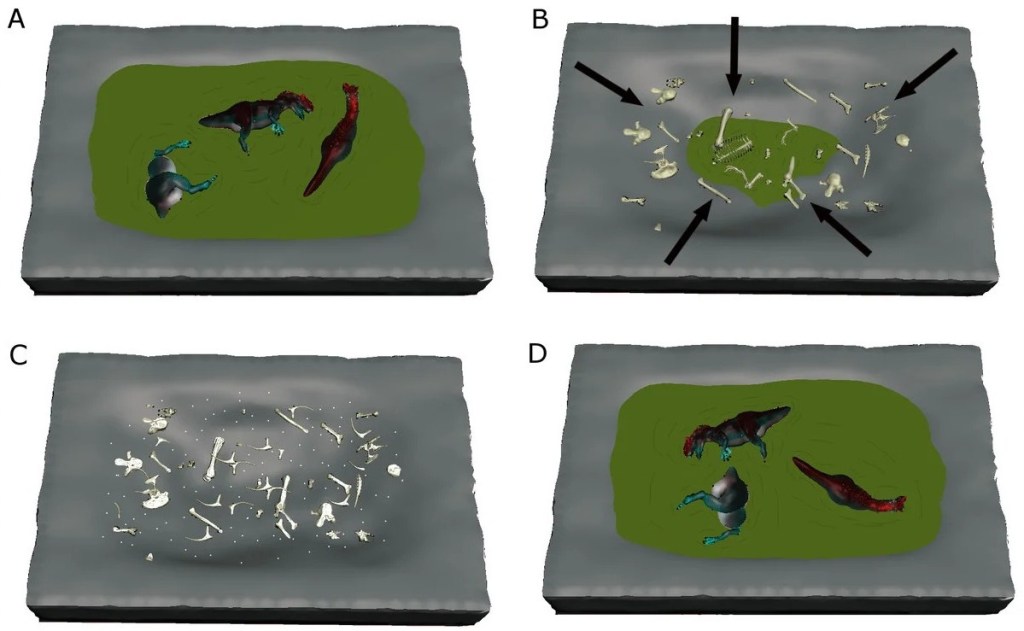
While it’s certainly dramatic to think of hundreds of dinosaurs accumulating in one spot all at once, the findings of Peterson and his colleagues suggest that Cleveland-Lloyd didn’t form in a single event. This spot in the Utah desert was once an ephemeral pond that came and went as the Jurassic seasons shifted from wet to dry. And during the wet times, local flooding transported dinosaur bodies and bones to this particular spot where they settled.
How the CLDQ bonebed was formed, starting with carcasses being washed in, bones being exposed, bones being weathered and broken into fragments, and the addition of more carcasses in the next flood stage. Credit: Peterson et al 2017
The bone fragments help tell the story. The patterns of abrasion and other details suggest that the fragments came from bones already within the pond deposit, getting jostled and reworked with the swings between the seasons. Likewise, the geochemical results supported that this was a wet spot for at least some times of the year. In fact, the analysis showed that the Cleveland-Lloyd sediments had unusually elevated levels of heavy metals compared to other bonebeds of similar age. This doesn’t mean that Cleveland-Lloyd was a poison spring – as has also been suggested to explain the carnage – but that the geochemical profile is instead a sign of rotting carcasses sitting in a standing body of water, turning the pond into an undrinkable, mineral-rich soup. And this could explain why fossils of fish, turtles, and crocodiles are rare in the quarry, as well as why bite marks and signs of scavenging are so rare. When full, this was a rank spot with foul water that was best avoided.
What the new study does is look at the environment of Cleveland-Lloyd over the span of Jurassic seasons. It sets new parameters for thinking about, and questioning, what happened there over 145 million years ago. The site was an ephemeral pond, and it didn’t come together all at once. That may sound simple, but it sets a new baseline for interpreting how such an unusual site came to be.
Plenty of questions remain. If the dinosaurs were washed in, then what killed them in the first place? And does this deposit represent especially harsh times – like intense, recurring droughts – or does it encapsulate the normal comings and goings of dinosaurs during the Late Jurassic? On top of that, we still don’t know why Allosaurus is overrepresented at this site compared to almost every other Morrison Formation bonebed of its kind.
Perhaps something unusual was happening in the vicinity that caused Allosaurus to congregate. Then again, the “different lizard” was by far the most common carnivore of the Late Jurassic west – if you find a theropod in the Morrison, nine times out of ten it’s going to be Allosaurus – and so exhuming an abundance of Allosaurus in a deposit that formed over years and years might not actually require a special explanation other than the predators were abundant at that time. In fact, a few hours away from Cleveland-Lloyd just over the Colorado border, there is another, smaller bonebed where Allosaurus dominates. Perhaps Cleveland-Lloyd represents just another slice of regular Jurassic life rather than something unusual that requires special explanation. Then again, as Peterson and colleagues write, it’s possible that the surfeit of Allosaurus at Cleveland-Lloyd is pointing towards previously-unknown aspects of their behavior – perhaps there was a breeding or nesting site nearby, or maybe these dinosaurs were brought into closer numbers in times of drought and then die as is seen with modern animals in sharply seasonal habitats.
The story of Cleveland-Lloyd is far from told. The conditions that created the bonebed, and what led to Allosaurus
being buried in unprecedented numbers, are still unknown, not to
mention all the other paleobiological and ecological details still
embedded in bone and rock. But the new study is a significant step in
reconstructing what happened during the days when dinosaurs ruled the
Earth. And by starting with how they died, maybe we can learn something
new about how these amazing animals lived.
The coming of the lawless one is according to the working of Satan, with all power, signs, and lying wonders, and with all unrighteous deception among those who perish, because they did not receive the love of the truth, that they might be saved. And for this reason God will send them strong delusion, that they should believe the lie, that they all may be condemned who did not believe the truth but had pleasure in unrighteousness.
(2 Thessalonians 2:9-12) NKJV
Popular Science (SciPop) is designed to make it so that you can’t see the wood for the trees or a tree for the woods. It’s not a conspiracy, it’s part of God’s will that we call the strong delusion.
The multitude of camels shall cover thee, the dromedaries of Midian and Ephah; all they from Sheba shall come: they shall bring gold and incense; and they shall shew forth the praises of the LORD.
(Isaiah 60:6) KJV
Deposition and lithification of sediment (Noah’s flood), had to be before the formation of mountains composed of the sediment (Peleg’s tectonics).
I will take no bullock out of thy house, nor he goats out of thy folds. For every beast of the forest is mine, and the cattle upon a thousand hills. I know all the fowls of the mountains: and the wild beasts of the field are mine. If I were hungry, I would not tell thee: for the world is mine, and the fulness thereof.
(Psalms 50:9-12) KJV
The Miocene is the Miocene because it’s the Miocene. Anything that’s not characteristic of the Miocene is assigned to something other than the Miocene. It’s a little microcosm of circular reasoning.
The only way to account for the sedimentary deposits and fossils of the Cretaceous is by a world-wide flood. It’s so obvious that scientific jargon can’t hide it.
Woe unto them that call evil good, and good evil; that put darkness for light, and light for darkness; that put bitter for sweet, and sweet for bitter!
(Isaiah 5:20) KJV
If we examine the evidence we can’t avoid the obvious conclusion that Mississippian sediments are the remains of an ecosystem which was buried in a flood.
And it came to pass, as they fled from before Israel, and were in the going down to Bethhoron, that the LORD cast down great stones from heaven upon them unto Azekah, and they died: they were more which died with hailstones than they whom the children of Israel slew with the sword.
(Joshua 10:11) KJV
There are vast areas of sedimentary deposits which contain the remains of entire schools of fish, such that their bodies are in the millions. How could this happen in a flood of water?




 Matty (Headwind)