
The light on the first day of creation came from the process of Nucleogenesis. This reaction ran its course and darkness returned. This darkness was not the absence of light, but the obstruction of light. God called this darkness night. On the second day God created gravity that caused the light emitting particles to coalesce to form into a rigid sphere, called the firmament, which is on the edge of space. The firmament was the source of light on the second day of creation, and has shone brightly ever since.
The purpose God had for creating gravity and forming the firmament was to establish a place, called heaven, where there would never be night, where God would dwell in light perpetually because the firmament is bright like the sun, as we see from Daniel:
And they that be wise shall shine as the brightness of the firmament; and they that turn many to righteousness as the stars for ever and ever. (Daniel 12:3)
So what was the source of darkness at the end of the second day? And how is it that we have darkness in space such that we need to have sun, moon and stars for light?
Scripture has an answer for this.
God withdrew the obvious proof of his presence as part of his plan of redemption. God gave us free will so that those of us who truly want to know Him will make a choice to believe. It can’t be blindingly obvious that God created us, that would mean there is no free will. God hid himself from view by clothing the inner surface of the firmament in blackness.
You don’t believe me?
Isaiah did:
I clothe the heavens with blackness, and I make sackcloth their covering. (Isaiah 50:3)
I know what Bible scholars will say: one passage of scripture is not enough to develop a doctrine. Quite right. That’s why it is important that this interpretation be consistent with the entire narrative of scripture. Yes, there may be one place that states the doctrine explicitly, but it is supported by a myriad of passages that show how the physical structure of the cosmos has been established.
This also gives us a way to account for a passage in Psalm 18 where within the same context the Bible refers to God being in light and darkness at the same time:
He bowed the heavens also, and came down: and darkness was under his feet. And he rode upon a cherub, and did fly: yea, he did fly upon the wings of the wind. He made darkness his secret place; his pavilion round about him were dark waters and thick clouds of the skies. At the brightness that was before him his thick clouds passed, hail stones and coals of fire. The LORD also thundered in the heavens, and the Highest gave his voice; hail stones and coals of fire. Yea, he sent out his arrows, and scattered them; and he shot out lightnings, and discomfited them. Then the channels of waters were seen, and the foundations of the world were discovered at thy rebuke, O LORD, at the blast of the breath of thy nostrils. (Psalm 18:9-15)
By understanding that the firmament is made of material that shines brightly, but that is hidden from below by a layer of blackness on its inner concave surface, we can see how, in the passage, brightness can be before God and there can be darkness under his feet at the same time. So we actually have a physical way to account for the fact that God’s heaven is a place where there is no need of the sun for light, but that he also made darkness his secret place.
Unbelievers would love to tout this as an example of the contradictions that are common throughout scripture, but you can see how there is no contradiction at all if we can accept the doctrine of the firmament.
It is also interesting to note that in this very context the passage goes on to describe channels of water being seen (the fountains of the great deep) and the foundations of the world. So we have here more detail to add to our understanding of the creative process that took place on the second day, and that continued into the third day.
This is also not the only reference to the idea that God is able to physically visit the Earth by riding on a piece of heaven. I hate to give the impression of Jesus surfing through the clouds, but it does appear that a section of firmament is used like an elevator to travel the distance between heaven and Earth. Oh and guess what? Yep, it’s Biblical:
Sing unto God, sing praises to his name: extol him that rideth upon the heavens by his name JAH, and rejoice before him. (Psalm 68:4)
To him that rideth upon the heavens of heavens, which were of old; lo, he doth send out his voice, and that a mighty voice. (Psalm 68:33)
You see what a correct understanding of the firmament does for us? Cosmic surfboards.
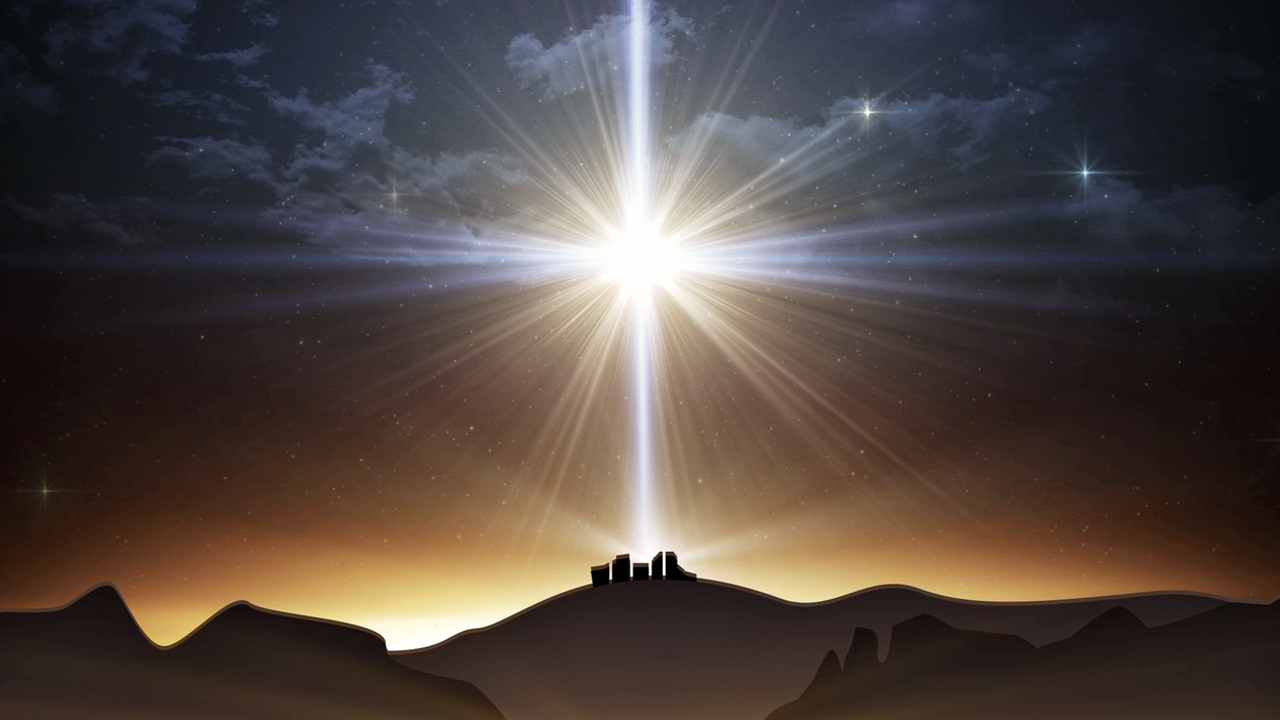
The most outstanding example of this phenomenon is the Star of Bethlehem.
No, don’t go there, I hear you cry.
Now when Jesus was born in Bethlehem of Judaea in the days of Herod the king, behold, there came wise men from the east to Jerusalem, Saying, Where is he that is born King of the Jews? for we have seen his star in the east, and are come to worship him. (Matthew 2:1,2)
The wise men traveled from afar as they tracked the progress of a star. What they were actually seeing was a section of firmament descending vertically from the heaven to the Earth. It appeared to be moving and growing brighter but it was in fact tracking in a straight line from heaven to Earth.
When they had heard the king, they departed; and, lo, the star, which they saw in the east, went before them, till it came and stood over where the young child was. When they saw the star, they rejoiced with exceeding great joy. (Matthew 2:9,10)
The phenomenon of a star increasing in brightness as it approached the Earth was visible to all. Not just some wise men astrologers. Consider the shepherds in the fields and let’s look at the narrative that surrounds them:
And there were in the same country shepherds abiding in the field, keeping watch over their flock by night. And, lo, the angel of the Lord came upon them, and the glory of the Lord shone round about them: and they were sore afraid. And the angel said unto them, Fear not: for, behold, I bring you good tidings of great joy, which shall be to all people. For unto you is born this day in the city of David a Saviour, which is Christ the Lord. And this shall be a sign unto you; Ye shall find the babe wrapped in swaddling clothes, lying in a manger. And suddenly there was with the angel a multitude of the heavenly host praising God, and saying,
Glory to God in the highest, and on earth peace, good will toward men.
And it came to pass, as the angels were gone away from them into heaven, the shepherds said one to another, Let us now go even unto Bethlehem, and see this thing which is come to pass, which the Lord hath made known unto us. (Luke 2:8-15)
Could not this be a description of a section of firmament coming down to Earth with a host of angels on board? Surely, the birth of the King of Kings and Lord of Lords was the greatest event in history thus far, and the entire heavenly host wished to be present. The brightly shining firmament was the glory of the Lord that shone round about the shepherds.
What can I tell you? A rigid structural firmament of crystalline composition solves a lot of scriptural problems.
If you’re still uncomfortable with the idea that God uses a section of the rigid crystalline firmament as a movable platform then check out Exodus 24, when Moses, Aaron, Nadab and Abihu and seventy of the elders of Israel went up to Mount Sinai to meet with the Lord:
Then went up Moses, and Aaron, Nadab, and Abihu, and seventy of the elders of Israel: And they saw the God of Israel: and there was under his feet as it were a paved work of a sapphire stone, and as it were the body of heaven in his clearness. And upon the nobles of the children of Israel he laid not his hand: also they saw God, and did eat and drink. (Exodus 24:9-11)
Slam dunk.
 Matty (Headwind)