

As also in all his epistles, speaking in them of these things; in which are some things hard to be understood, which they that are unlearned and unstable wrest, as they do also the other scriptures, unto their own destruction.
(2 Peter 3:16) KJV
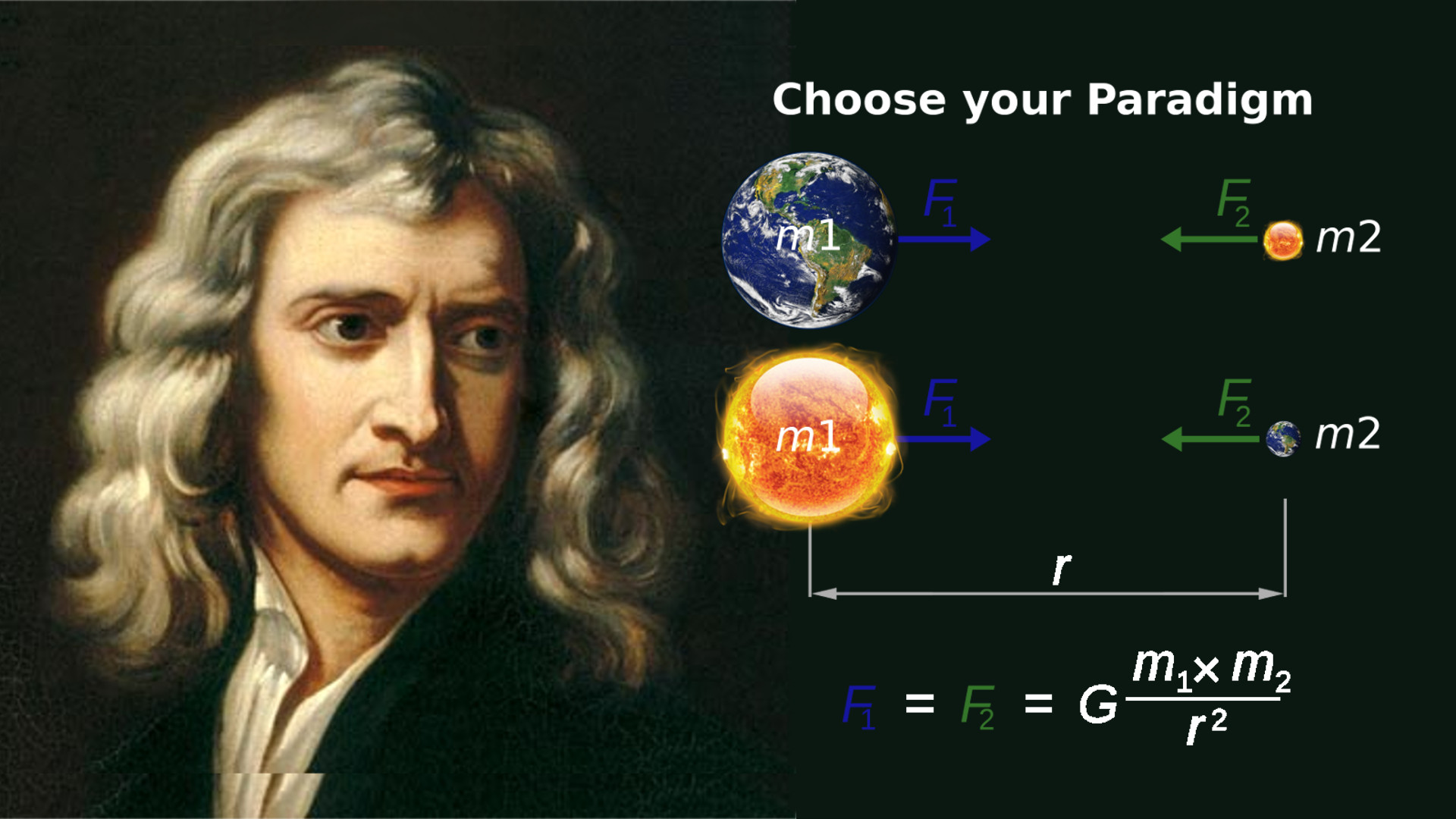
Sir Isaac Newton was fully aware that we could use words to define phenomena which were in fact unknown. Words are defined by what we use them for. It’s a sublimely subtle form of induction.
Inductive reasoning (as opposed to deductive reasoning or abductive reasoning) is reasoning in which the premises are viewed as supplying strong evidence for the truth of the conclusion. While the conclusion of a deductive argument is certain, the truth of the conclusion of an inductive argument is probable, based upon the evidence given.
– Inductive Reasoning, definition (Wikipedia)
Newton was trying to make case that the enlightened mathematical mind of his age was straining the sacred writing, or making it look as if the Bible was wrong. In fact, Newton and his peers were being strained by the Bible, but since most of the peers wanted to disprove it they decided to believe his induced paradigm rather than the truth. It’s okay though, it was all part of God’s plan. The people needed a strong delusion as an alternative, because we all have free will to believe whatever we want, and Newton provided it. Newton was an unwitting pawn who craved adoration and worship from people who thought that he was smarter than God. He got it.
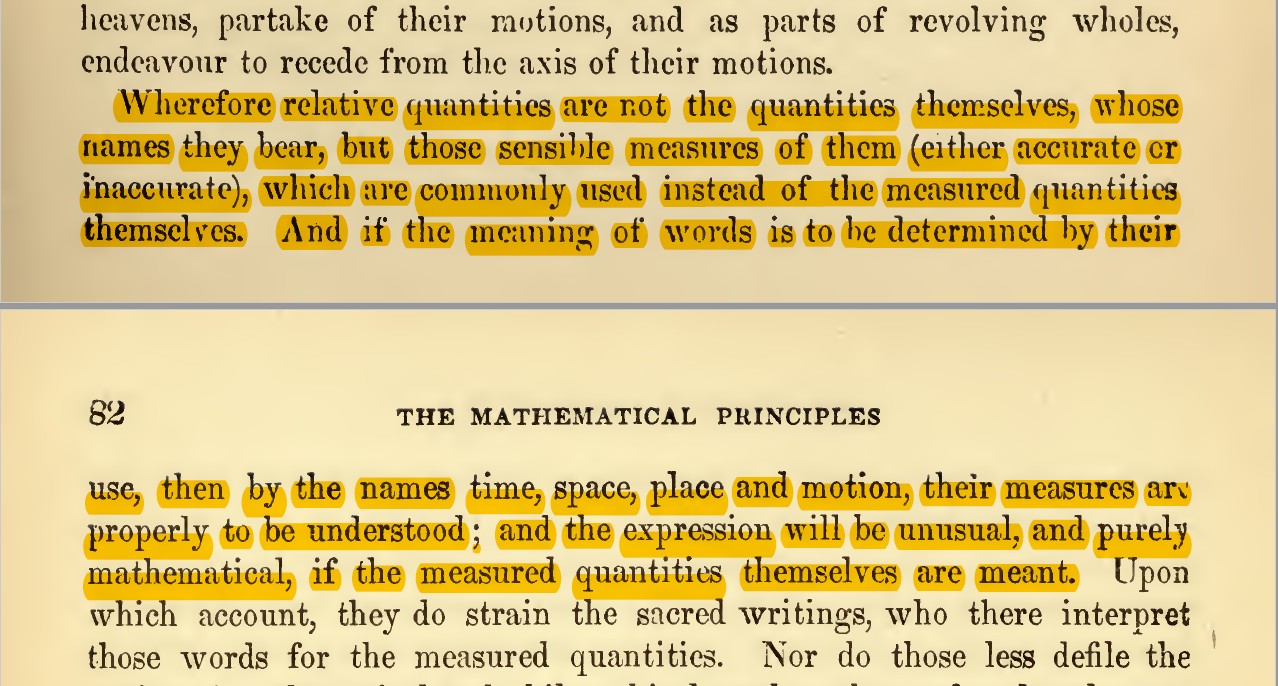
Wherefore relative quantities are not the quantities themselves, whose names they bear, but those sensible measures of them (either accurate or inaccurate), which are commonly used instead of the measured quantities themselves. And if the meanings of words is to be determined by their use, then by the names time, space, place and motion, their measures are properly to be understood; and the measured quantities will be unusual, and purely mathematical, if the measured quantities themselves are meant. Upon which account, they do strain the sacred writings, who there interpret the words for the measured quantities.
– Sir Isaac Newton, Principia Mathematica p. 81-82
In summary, quantities aren’t really quantities, even if we give them names. Words define the thing, even though the thing may be unknown. If we choose to believe the definitions which we made up to make it look like the Bible isn’t true, then the Bible doesn’t have to be true.
This means that if a swirl of specks, for which the measured quantity is a minute amount of light, is imputed to be a galaxy as defined by the definition of the word, then we’re taking the word in place of the measured quantity. This would indeed strain the sacred writings. However, if the measured quantity, in this case a speck of light, is actually a speck of light, then there’s no problem at all. A galaxy is simply a word that’s used to describe a thing, but the thing isn’t the definition of the word.
That’s a long way to go around it, but there’s no way to test the hypothetical radioisotope decay constant without depending on the untestable hypothesis that stellar spectroscopy confirms the decay constant. The theoretical construction of radioisotope dating is circular reasoning between multiple untestable hypotheses. That means it’s not scientific. It’s pseudoscience.


 Matty (Headwind)