And a river went out of Eden to water the garden; and from thence it was parted, and became into four heads. The name of the first is Pison: that is it which compasseth the whole land of Havilah, where there is gold; And the gold of that land is good: there is bdellium and the onyx stone. And the name of the second river is Gihon: the same is it that compasseth the whole land of Ethiopia. And the name of the third river is Hiddekel: that is it which goeth toward the east of Assyria. And the fourth river is Euphrates.
( Genesis 2:10-14 )
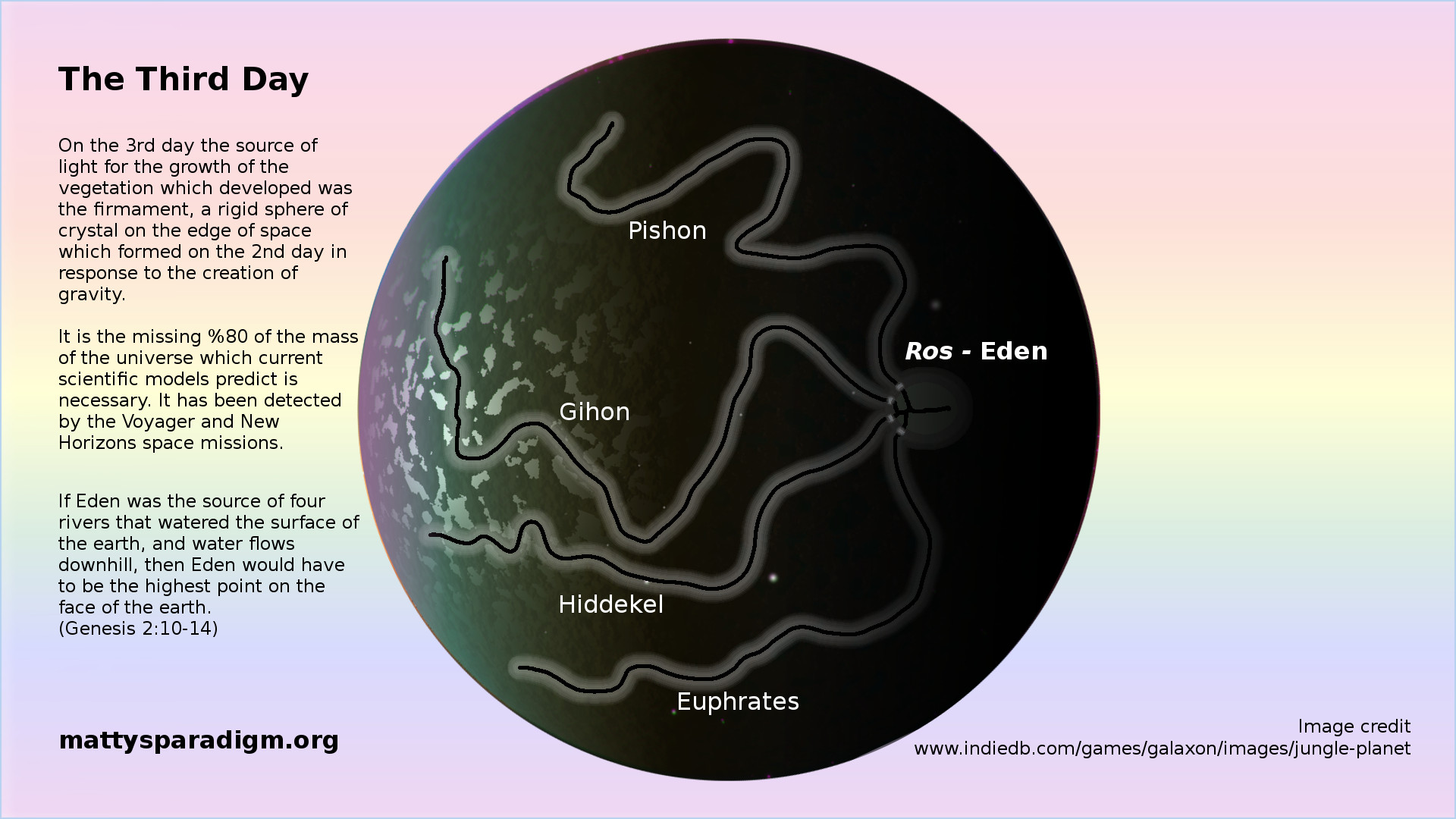
Applying practical knowledge and simple logic to Genesis 2:10-14
IF a river from Eden watered the whole surface of the earth,
AND water flows downhill,
THEN Eden was the highest point on the surface of the earth.
Scientific blindness is never so apparent as when dealing with remnants of Noah’s flood. This articles shows how the words flood, wet, catastrophe, intense, dry and drought are unavoidable.
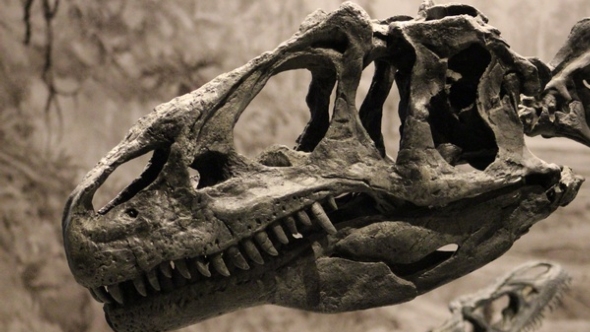
Out in Utah’s eastern desert, nestled among the purple- and red-banded hills of the Morrison Formation, there rests one of the richest dinosaur bonebeds ever found. It’s also the most mysterious. Since the site’s initial discovery over a century ago, the jumbled remains of over 46 Allosaurus – as well as the comparatively rare bones of other Jurassic dinosaurs – have been pulled from this one spot, and there’s every indication that there is more to be found than has yet been uncovered. But what brought all these dinosaurs here, and why do predators dominate this spot when almost every other bonebed of its kind has the expected array of abundant herbivores and rare carnivores?
There are almost as many takes on what created the bonebed at Cleveland-Lloyd Dinosaur Quarry as scientists who have studied it. The initial, and most obvious, idea was that this was a predator trap like the La Brea asphalt seeps. Some poor herbivore got stuck in mud, died, and its rotten stink drew scores of Allosaurus here, which became trapped in turn. But there’s no tar or other trapping mechanism to do the dirty work. This led to other suggestions – that the dinosaurs were killed by drought, that the site was a poison spring, that the dinosaurs died elsewhere and their carcasses were washed to the spot – but there was always some point that didn’t make sense or remained contentions. Where some experts saw a dry environment, others saw one that was frequently wet. Where some saw evidence of one catastrophic event, others saw multiple depositions that happened over time.
That’s what led geoscientists Joe Peterson, John Warnock, Steven Clawson, and their colleagues to move literal tons of rock and excavate Cleveland-Lloyd anew. Not for new bones, but for the geological clues that might let the researchers more accurately envision what happened there in the days of the Late Jurassic. What they’ve found doesn’t conclusively solve the Mesozoic murder mystery, but it refines the setting where the inscrutable events took place.
Peterson and coauthors looked at the fossil assemblage from two angles – a geological technique called x-ray florescence to determine the geochemistry of the Cleveland-Lloyd rocks and a detailed analysis of bone fragments found within the quarry. Together, these two lines of evidence help outline what must have been an incredibly smelly Jurassic scene.
While it’s certainly dramatic to think of hundreds of dinosaurs accumulating in one spot all at once, the findings of Peterson and his colleagues suggest that Cleveland-Lloyd didn’t form in a single event. This spot in the Utah desert was once an ephemeral pond that came and went as the Jurassic seasons shifted from wet to dry. And during the wet times, local flooding transported dinosaur bodies and bones to this particular spot where they settled.
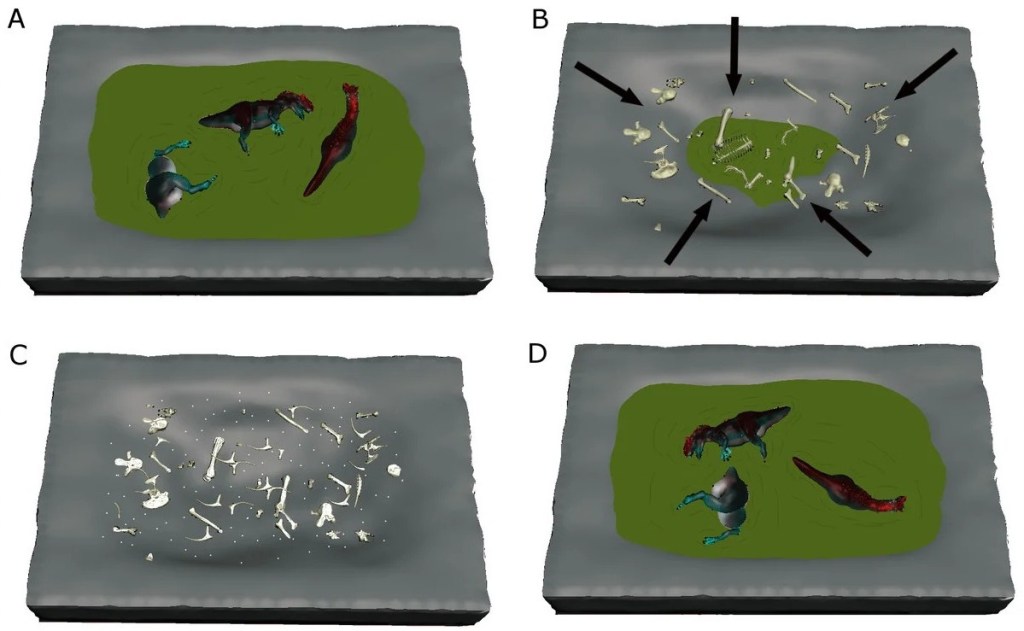
How the CLDQ bonebed was formed, starting with carcasses being washed in, bones being exposed, bones being weathered and broken into fragments, and the addition of more carcasses in the next flood stage. Credit: Peterson et al 2017
The bone fragments help tell the story. The patterns of abrasion and other details suggest that the fragments came from bones already within the pond deposit, getting jostled and reworked with the swings between the seasons. Likewise, the geochemical results supported that this was a wet spot for at least some times of the year. In fact, the analysis showed that the Cleveland-Lloyd sediments had unusually elevated levels of heavy metals compared to other bonebeds of similar age. This doesn’t mean that Cleveland-Lloyd was a poison spring – as has also been suggested to explain the carnage – but that the geochemical profile is instead a sign of rotting carcasses sitting in a standing body of water, turning the pond into an undrinkable, mineral-rich soup. And this could explain why fossils of fish, turtles, and crocodiles are rare in the quarry, as well as why bite marks and signs of scavenging are so rare. When full, this was a rank spot with foul water that was best avoided.
What the new study does is look at the environment of Cleveland-Lloyd over the span of Jurassic seasons. It sets new parameters for thinking about, and questioning, what happened there over 145 million years ago. The site was an ephemeral pond, and it didn’t come together all at once. That may sound simple, but it sets a new baseline for interpreting how such an unusual site came to be.
Plenty of questions remain. If the dinosaurs were washed in, then what killed them in the first place? And does this deposit represent especially harsh times – like intense, recurring droughts – or does it encapsulate the normal comings and goings of dinosaurs during the Late Jurassic? On top of that, we still don’t know why Allosaurus is overrepresented at this site compared to almost every other Morrison Formation bonebed of its kind.
Perhaps something unusual was happening in the vicinity that caused Allosaurus to congregate. Then again, the “different lizard” was by far the most common carnivore of the Late Jurassic west – if you find a theropod in the Morrison, nine times out of ten it’s going to be Allosaurus – and so exhuming an abundance of Allosaurus in a deposit that formed over years and years might not actually require a special explanation other than the predators were abundant at that time. In fact, a few hours away from Cleveland-Lloyd just over the Colorado border, there is another, smaller bonebed where Allosaurus dominates. Perhaps Cleveland-Lloyd represents just another slice of regular Jurassic life rather than something unusual that requires special explanation. Then again, as Peterson and colleagues write, it’s possible that the surfeit of Allosaurus at Cleveland-Lloyd is pointing towards previously-unknown aspects of their behavior – perhaps there was a breeding or nesting site nearby, or maybe these dinosaurs were brought into closer numbers in times of drought and then die as is seen with modern animals in sharply seasonal habitats.
The story of Cleveland-Lloyd is far from told. The conditions that created the bonebed, and what led to Allosaurus
being buried in unprecedented numbers, are still unknown, not to
mention all the other paleobiological and ecological details still
embedded in bone and rock. But the new study is a significant step in
reconstructing what happened during the days when dinosaurs ruled the
Earth. And by starting with how they died, maybe we can learn something
new about how these amazing animals lived.
Evidence of the rapid formation of tectonic plates during the breakup of Pangaea is described in garbled science lingo and woven into the prevailing narrative of asteroid induced mass extinction.
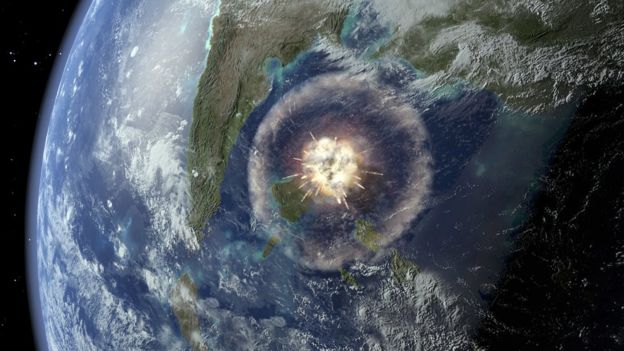
Scientists say they can now describe in detail how the asteroid that wiped out the dinosaurs produced its huge crater.
The
reconstruction of the event 66 million years ago was made possible by
drilling into the remnant bowl and analysing its rocks.
These show how the space impactor made the hard surface of the planet slosh back and forth like a fluid.
At one stage, a mountain higher than Everest was thrown up before collapsing back into a smaller range of peaks.
“And this all happens on the scale of minutes, which is quite amazing,” Prof Joanna Morgan from Imperial College London, UK, told BBC News.
Their
study confirms a very dynamic, very energetic model for crater
formation, and will go a long way to explaining the resulting
cataclysmic environmental changes.
The debris thrown into the
atmosphere likely saw the skies darken and the global climate cool for
months, perhaps even years, driving many creatures into extinction, not
just the dinosaurs.
The outer rim (white arc) of the crater lies under the Yucatan Peninsula itself, but the inner peak ring is best accessed offshore
A 15km-wide object dug a hole in Earth’s crust 100km across and 30km deep
This bowl then collapsed, leaving a crater 200km across and a few km deep
The crater’s centre rebounded and collapsed again, producing an inner ring
Today, much of the crater is buried offshore, under 600m of sediments
On land, it is covered by limestone, but its rim is traced by an arc of sinkholes
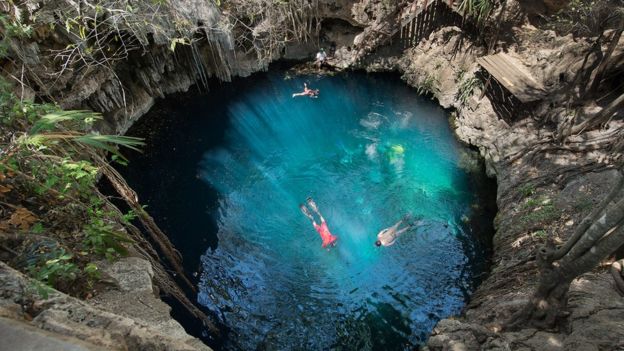
Mexico’s famous sinkholes (cenotes) have formed in weakened limestone overlying the crater
The researchers targeted a particular zone in the 200km-wide bowl
known as the “peak ring”, which – if earlier ideas were correct – should
have contained the rocks that moved the greatest distance in the
impact. These would have been dense granites lifted from almost 10km
down.
And that is precisely what the team found.
“Once we
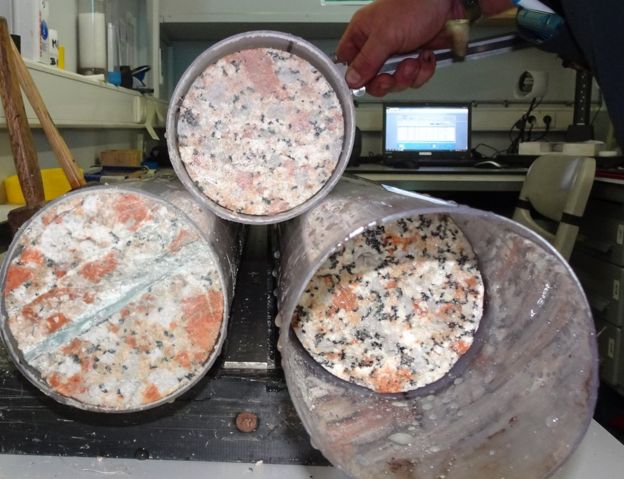
got through the impact melt on top, we recovered pink granite. It was so
obvious to the eye – like what you would expect to see in a kitchen
countertop,” recalled Prof Sean Gulick from the University of Texas at Austin, US.
But these were not normal granites, of course. They were deformed and fractured at every scale – visibly in the hand and even down at the level of the rock’s individual mineral crystals. Evidence of enormous stress, of having experienced colossal pressures.
The team retrieved many hundreds of metres of rock from the crater
The analysis of the core materials now fits an astonishing narrative.
This
describes the roughly 15km-wide stony asteroid instantly punching a
cavity in the Earth’s surface some 30km deep and 80-100km across.
Unstable, and under the pull of gravity, the sides of this depression promptly started to collapse inwards.
At
the same time, the centre of the bowl rebounded, briefly lifting rock
higher than the Himalayas, before also falling down to cover the
inward-rushing sides of the initial hole.
“If this deep-rebound
model is correct (it’s called the dynamic collapse model), then our peak
ring rocks should be the rocks that have travelled farthest in the
impact – first, outwards by kilometres, then up in the air by over 10km,
and back down and outwards by another, say, 10km. So their total travel
path is something like 30km, and they do that in under 10 minutes,”
Prof Gulick told the BBC’s Science in Action programme.
Imagine
a sugar cube dropped into a cup of tea. The drink’s liquid first gets
out of the way of the cube, moves back in and up, before finally
slopping down.
When the asteroid struck the Earth, the rocks it hit also behaved like a fluid.
“These rocks must have lost their strength and cohesion, and very dramatically had their friction reduced,” said Prof Morgan. “So, yes, temporarily, they behave like a fluid. It’s the only way you can make a crater like this.”
One of the important outcomes of the research is that it provides a
useful template also to understand the surfaces of other planets.
All the terrestrial worlds and even Earth’s Moon are scarred with craters just like Chicxulub.
And
knowing how rocks can move vertically and horizontally in an impact
will assist scientists as they attempt to interpret similar crustal
features seen elsewhere in the Solar System.
The project to drill into Chicxulub Crater was conducted by the European Consortium for Ocean Research Drilling (ECORD) as part of the International Ocean Discovery Program (IODP). The expedition was also supported by the International Continental Scientific Drilling Program (ICDP).
Schrodinger Crater on the Moon looks exactly the same as Chicxulub and would have been made – according to this analysis – in a very similar way Artwork: The asteroid that made the crater was probably moving at about 20km/s when it hit the Earth
And before the throne there was a sea of glass like unto crystal: and in the midst of the throne, and round about the throne, were four beasts full of eyes before and behind.
(Revelation 4:6) KJV
Accepting the firmament as a sphere of rigid crystal on the edge of space solves many scriptural and physical problems. The King James Version is the only Bible from which an accurate cosmological model may be deduced.
For thus saith the LORD that created the heavens; God himself that formed the earth and made it; he hath established it, he created it not in vain, he formed it to be inhabited: I am the LORD; and there is none else. ( Isaiah 45:18 )
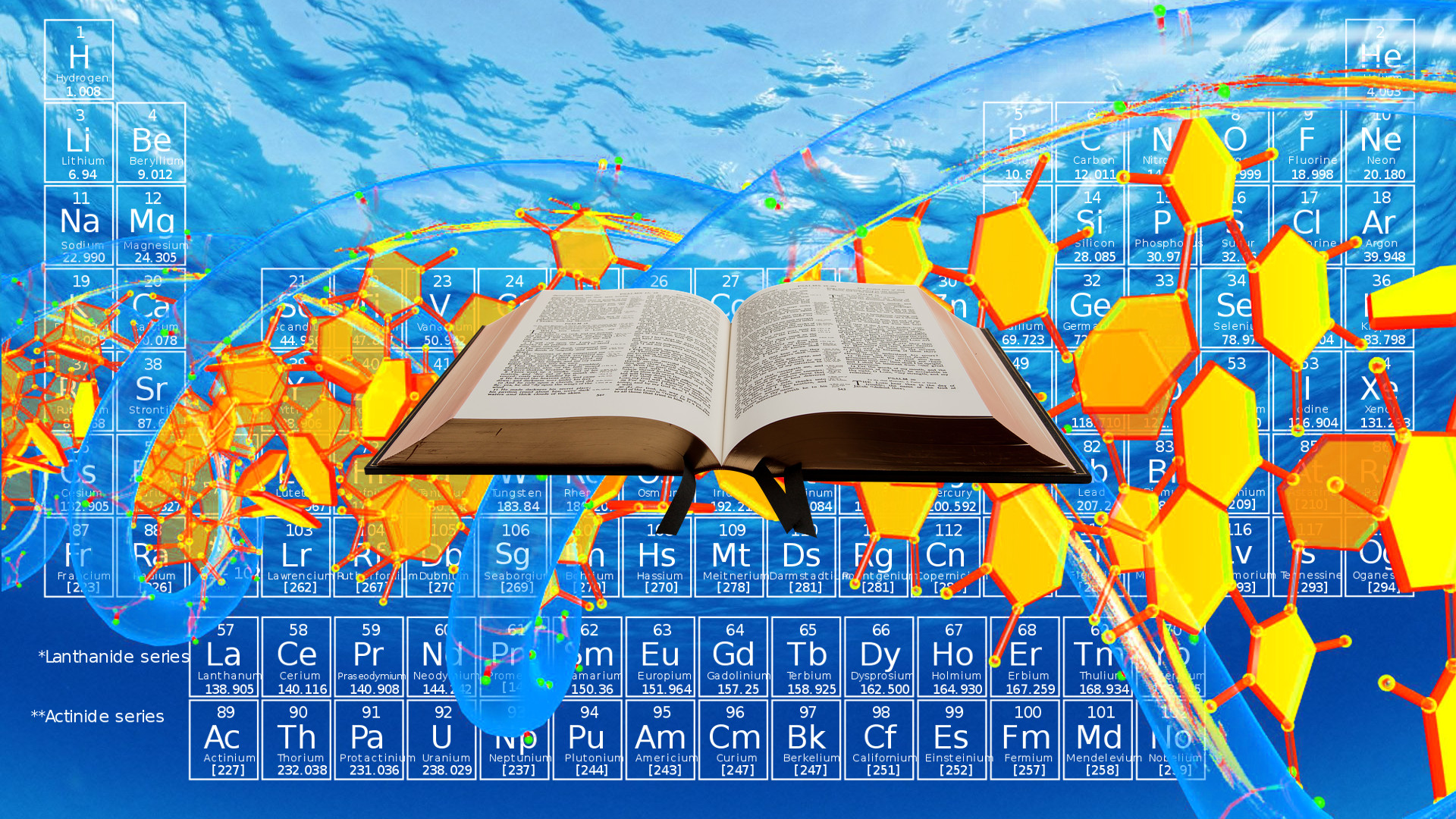
By the end of the first day light was trapped in a watery mass teeming with biological life. It was the primordial soup. The first day produced the written word: the Bible encoded as replicating DNA.
This is a direct copy of a SciPop or news article preserved here because things on the internet have a bad habit of disappearing when you try to find them again. Full credit is given to the original authors and the source.
And the Word was made flesh, and dwelt among us, (and we beheld his glory, the glory as of the only begotten of the Father,) full of grace and truth. ( John 1:14 )
The Bible, the Word of God, the written form of he whom Jesus of Nazareth was incarnated to embody, was encoded as DNA on the first day of creation.
Could we have the Bible as non-coding DNA in every cell of our bodies?
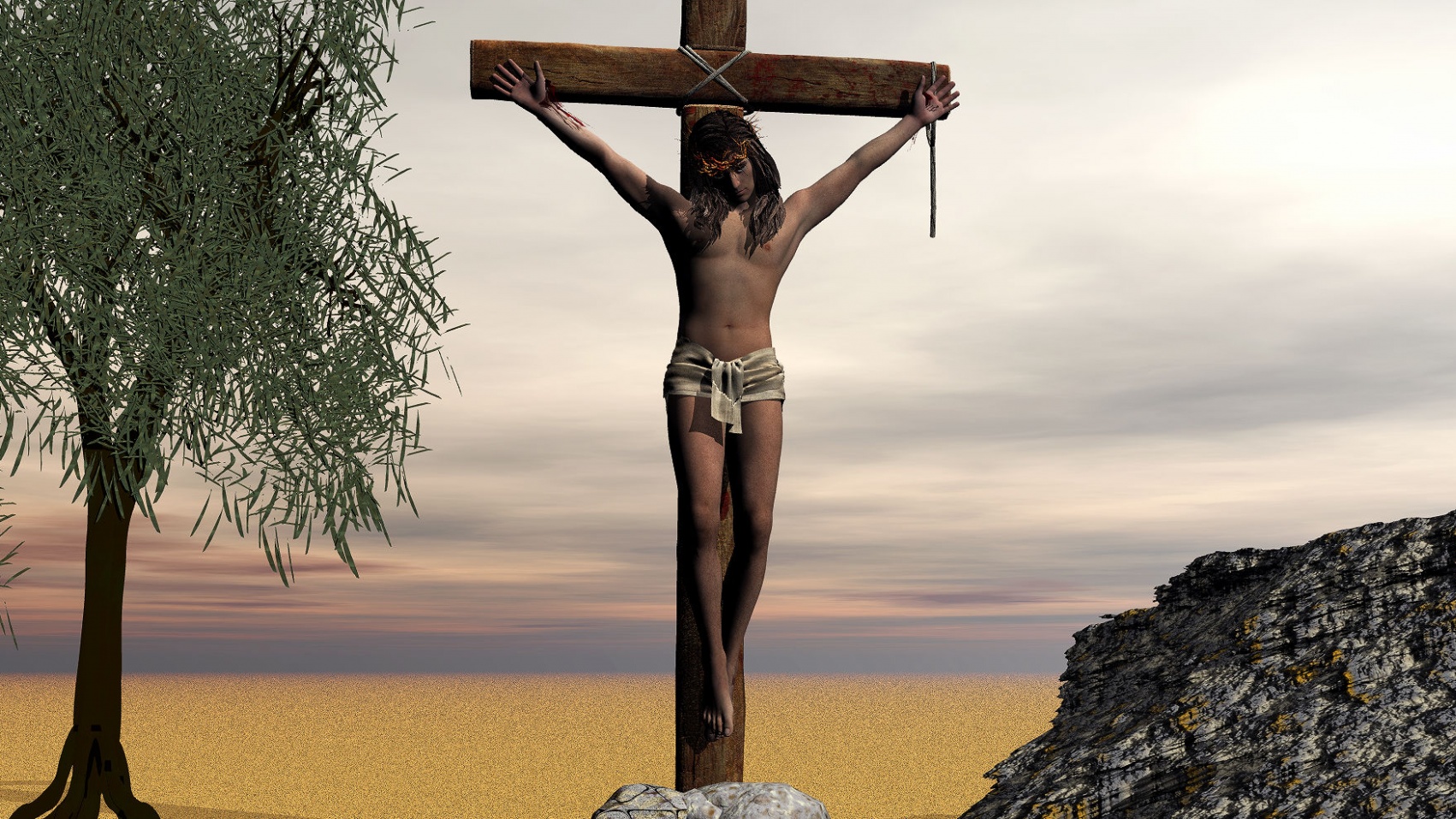
And about the ninth hour Jesus cried with a loud voice, saying, Eli, Eli, lama sabachthani? that is to say, My God, my God, why hast thou forsaken me? ( Matthew 27:46 )
IF earthly things are patterned after heavenly, AND Christ’s death on the cross is patterned after the sacrifice God made on day 1, THEN Christ’s cry is patterned after the noise of the water molecules spliting.
It was therefore necessary that the patterns of things in the heavens should be purified with these; but the heavenly things themselves with better sacrifices than these. For Christ is not entered into the holy places made with hands, which are the figures of the true; but into heaven itself, now to appear in the presence of God for us: Nor yet that he should offer himself often, as the high priest entereth into the holy place every year with blood of others; For then must he often have suffered since the foundation of the world: but now once in the end of the world hath he appeared to put away sin by the sacrifice of himself. And as it is appointed unto men once to die, but after this the judgment: So Christ was once offered to bear the sins of many; and unto them that look for him shall he appear the second time without sin unto salvation. ( Hebrews 9:23-28 )
The sacrificial death on the cross of Jesus of Nazareth is the fulfillment of the purpose of creation, given symbolically so that the meaning would be apparent to a world without knowledge of subatomic physics.
And all that dwell upon the earth shall worship him, whose names are not written in the book of life of the Lamb slain from the foundation of the world. If any man have an ear, let him hear. ( Revelation 13:8-9 )
If God knew the consequences of making creation before he created it but he chose to create it anyway, it means that the sacrificial death of Jesus Christ on the cross at Calvary was Plan A, not Plan B.








 Matty (Headwind)