This evil people, which refuse to hear my words, which walk in the imagination of their heart, and walk after other gods, to serve them, and to worship them, shall even be as this girdle, which is good for nothing.
(Jeremiah 13:10) KJV
Imagine a universe with no God and induce a rationalization of evidence to fit it. Make it into TV shows and movies and fill everyone’s mind with it. That’s what popular science (SciPop) has done.
Then I will teach transgressors Your ways, And sinners shall be converted to You.
(Psalms 51:13) NKJV
When we give the desire to know God preeminence in our life our heart will be purified. We believe in Jesus Christ and get saved, but that’s only the beginning. Continually seeking the Lord as an ongoing imperative purifies our heart. Then the pure in heart will see the Lord. The more of the Lord that we seek, then the more of the Lord we will know.
Then they entered into a covenant to seek the Lord God of their fathers with all their heart and with all their soul; and whoever would not seek the Lord God of Israel was to be put to death, whether small or great, whether man or woman.
(2 Chronicles 15:12) NKJV
What happens when people don’t seek the Lord? In the Old Testament times of the children of Israel they would be put to death. In our modern age there’s nothing like that. You’re free to believe whatever you want.
Hell from beneath is moved for thee to meet thee at thy coming: it stirreth up the dead for thee, even all the chief ones of the earth; it hath raised up from their thrones all the kings of the nations.
(Isaiah 14:9) KJV
IF nuclear decay isn’t constant, AND an initial burst of radiation caused the core of the Earth to melt, THEN material from the lower mantle will melt and fall into the molten core which is why it’s expanding.
For a fire is kindled in mine anger, and shall burn unto the lowest hell, and shall consume the earth with her increase, and set on fire the foundations of the mountains.
(Deuteronomy 32:22) KJV
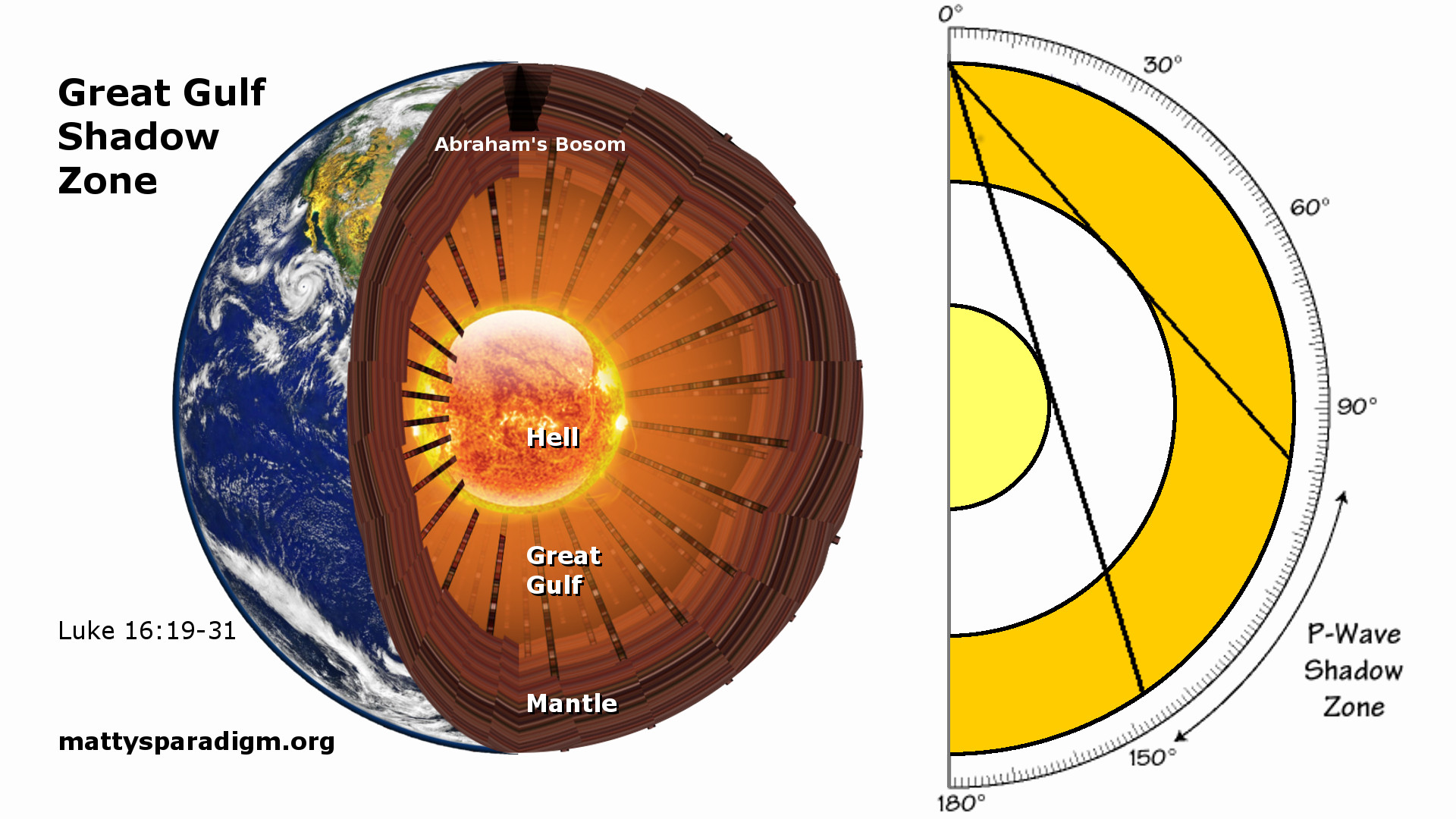
Hell is at the center of the Earth and its expansion is the cause of global warming. This is a predictive testable hypothesis based on ocean water warming data. The location and size of hell are confirmed by seismological data.
Out of the south cometh the whirlwind: and cold out of the north. By the breath of God frost is given: and the breadth of the waters is straitened.
( Job 37:9-10 ) KJV
Generalizations have been used to obscure the truth which is that ice
formed because the waters of Noah’s flood evaporated. Evaporation
causes cooling, and cooling caused the ice. Ice has been retreating ever
since Noah’s flood. The ice has been mitigating the effect of the
expansion of hell. Now there is very little ice left which is why we are
experiencing “climate change.”
Each of the geological Eras,
Periods and Epochs are technically accurate descriptions of the
evidence. However, the misdirection is that each one happened at a
different time in history. They are the same event.
There’s something else to bear in mind: the mammoth and other creatures were preserved in ice. The ice formed because of the cooling effect of the flood waters evaporating. Therefore there was no ice before the flood. The ice was a result of the flood. Therefore the mammoth didn’t live in an icy environment, and paleoecological reconstructions of it are completely wrong. They get cause and effect in the wrong order.
Simultaneous heat waves scorched land areas all over
the Northern Hemisphere last summer, killing hundreds and hospitalizing
thousands while intensifying destructive and deadly wildfires.
A study published this week
in the journal Earth’s Future concludes that this heat wave epidemic
“would not have occurred without human-induced climate change.”
The
alarming part? There are signs record-setting heat waves are beginning
anew this summer — signaling, perhaps, that these exceptional and
widespread heat spells are now the norm.
In the
past few days, blistering, abnormal heat has afflicted several parts of
the Northern Hemisphere, including major population centers.
On
the other side of the hemisphere, the temperature in San Francisco shot
up to 100 degrees (37.8 Celsius) Monday, its highest temperatures ever
recorded in the months of June, July or August, or this early in the
calendar year.
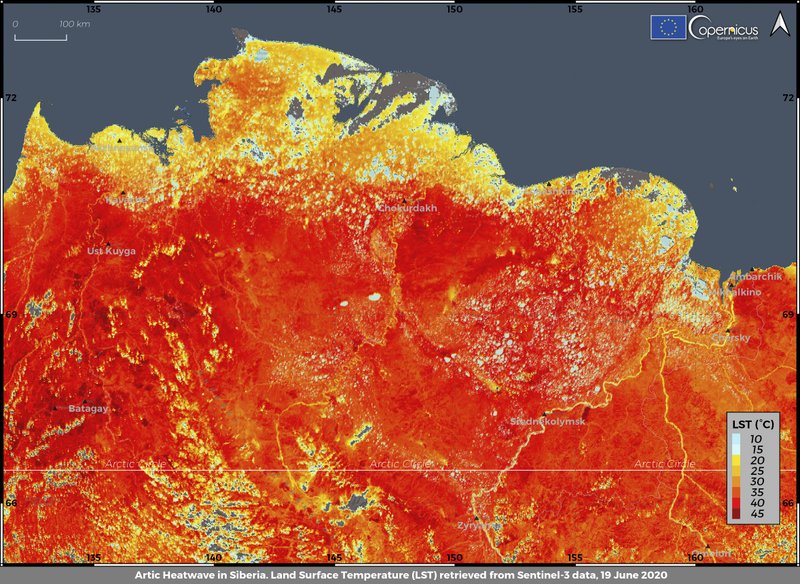
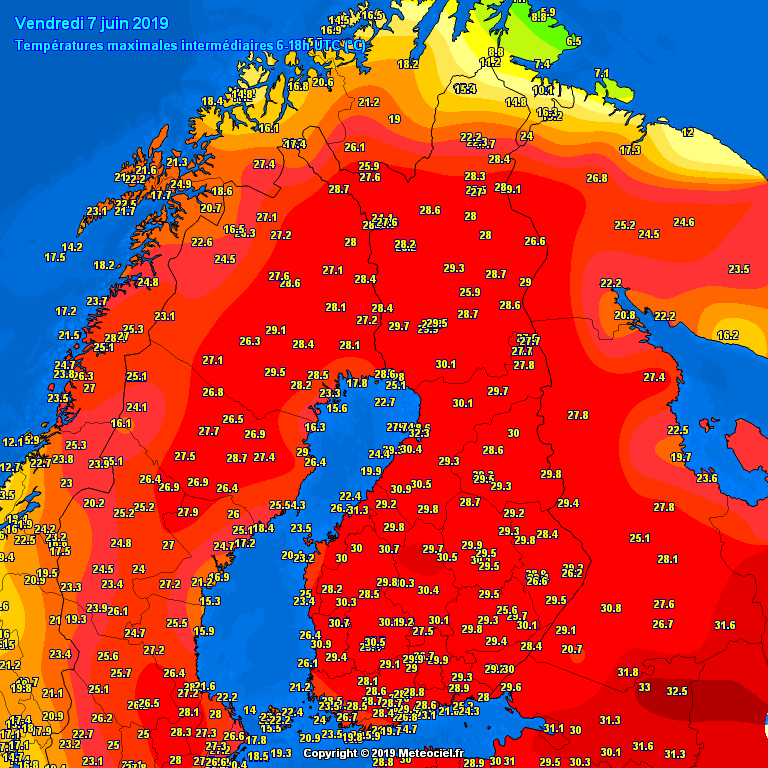
Heat spread unusually far north, even up into the northern reaches of Scandinavia. Mika Rantanen, a meteorologist at the University of Helsinki, tweeted last Friday that there “are no known cases in Finland’s climate history when it has been hotter than now so early in the summer.” Temperatures above 86 degrees (30 Celsius) penetrated inside the Arctic Circle, he noted.
While some scientists hesitate to attribute
individual heat spells to climate change, Daniel Swain, a climate
scientist at the University of California at Los Angeles, tweeted that
his research suggests that we’ve “reached the point where a majority
(perhaps a vast majority) of unprecedented extreme heat events globally
have a detectable human influence.”
Last
summer, exceptional heat affected 22 percent of the populated and
agricultural areas of the Northern Hemisphere between the months of May
and July, the Earth’s Future study said. The contiguous United States
witnessed its hottest May on record, California endured its hottest July
and numerous European cities notched their highest temperatures ever
recorded, while cities in Asia, the Middle East and Africa also
established new heat milestones.
It remains to be seen whether heat waves this summer become as pervasive and intense as last summer. That said, the Earth’s Future study concluded we’ve entered “a new climate regime,” featuring “extraordinary” heat waves on a scale and ferocity not seen before.
The study’s modeling analysis, conducted by
researchers in Switzerland and the United Kingdom, found heat events
like last summer’s do “not occur in historical simulations” and “were
unprecedented prior to 2010.”
As the climate warms, the study projects that the area affected by heat waves like last summer’s will increase 16 percent for every 1.8 degrees (1 Celsius) of warming.
“Heat waves will likely reach highly dangerous levels for ecosystems and societies over the coming decades,” the study said.
Heat
events like those last summer are predicted to occur two every three
years for global warming of 2.7 degrees (1.5 Celsius) and every year for
warming of 3.6 degrees (2 Celsius).
So far, Earth has warmed by approximately 1.9 degrees
(1.05 Celsius) since 1880. The goal of the Paris agreement on climate
change is keep the global temperature rise to 3.6 degrees (2 Celsius) or
less.
Last week, a study in the journal Science Advances
found that keeping warming to 2.7 degrees (1.5 Celsius), compared with
5.4 degrees (3 Celsius), could avoid between 110 and 2,720 heat-related
deaths annually in 15 different U.S. cities.
“A strong reduction in fossil fuel emissions is paramount to reduce the risks of unprecedented global-scale heat-wave impacts,” the Earth’s Future study concluded.
Jason Samenow Jason
Samenow is The Washington Post’s weather editor and Capital Weather
Gang’s chief meteorologist. He earned a master’s degree in atmospheric
science and spent 10 years as a climate change science analyst for the
U.S. government. He holds the Digital Seal of Approval from the National
Weather Association. Follow
A new generation of scientific instruments has begun scouring ocean depths for temperature data, and the evidence being pinged back via satellite warns that the consequences of fossil fuel burning and deforestation are accumulating far below the planet’s surface.
More than 90 percent of the heat trapped by greenhouse gas pollution since the 1970s has wound up in the oceans, and research published Monday revealed that a little more than a third of that seafaring heat has worked its way down to depths greater than 2,300 feet (700 meters).
Plunged to ocean depths by winds and currents, that trapped heat has eluded surface temperature measurements, fueling claims of a “hiatus” or “pause” in global warming from 1998 to 2013. But by expanding cool water, the deep-sea heat’s impacts have been indirectly visible in coastal regions by pushing up sea levels, contributing to worsening high-tide flooding.
“The heat’s going in at the surface, so it’s getting down pretty deep,” said Glen Gawarkiewicz, a Woods Hole Oceanographic Institution scientist who was not involved with the study. “With 35 percent of the heat uptake going below 700 meters, it really points out the importance of continued deep ocean sampling. It was a surprise to me that it was that large of a fraction.”
The research, published in Nature Climate Change, was led by Lawrence Livermore National Laboratory. It compared modeling results with data from a mishmash of sources, most notably from a nascent fleet of monitoring devices called deep Argo floats.
The researchers concluded that half of overall ocean warming has occurred since 1997—a date that they noted in their paper was “nearly coincident with the beginning of the observed surface warming hiatus.”
Percentage of global ocean heat content change
A combination of climate pollution, a recent change in a long-running cycle of the Pacific Ocean and the current El Niño has led to a spike in warming rates recorded at the surface of the planet. That followed a surface warming slowdown; 2014 and 2015 were the warmest years on record globally.
Research groups from around the world have deployed thousands of Argo floats to measure since around the year 2000 to take temperature, salinity and other measurements. Technological advances have allowed a small fleet of deeper-diving floats to be deployed more recently. Some of those have been built to dive as deep as 20,000 feet.
“Knowing how much the ocean is warming and how fast and where are all important for knowing how much the atmosphere is going to warm and how much seas are going to rise,” said Gregory C. Johnson, a National Oceanic and Atmospheric Administration scientist who works on that agency’s Argo float program.
Monday’s paper used the new deep-sea Argo data to expand on a paper published in 2014 by Lawrence Livermore and other researchers, which revealed high levels of warming in the ocean’s surface layer.
“The oceans as an energy store are really doing a lot of the work,” said Lawrence Livermore researcher Paul Durack, who helped produce the studies that were published Monday and in 2014. “The actual temperature change is relatively small, but due to the huge heat capacity of the oceans this equates to a very, very large heat content change.”










 Matty (Headwind)