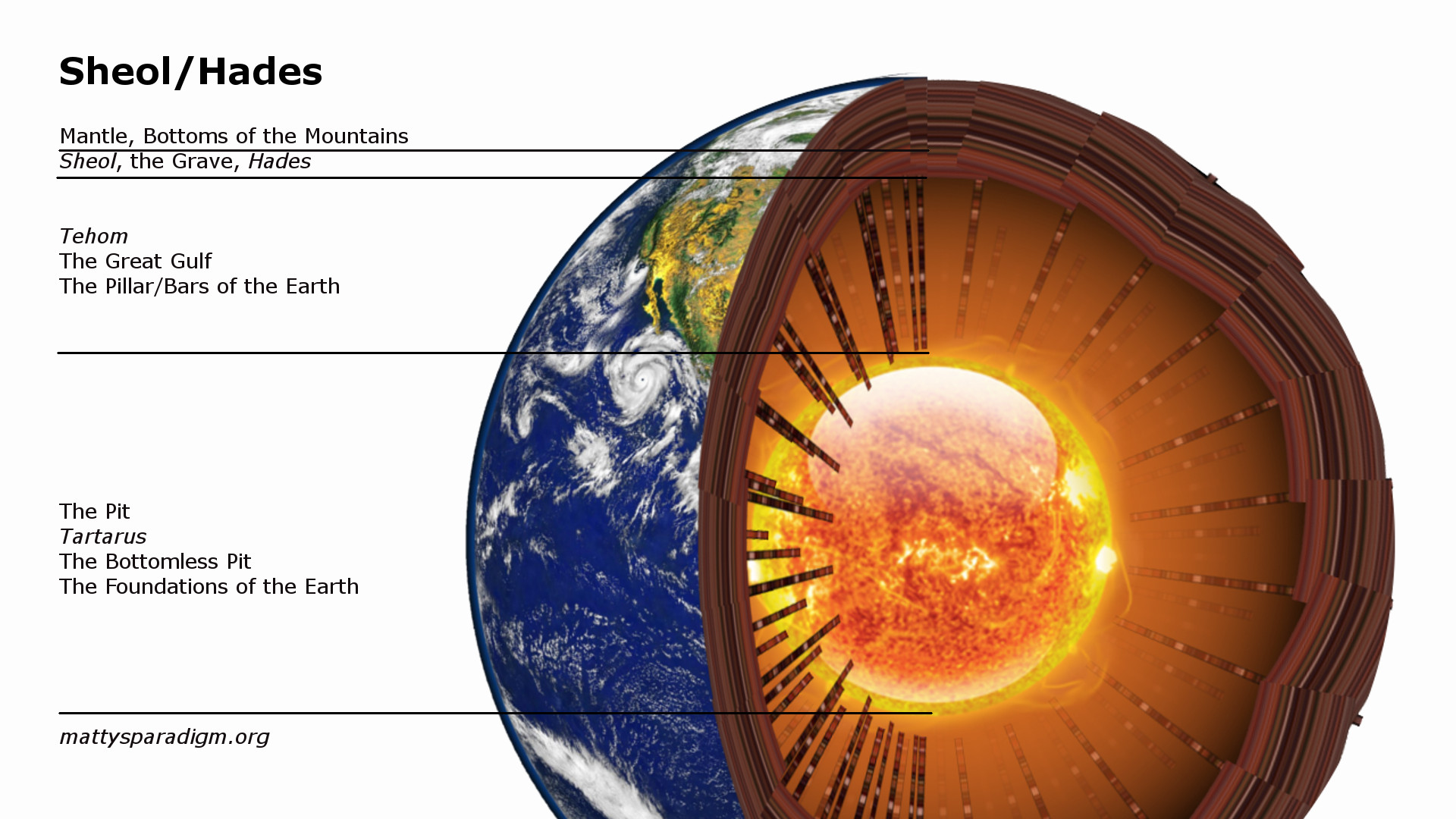
Graves and Pits

O LORD, thou hast brought up my soul from the grave: thou hast kept me alive, that I should not go down to the pit.

(Psalms 30:3) KJV

We are discussing the repercussions of the fall of man on the physical system of creation. One of the repercussions was the start of radioactive decay. This in turn is the beginning of hell, since the explosive rate of decay, concentrated at the core of the earth, caused the core to melt. This is the beginning of hell. We have now put this in the context of the rest of history with a leisurely stroll through the history of the expansion of hell over the last week or so.

We have built a very strong case for the existence of hell in the center of the earth by relating it to the major physical events in the history of the earth. This has been driven by scripture that describes these events. We start with the creation of gravity on the second day as the foundation of the earth which becomes hell. Scripture provides many clues about the changes to the earth over its history and up to the present day.

Let’s take a look at some of the scripture that describes hell and where it is as a way of confirming what is becoming a highly elaborate hypothesis for the cause of global warming. In its historical context the book of Job is the oldest book of the Bible. Genesis records for us an account of the creation, but it was written by Moses, who was many generations after the life of Job. Job was probably a contemporary of Abraham. It is clear that the people of this time had a clear concept of souls and what happens to them after the death of the body: they go to sheol. So what and where is sheol? The context of the verses below is that God has the power to keep the soul from going to sheol.

He keepeth back his soul from the pit, and his life from perishing by the sword.

(Job 33:18) KJV

In this passage we are told that the soul can go to “the pit,” and the word in the passage translated as “sword,” is elsewhere rendered as sheol. Essentially this is speaking about the pit of sheol. Pits are holes in the ground, so we are talking about someplace deep in the earth where souls go.

Yea, his soul draweth near unto the grave, and his life to the destroyers.

(Job 33:22) KJV

This time the word “grave,” is a translation of the Hebrew sheol. Graves are holes in the ground, like pits, so once again we are placing sheol deep within the earth.

Then he is gracious unto him, and saith, Deliver him from going down to the pit: I have found a ransom.

(Job 33:24) KJV

Once again a statement of God’s power to save the soul of an individual from going into sheol.

He will deliver his soul from going into the pit, and his life shall see the light.

(Job 33:28) KJV

Here the outcome of the soul going into the pit of sheol is connected with light and darkness. Sheol is darkness.

To bring back his soul from the pit, to be enlightened with the light of the living.

(Job 33:30) KJV

Here we see a statement that the Lord is able to bring back a soul from the pit of sheol. There is clearly some nuance of meaning here that may be obscured by the various references to the pit, sword, and grave which are all translations of sheol. It should be obvious that sheol is a dark pit where souls go, but some are saved from it and others are not. Not only that, but it is not always a permanent outcome since souls can be brought back from it. As confusing as this may be it is completely compatible with the Matty’s Paradigm model of the interior of the earth. There is a sheol that you can’t come back from (the pit or molten core), and there is one that you can come back from (the grave or bosom of Abraham). The difference is whether or not you are reconciled to God. If you are saved from the pit you go to the grave.
July 18th

The Age of Accountability

Behold, I was brought forth in iniquity, And in sin my mother conceived me.

(Psalms 51:5) NKJV

There’s no age of accountability in the Bible. Children aren’t innocent up until a certain age. The right to a legal safe abortion should be guaranteed, but each one carries with it the loss of a soul. Then we have it on our conscience.

Continue reading “July 18th”

July 16th

Perdition

But those who desire to be rich fall into temptation and a snare, and into many foolish and harmful lusts which drown men in destruction and perdition.

(1 Timothy 6:9) NKJV

Perdition can be translated “ruin.” Perdition is a nuanced kind of destruction with eternal consequences. It’s not the end of something, as if it disappears. It’s the end of what could have been.

Continue reading “July 16th”

July 14th

Cutaway of planet Earth showing the crust, mantle, great gulf and hell.

Torment in Flame

“There was a certain rich man who was clothed in purple and fine linen and fared sumptuously every day. But there was a certain beggar named Lazarus, full of sores, who was laid at his gate, desiring to be fed with the crumbs which fell from the rich man’s table. Moreover the dogs came and licked his sores.

(Luke 16:19-21) NKJV

We (that’s me and the Holy spirit) have a model of the internal structure of the Earth which shows us how the various ways that hell is referred to describe a complex underworld which is congruent with all physical evidence.

Continue reading “July 14th”

July 13th

Spirits in Prison

By which also he went and preached unto the spirits in prison; Which sometime were disobedient, when once the longsuffering of God waited in the days of Noah, while the ark was a preparing, wherein few, that is, eight souls were saved by water.

(1 Peter 3:19-20) KJV

Jesus descended into the lower parts of the Earth. We can resolve this as being a place in the lower mantle, euphemistically called “Abraham’s bosom” the location that he described in Luke 16.

Continue reading “July 13th”

The Midst Of Hell

The strong among the mighty shall speak to him out of the midst of hell with them that help him: they are gone down, they lie uncircumcised, slain by the sword.

(Ezekiel 32:21) KJV

In the King James version of the Bible the word hell occurs 54 times. In the Old Testament this is a translation of the Hebrew word sheol – שְׁא֣וֹל. In the New Testament the word hell is a translation of three Greek words: hades– ᾅδῃ, tartarusταρταρώσας and gehennaγέενναν. I will explain how all of these words relate to the internal structure of the earth or, in one case, why it doesn’t.

Continue reading “The Midst Of Hell”

There is a Great Gulf Fixed

And beside all this, between us and you there is a great gulf fixed: so that they which would pass from hence to you cannot; neither can they pass to us, that would come from thence.

(Luke 16:26) KJV

Hell is located at the center of the Earth. Its position and size are verified by seismological data. There is a great gulf of open space between the surface of hell and the inner surface of the lower mantle.

Continue reading “There is a Great Gulf Fixed”

March 27th

Looking out across the molten core of the earth from a place in the lower mantle

The Lowest Hell

For a fire is kindled in mine anger, and shall burn unto the lowest hell, and shall consume the earth with her increase, and set on fire the foundations of the mountains.

(Deuteronomy 32:22) KJV

Deuteronomy 32:22 begins the doctrine of the expansion of hell. The foundations of the world is the Earth’s mantle. It’s been set on fire by the heat from hell below, and this is the cause of tectonic activity.

Continue reading “March 27th”

March 25th

From Tehom to Sheol

When Noah was six hundred years old, on the seventeenth day of the second month all the outlets of the vast body of water beneath the earth burst open, all the floodgates of the sky were opened, and rain fell on the earth for forty days and nights.

(Genesis 7:11-12) Good News Translation

Amos tells us that the great deep was devoured by fire, and that’s a conclusion which we can deduce from our spherical hollow Earth model based around a gravitational singularity.

Continue reading “March 25th”

March 20th

The Sides of the Pit

Asshur is there and all her company: his graves are about him: all of them slain, fallen by the sword: Whose graves are set in the sides of the pit, and her company is round about her grave: all of them slain, fallen by the sword, which caused terror in the land of the living.

(Ezekiel 32:22-23) KJV

Yesterday we concluded that after death all souls go to the grave. This is one of the ways in which the word sheol is translated. We’ve found that after that there are two possible outcomes:

  1. Those who knew the Lord during their life remain in the mantle,
  2. Those who rejected the Lord descend into the core.
Continue reading “March 20th”